

The EACR’s ‘Highlights in Cancer Research’ is a regular summary of the most interesting and impactful recent papers in cancer research, curated by the Board of the European Association for Cancer Research (EACR).
The list below appears in no particular order, and the summary information has been provided by the authors unless otherwise indicated.
Use the dropdown menu or ‘Previous’ and ‘Next’ buttons to navigate the list.
doi: 10.1038/s41556-025-01810-x.
Summary of the findings
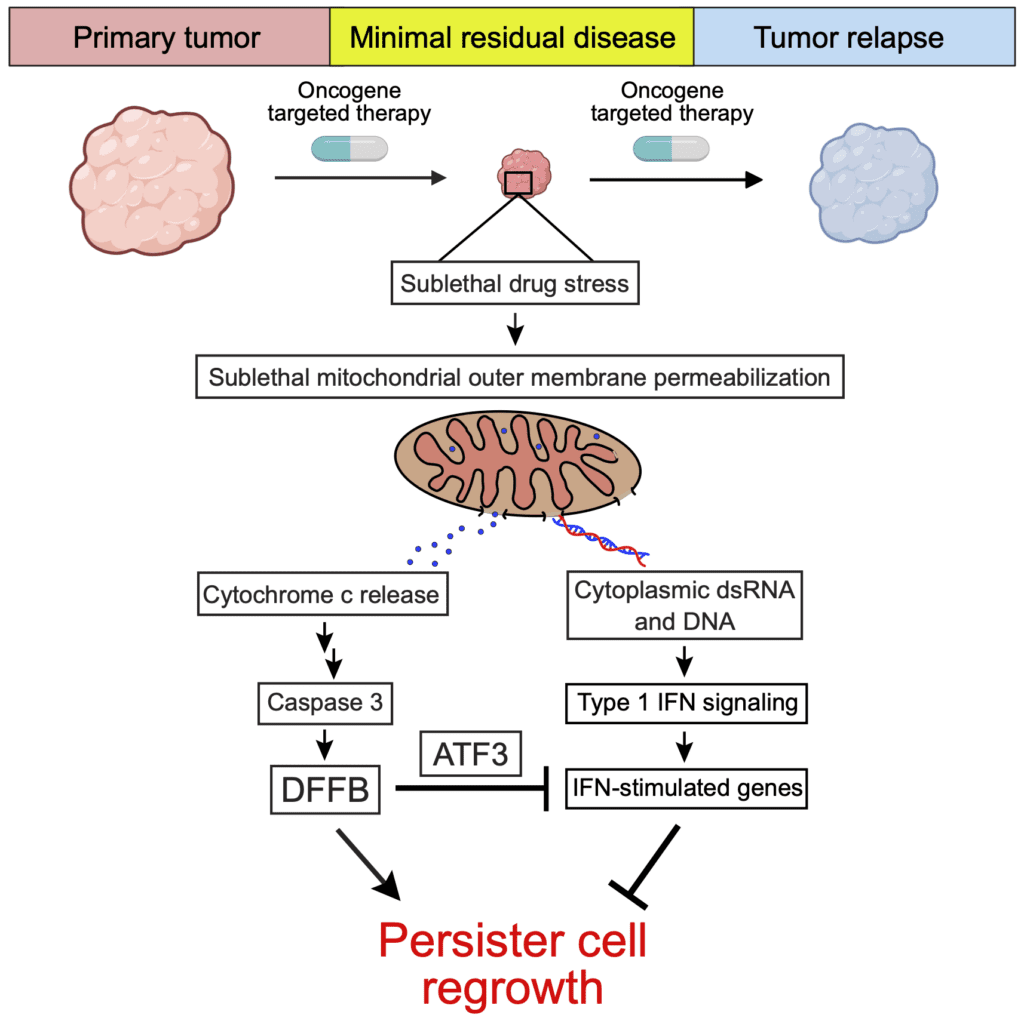
Acquired resistance to oncogene-targeted therapy contributes to cancer patient mortality. During treatment, cancer persister cells reversibly enter a quiescent state, tolerate drug stress, undergo adaptations and seed tumor regrowth. There is limited understanding of the adaptive mechanisms utilized by persister cells to escape growth arrest. To address this, Williams et al. discovered that due to sublethal apoptotic drug stress, persister cells generate type I IFN which enforces their growth arrest. However, persister cells also activate the apoptotic DNA endonuclease DFFB (also known as CAD) as a result of sublethal apoptotic caspase activity. While DFFB is normally responsible for fragmenting chromosomal DNA during apoptotic cell death, in surviving persister cells it instead induces nonlethal DNA damage, mutagenesis, and promotes expression of stress response factor ATF3. ATF3 relieves persister cells from type I IFN-enforced growth arrest by inhibiting IFN-stimulated gene (ISG) expression. Therefore, persister cells repurpose cell death machinery to escape from IFN-enforced growth arrest. These observations point toward potential therapeutic opportunities to inhibit this IFN suppression mechanism to prevent acquired resistance to targeted therapies.
.