
The Cancer Researcher
  • Home
  • About
  • The Cancer Researcher Podcast
  • #KeepResearchCurious
No Result
View All Result
  • Home
  • About
  • The Cancer Researcher Podcast
  • #KeepResearchCurious
No Result
View All Result
The Cancer Researcher
No Result
View All Result

Highlights in Cancer Research: April 2026

April 28, 2026
Highlights in Cancer Research: November 2022

The EACR’s ‘Highlights in Cancer Research’ is a regular summary of the most interesting and impactful recent papers in cancer research, curated by the Board of the European Association for Cancer Research (EACR).

The list below appears in no particular order, and the summary information has been provided by the authors unless otherwise indicated.

Use the dropdown menu or ‘Previous’ and ‘Next’ buttons to navigate the list.


4. Humoral determinants of checkpoint immunotherapy

  • 1. The local microenvironment suppresses the synergy between irradiation and anti-PD1 therapy in breast-to-brain metastasis
  • 2. Understanding and reversing mammary tumor-driven reprogramming of myelopoiesis to reduce metastatic spread
  • 3. A large-scale retrospective study in metastatic breast cancer patients using circulating tumour DNA and machine learning to predict treatment outcome and progression-free survival
  • 4. Humoral determinants of checkpoint immunotherapy
  • 5. AKR1B10 dictates c-Myc stability to suppress colorectal cancer metastasis via PP2A nitration
  • 6. NNMT inhibition in cancer-associated fibroblasts restores antitumour immunity
  • 7. Paneth-like transition drives resistance to dual targeting of KRAS and EGFR in colorectal cancer
  • 8. Respiratory viral infections awaken metastatic breast cancer cells in lungs
  • 9. DNA fragmentation factor B suppresses interferon to enable cancer persister cell regrowth
Previous
Next

Dai Y., Aizenbud L., Qin K. et al. Nature. 644: 527–536 . (2025).
doi: 10.1038/s41586-025-09188-4.

Summary of the findings
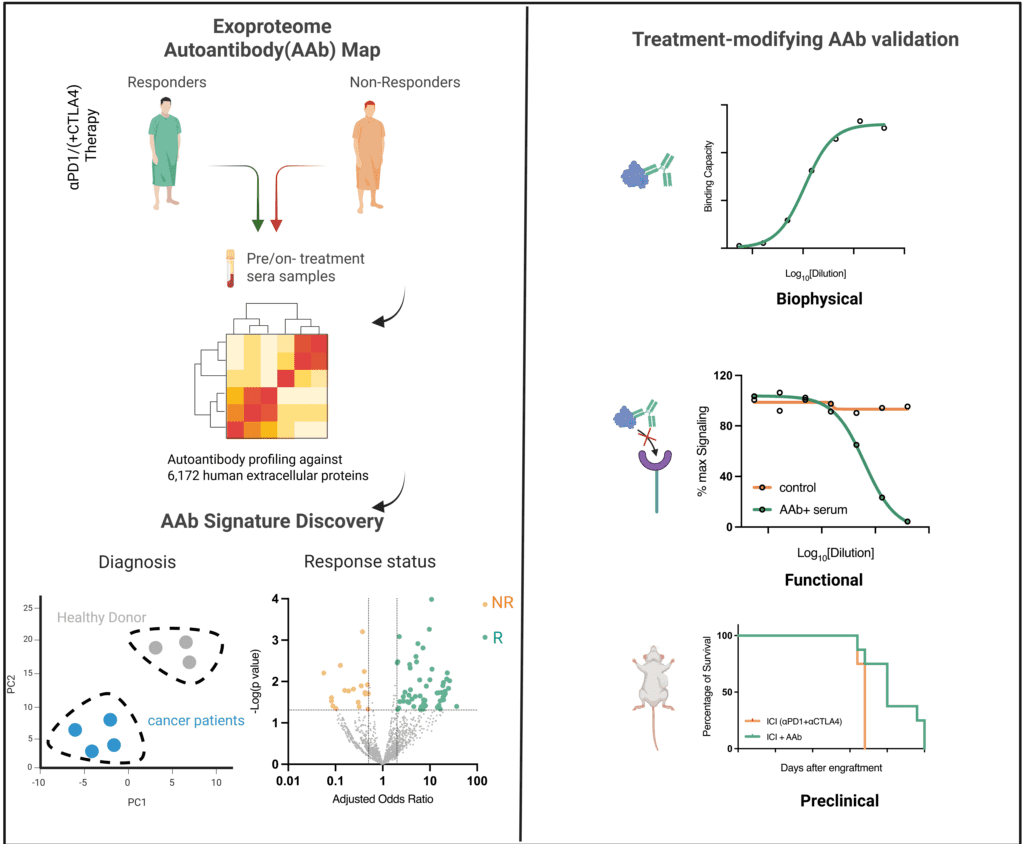
This study systematically mapped autoantibody (AAb) responses against 6,172 extracellular and secreted proteins in a large cohort of checkpoint immunotherapy (CPI)-treated patients. The authors found that cancer patients harbor remarkably diverse AAb repertoires that distinguish them from healthy individuals. While AAbs showed limited association with immune-related adverse events, many AAbs were strongly linked to treatment response, either favorably or unfavorably. Key targets included cytokines such as type I interferons, IL-6, and OSM, as well as the TNF superfamily member TL1A and BMP receptor components. Functional experiments confirmed that several of these AAbs neutralize their targets, and preclinical mouse models validated that antibodies neutralizing IFN-I or TL1A improved CPI efficacy. These results establish AAbs as an underappreciated source of inter-patient variability in immunotherapy outcomes.
.

Future impact

These findings open several promising directions. Because AAbs effectively act as naturally occurring biologic drugs, the targets they highlight can serve as a shortlist for therapeutic development or drug repurposing. For instance, existing agents like anifrolumab (an IFNAR-blocking antibody approved for lupus) could be explored in combination with CPIs. Conversely, AAbs that impair treatment point to pathways that should be preserved or enhanced, such as BMP receptor signaling. More broadly, the “autoantibody-wide association study” framework introduced here could be applied across diseases to uncover functional roles of humoral autoreactivity, much as genome-wide association studies have done for genetic variation. Larger cohorts and prospective clinical trials will be needed to confirm causal relationships and translate these findings into improved patient stratification and combination treatment strategies.

.
Read more in Nature
.

4. Humoral determinants of checkpoint immunotherapy

  • 1. The local microenvironment suppresses the synergy between irradiation and anti-PD1 therapy in breast-to-brain metastasis
  • 2. Understanding and reversing mammary tumor-driven reprogramming of myelopoiesis to reduce metastatic spread
  • 3. A large-scale retrospective study in metastatic breast cancer patients using circulating tumour DNA and machine learning to predict treatment outcome and progression-free survival
  • 4. Humoral determinants of checkpoint immunotherapy
  • 5. AKR1B10 dictates c-Myc stability to suppress colorectal cancer metastasis via PP2A nitration
  • 6. NNMT inhibition in cancer-associated fibroblasts restores antitumour immunity
  • 7. Paneth-like transition drives resistance to dual targeting of KRAS and EGFR in colorectal cancer
  • 8. Respiratory viral infections awaken metastatic breast cancer cells in lungs
  • 9. DNA fragmentation factor B suppresses interferon to enable cancer persister cell regrowth
Previous
Next
Tags: EACR Top Ten Cancer Research PublicationsHighlights in Cancer Research

Related Posts

How the EACR Congress inspired translational innovation and the launch of a spin-out company

How the EACR Congress inspired translational innovation and the launch of a spin-out company

May 14, 2026

EACR member Munitta Muthana provides some insight into her team’s experience at EACR 2025 in Lisbon, and how it catalysed the momentum and vision for their...

How Nerves Shape Cancer: From Energy Rewiring to Metastasis – Episode 32 of The Cancer Researcher Podcast

How Nerves Shape Cancer: From Energy Rewiring to Metastasis – Episode 32 of The Cancer Researcher Podcast

May 11, 2026

In recent years, the neuronal component of the cancer microenvironment and the metabolic plasticity of cancer cells have become increasingly recognised as essential for cancer progression....

“The best scientific event I have ever participated in”: Rafaela’s EACR Travel Grant leads to new opportunities

“The best scientific event I have ever participated in”: Rafaela’s EACR Travel Grant leads to new opportunities

April 20, 2026

The EACR, AACR, and The Mark Foundation for Cancer Research recently teamed up to offer a number of travel grants to help EACR or AACR members...

The Cancer Researcher EACR logo

About Us

The Cancer Researcher is an online magazine for the cancer research community from the European Association for Cancer Research.

The EACR, a registered charity, is a global community for those working and studying in cancer research. Our mission is “The advancement of cancer research for the public benefit: from basic research to prevention, treatment and care.”

Advertisement Advertisement Advertisement
ADVERTISEMENT

RECENT POSTS

How the EACR Congress inspired translational innovation and the launch of a spin-out company
Career

How the EACR Congress inspired translational innovation and the launch of a spin-out company

May 14, 2026
“This technique is highly complex and would not have been possible to perform in my lab”: María Martínez Fernández’s EACR Travel Fellowship
Community

“This technique is highly complex and would not have been possible to perform in my lab”: María Martínez Fernández’s EACR Travel Fellowship

May 12, 2026
The Cancer Researcher

© 2025 EACR

Navigate site

  • About
  • Privacy
  • Main EACR website

Follow us

No Result
View All Result
  • Home
  • About
  • The Cancer Researcher Podcast
  • #KeepResearchCurious

© 2025 EACR