
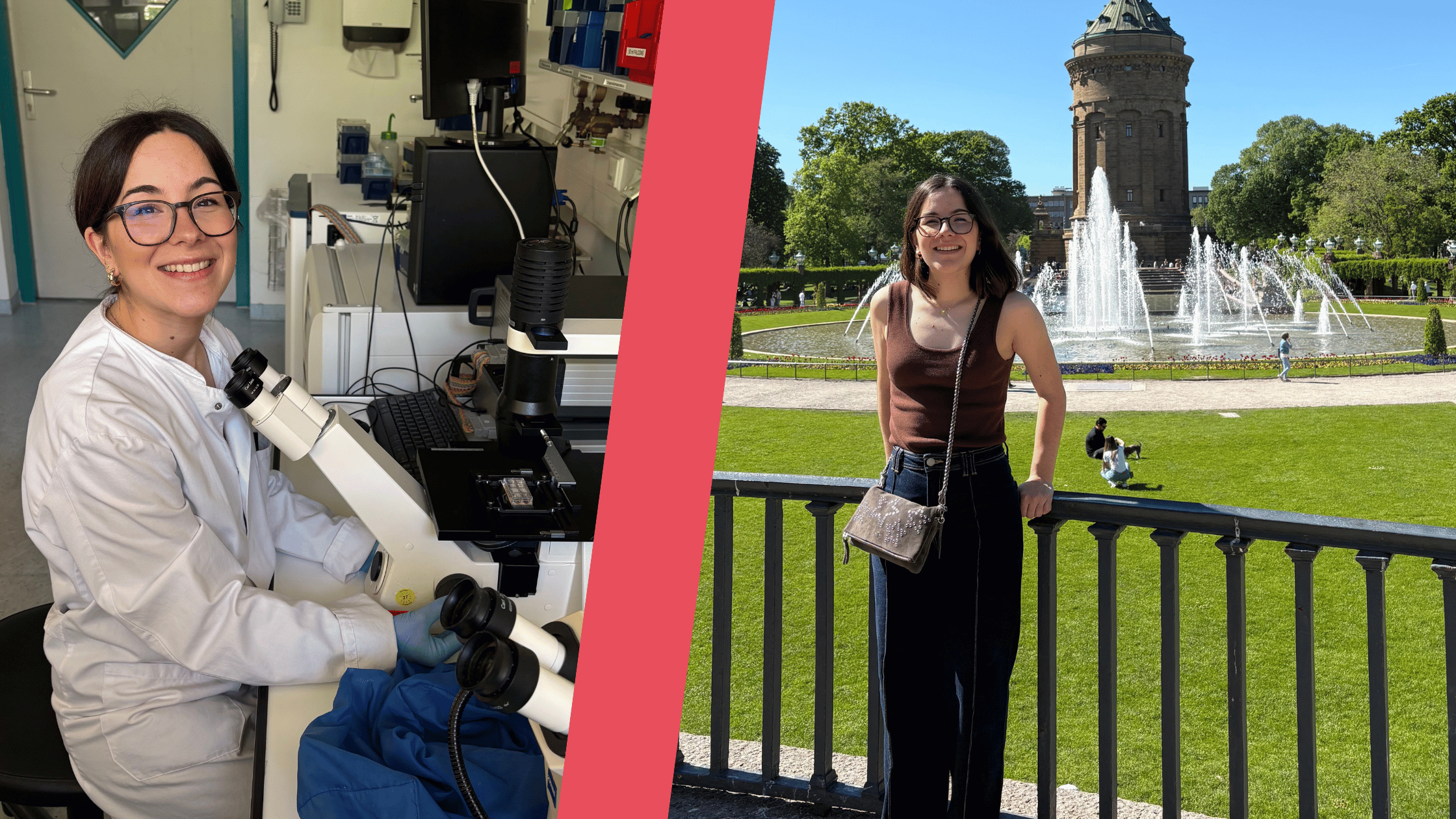
María Martínez Fernández is a PhD student at the Institute of Neuroscience of Castilla y León, Salamanca, Spain who received an EACR Travel Fellowship to visit and work at Universitätsklinikum Mannheim, Mannheim, Germany between February and April 2026.
The EACR, with support from Worldwide Cancer Research, provides Travel Fellowships of up to €3,500 to enable early-career cancer researchers to gain new skills through a short-term visit to a lab or research group in another country.
You can read about other Travel Fellows and their experiences here.
What is the topic of your current research?
My PhD research focuses on studying the effect of the antitumour peptide TAT-Cx43266-275 in different preclinical models of GBM, including both cell-based and mouse models. In simple terms, I investigate how this peptide, which is a small protein, can slow down tumour growth or even kill cancer cells. I also study how these effects translate in mice, where treatment with this peptide can lead to longer survival of these animals and smaller tumours.
Can you summarise what you learned on your visit?
During this stay, I learned how to work with tumour organoids derived from GBM patient cells. My goal was to test whether the antitumour peptide we work with in my lab in Salamanca had any effect on the expression of key proteins involved in the development of this tumour in these samples, on the formation of tumour microtubes (TMs), and on the functionality of these TMs.
Did you have a personal mentor or anyone who particularly helped you?
Yes, Julius Beichert, a medical student at the University of Mannheim who was also conducting experiments in the same lab during my stay, helped me enormously from the moment I arrived. He was very committed to ensuring that my research progressed successfully and provided me with highly valuable advice at all times.
Why did you choose the host lab?
A colleague who had completed his end-of-degree project in my lab in Salamanca told us about this group, as he had previously completed his PhD in Heidelberg and had known Miriam, my host supervisor, since then. He explained that her lab specialises in the study of tumour microtubes, which was exactly what I wanted to explore during my stay, and he strongly recommended that I go there.
What were you able to do that you could not have achieved in your home lab?
My host lab focuses on the study of tumour microtubes, and the lab they collaborate with in Heidelberg specialises in studying how GBM cells communicate with each other through calcium waves via these tumour microtubes. This technique is highly complex and would not have been possible to perform in my lab in Salamanca, as we lacked both the technical expertise and the necessary microscopy equipment.
[A colleague] explained that [Miriam’s] lab specialises in the study of tumour microtubes, which was exactly what I wanted to explore during my stay.
Does your lab plan to do any future collaborations with the host lab?
Once I finish my PhD next December, I would like to begin preparing a publication that includes all the results of my thesis, including those obtained from the experiments I carried out during my stay in Germany. Additionally, as I did not have enough time to complete all the experiments I had planned during my stay in Germany, we will establish a collaboration to finish the remaining experiments in my lab in Salamanca.
Describe a ‘typical day’ on your visit.
A typical day during my stay would involve waking up around 6:30–7:00 a.m., having breakfast, getting ready, and heading to the lab to start the experiments planned for that day with my GBM cells. These could include immunohistochemical techniques, microscopy imaging, cell seeding for calcium wave communication studies… Once I finished the cell culture work, I would take a break for lunch and then continue with computer-based tasks, such as analysing pending experiments or checking emails, and also updating my lab notebook. In my notebook, I carefully recorded everything I did each day so that others could replicate my experiments in the future if needed.
Want to find out more?

If you are interested in applying for the Travel Fellowship scheme, please click here for more information: EACR Travel Fellowships