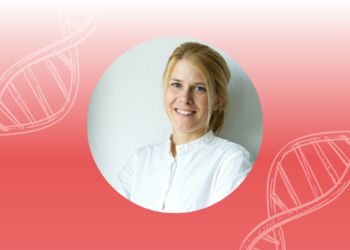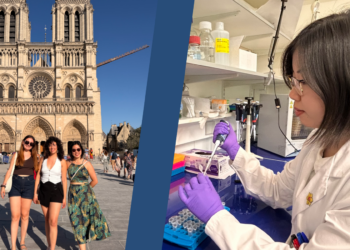

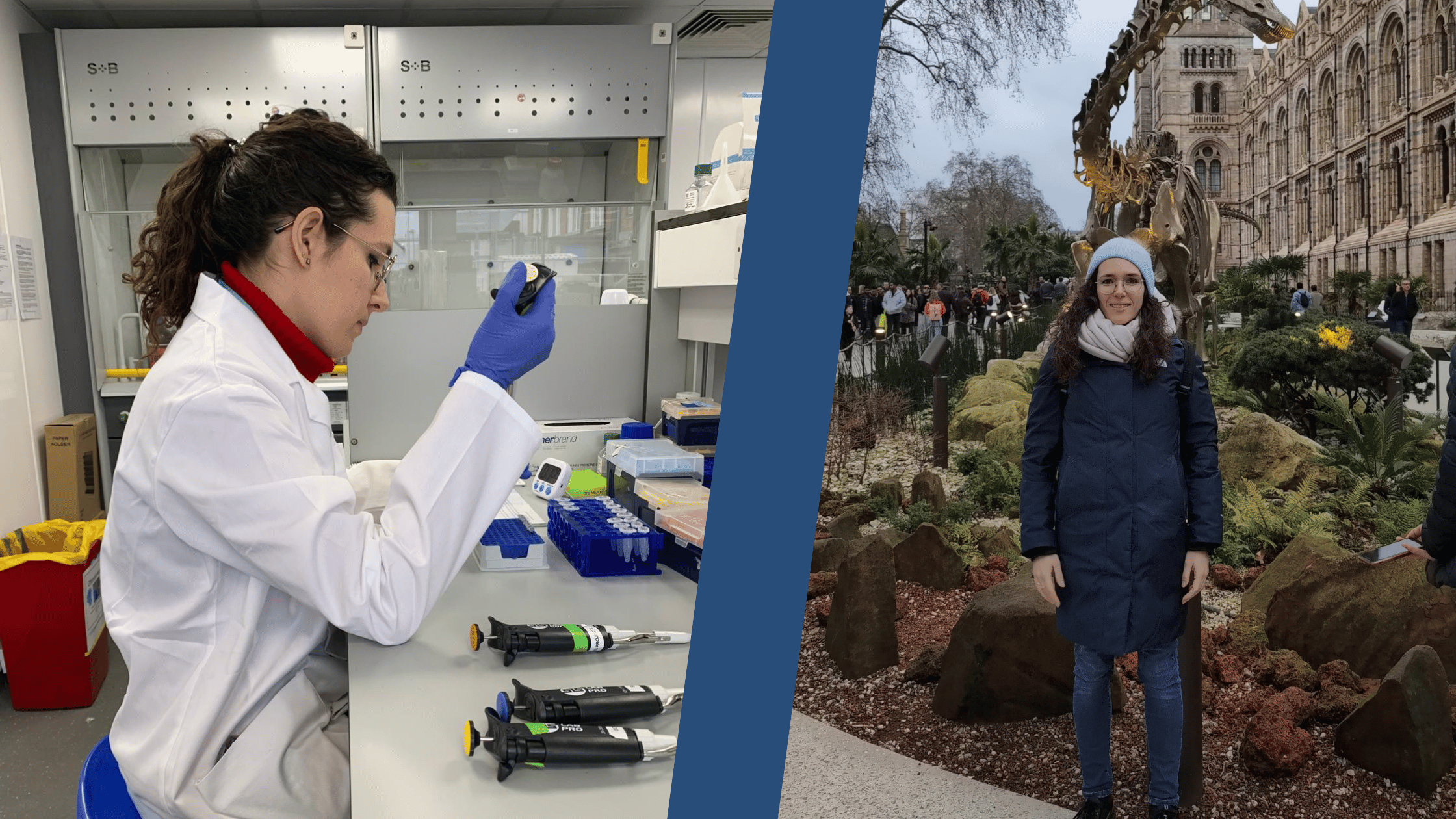
Andrea Moreno Manuel is a postdoctoral researcher at the Aragon Health Research Institute, Spain who received an EACR Travel Fellowship to visit and work at the London South Bank University, United Kingdom between December 2025 and March 2026.
The EACR, with support from Worldwide Cancer Research, provides Travel Fellowships of up to €3,500 to enable early-career cancer researchers to gain new skills through a short-term visit to a lab or research group in another country. This project was also supported by Cátedra Cajal (FUAM-Merck) and ASPANOA.
You can read about other Travel Fellows and their experiences here.
What is the topic of your current research?
My research is focused on the identification of neoantigens in paediatric solid tumours. Neoantigens are abnormal proteins caused by tumour mutations, which can be recognised and attacked by the immune system. We aim to develop anti-tumour therapeutic strategies targeting these neoantigens.
Why did you decide to apply for an EACR Travel Fellowship?
I decided to apply for an EACR Travel Fellowship because I thought it would be a valuable opportunity for my career, as part of my postdoctoral training. This was also influenced by the potential collaboration with the host lab. We met the host PI in a meeting, where we presented my postdoctoral project and he explained his project and the methodology that he applies in the lab, which could be useful to validate my preliminary results. We thought that the optimal way to establish the collaboration was by conducting this research stay, so I could also learn the techniques and implement them once back in our lab, to continue this research line and validate future results. I also believe these types of fellowships are essential to boost scientific careers, especially for early-career researchers.
Can you summarise the research you did or what you learned on your visit?
My postdoctoral project aims to identify neoantigens which could be used as therapeutic targets. My preliminary analysis using computational tools allowed me to identify potential neoantigen candidates. Therefore, the main objective of this research stay was to validate these candidates using bacterial spores for peptide display. For this purpose, I have learnt how to design primers targeting these peptides and how to clone bacteria to integrate these peptides, which will be displayed on bacterial spores.
More specifically, I have used basic techniques such as electrophoresis, PCR, western blot, nucleic acid isolation… I have also learnt bacterial specific techniques, including culture medium preparation, how to make competent cells, cloning techniques such as Golden Gate, among others. From the computational perspective, I have learned how to use Benchling for primer design and to design constructs to introduce our peptides into spore proteins.
Describe a ‘typical day’ on your visit.
A typical day at LSBU started at the laboratory, where I applied molecular biology techniques such as DNA isolation, electrophoresis, colony PCR, among others, which I conducted on my own. While we were waiting for sequencing results, we did other laboratory tasks, such as preparing reagents, cell media, or competent cells, often together with other students.
In the afternoon or while PCRs were running, I focused on literature review and met my host supervisor to show him my results and decide the following steps, or to discuss troubleshooting alternatives. I also attended meetings with my home supervisor and colleagues, or with students, when possible.
Did you have a personal mentor or anyone who particularly helped you?
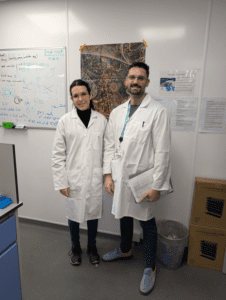
My main mentor was my host supervisor, Dr. Joaquín Caro. He has taken ample time out of his schedule to teach me techniques and to help me with troubleshooting. Additionally, I worked in tight collaboration with lab technicians and other postdoctoral and PhD researchers. I also helped students who were doing internships in the same group.
This research stay has also strengthened other skills such as communication, interdisciplinary thinking, and my ability to adapt to new research environments and workflows.
Have you brought back any specific techniques that have benefited your home lab?
Absolutely! I have worked with bacterial spores, which I had not done previously, and neither had any of my colleagues. To do so, I have learnt about spores’ formation and peptide display on spores. In the laboratory, I have used molecular biology techniques which I could apply to my home lab. This is important for my postdoctoral project, since we are using the bacterial spores to display neoantigens that I have previously identified in silico. Thanks to this research stay, we hope to implement the spore techniques in my home lab, to continue with the validation of novel neoantigens in the future. This could be useful not only to measure their immunogenicity and confirm the neoantigens identified, but also as therapeutic tools, by developing mucosal vaccines.
Does your lab plan to do any future collaboration with the host lab?
Yes, we are still working on the project and the collaboration is ongoing. We expect to start writing a manuscript soon and hopefully publish the results by the end of the year. Despite not having time to accomplish all the objectives of the proposal during the research stay, both groups are still actively working on the project. In addition, we established a collaboration with another group who will help us to validate immunogenicity of the peptide display on the spores against dendritic cells derived from human donors.
How has this visit been beneficial to your research or your career?
I believe this trip has inspired my research since I have learnt how groups are organised within universities (I have always worked in research institutes located in hospitals). Despite all groups belonging to the Biomedical Sciences Department, they worked on a wide range of topics. This has allowed me to understand how molecular biology techniques can be applied to different basic and translational research projects. Discussing science with experts with different backgrounds and perspectives has been enriching. I have also met other group leaders and lecturers, who shared their career paths with me. Since I have just started working as a postdoctoral researcher, listening to the experiences of other researchers has given me ideas for future projects, and will allow me to focus and develop my career. This research stay has also strengthened other skills such as communication, interdisciplinary thinking, and my ability to adapt to new research environments and workflows. Altogether, I consider this a valuable and inspiring opportunity.
Is there anything else you’d like to mention?
I would like to take this opportunity to thank the EACR for their financial support and for making this research stay possible, as it has resulted in a promising collaboration and has also been inspiring for my scientific career. I would like to express my sincere gratitude to my host supervisor, Dr. Joaquín Caro for his guidance during my research stay and for maintaining this collaboration. I would also like to thank all my colleagues from the host institution for everything they have taught me, for their warmth, and for integrating me into the group. Finally, I would like to thank my home supervisor, Dr. Rebeca Sanz for giving me this opportunity and for establishing this collaboration.
Want to find out more?

If you are interested in applying for the Travel Fellowship scheme, please click here for more information: EACR Travel Fellowships