

The EACR’s ‘Highlights in Cancer Research’ is a regular summary of the most interesting and impactful recent papers in cancer research, curated by the Board of the European Association for Cancer Research (EACR).
The list below appears in no particular order, and the summary information has been provided by the authors unless otherwise indicated.
Use the dropdown menu or ‘Previous’ and ‘Next’ buttons to navigate the list.
Garner H., Martinovic M. et al. Cancer Cell. 43 (7): 1279-1295.e9. (2025).
doi: 10.1016/j.ccell.2025.04.007.
Summary of the findings
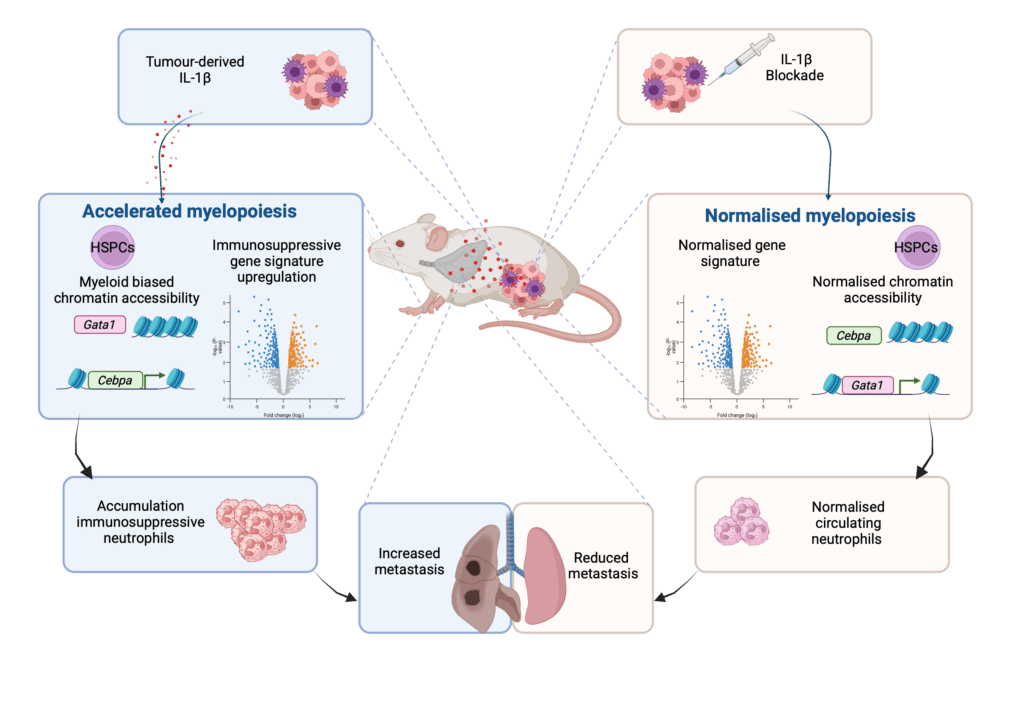
In this study, we defined how mammary tumours systemically rewire neutrophil development. Using a spontaneous mouse model of mammary tumorigenesis combined with phenotypic, transcriptome, and chromatin accessibility analyses, we show that tumour-derived interleukin-1b (IL-1b) acts on haematopoietic stem cells (HSCs) in the bone marrow to bias differentiation towards myeloid lineage and accelerates neutrophil development at the expense of T cell and red blood cell development.
Strikingly, we found that the immunosuppressive programming is initiated early in HSCs and is progressively reinforced throughout neutrophil differentiation, indicating that tumour-driven inflammation imprints functionality long before terminal maturation. Importantly, therapeutic blockade of IL-1b reverses these effects, restoring normal haematopoietic output, normalising neutrophils at the chromatin, transcriptional and cellular levels, reducing their immunosuppressive phenotype and significantly limiting metastatic spread.
Future impact
This study identifies IL-1b as a central regulator of tumour-induced haematopoietic reprogramming and highlights its potential as a therapeutic target to counteract systemic immunosuppression and metastasis. These findings provide a strong rationale for exploring anti-IL-1b therapies as a strategy to limit metastatic spread. In the context of established disease, combining IL-1b blockade with immune checkpoint inhibition may represent a more effective therapeutic approach. However, additional preclinical studies in models of tumours refractory to checkpoint blockade are needed to inform the rational design and clinical translation of such combination strategies.