
The Cancer Researcher
  • Home
  • About
  • The Cancer Researcher Podcast
  • #KeepResearchCurious
No Result
View All Result
  • Home
  • About
  • The Cancer Researcher Podcast
  • #KeepResearchCurious
No Result
View All Result
The Cancer Researcher
No Result
View All Result

Highlights in Cancer Research: April 2026

April 28, 2026
Highlights in Cancer Research: November 2022

The EACR’s ‘Highlights in Cancer Research’ is a regular summary of the most interesting and impactful recent papers in cancer research, curated by the Board of the European Association for Cancer Research (EACR).

The list below appears in no particular order, and the summary information has been provided by the authors unless otherwise indicated.

Use the dropdown menu or ‘Previous’ and ‘Next’ buttons to navigate the list.


8. Respiratory viral infections awaken metastatic breast cancer cells in lungs

  • 1. The local microenvironment suppresses the synergy between irradiation and anti-PD1 therapy in breast-to-brain metastasis
  • 2. Understanding and reversing mammary tumor-driven reprogramming of myelopoiesis to reduce metastatic spread
  • 3. A large-scale retrospective study in metastatic breast cancer patients using circulating tumour DNA and machine learning to predict treatment outcome and progression-free survival
  • 4. Humoral determinants of checkpoint immunotherapy
  • 5. AKR1B10 dictates c-Myc stability to suppress colorectal cancer metastasis via PP2A nitration
  • 6. NNMT inhibition in cancer-associated fibroblasts restores antitumour immunity
  • 7. Paneth-like transition drives resistance to dual targeting of KRAS and EGFR in colorectal cancer
  • 8. Respiratory viral infections awaken metastatic breast cancer cells in lungs
  • 9. DNA fragmentation factor B suppresses interferon to enable cancer persister cell regrowth
Previous
Next

Chia, S. B., Johnson B. J. et al. Nature. 645: 496–506. (2025).

doi: 10.1038/s41586-025-09332-0.

Summary of the findings

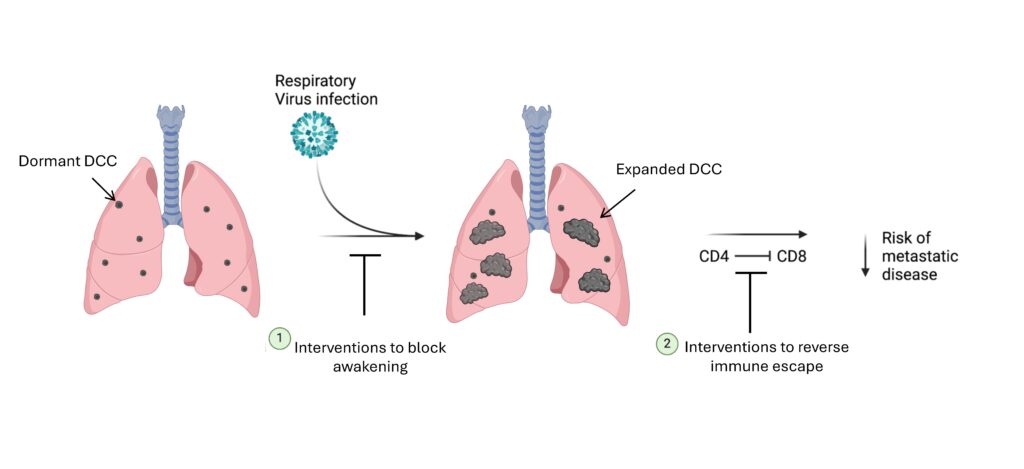
Cancer cells which disseminate from primary tumors (disseminated cancer cells, DCC) can remain dormant and persist in target organs up to decades before awakening to form overt metastatic disease. The DCC microenvironment determines dormancy or awakening, and acute respiratory viral infections (RVI) like SARS-CoV-2 and influenza virus induce potent inflammation in the lungs. Our recent studies demonstrated in mice that influenza A virus (IAV) and SARS-CoV-2 infections lead to loss of the pro-dormancy phenotype in breast DCC in the lung, causing DCC proliferation within days of infection, and a massive expansion of carcinoma cells into metastatic lesions over a few weeks. These phenotypic transitions (altered expression of epithelial/mesenchymal markers) and expansions are interleukin-6 (IL-6) dependent.

Later in the infection, DCC co-localize with CD4+ T cells in iBALT (induced bronchioalveolar lymphoid tissue), with few CD8+ T cells. While depleting CD4+ T cells did not affect the initial DCC expansion post-IAV infection, CD4+ T cell depletion led to an almost 100X reduction in DCC burden by 28 dpi. Importantly, depletion of both CD4+ and CD8+ T cells reverses the effect of depleting only CD4+ cells, indicating that CD4+ T cells were interfering with anti-tumor responses mediated by CD8+ T cells (further demonstrated by cytotoxic T-lymphocyte killing assays ex vivo). Using single cell (sc) RNAseq, we further showed that DCC can reprogram CD4+ and CD8+ T cells, with gene expression profiles consistent with immune suppression. Thus, CD4+ T-cells sustain pulmonary metastatic burden post-RVI by interfering with CD8+ T-cell cytotoxicity.

These experimental findings align with human observational data. Analyses of cancer survivors from the UK Biobank (all cancer) and Flatiron Health (breast cancer) databases revealed an increase in risk of cancer-related mortality and lung metastasis, respectively, in cancer survivors who suffered from SARS-CoV-2 infection when compared to those uninfected. These discoveries highlight the significant impact of RVI on metastatic cancer resurgence, offering novel insights into links between RVI and cancer risks.

.
.Future impact

Key goals moving forward will be to extend these discoveries to reduce the risk of metastatic progression in cancer survivors who experience RVI. The most obvious, and least risky, approach will be to prevent the RVI in the first place, such as through avoiding exposures (e.g. masking) or through vaccination. For vaccination, we will compare different vaccination strategies for their ability to effectively prevent dormant DCC awakening and metastatic disease progression. Additional studies will seek to develop interventions that could be applied during or after infection, with the goal of blocking the pathways that mediate awakening (i.e. the IL-6 pathway) or that mediate immune escape. In all, our goal will be to capitalize on mechanistic understanding of RVI induced metastatic progression to limit its impact on cancer survivors.
.Read more in Nature
.

8. Respiratory viral infections awaken metastatic breast cancer cells in lungs

  • 1. The local microenvironment suppresses the synergy between irradiation and anti-PD1 therapy in breast-to-brain metastasis
  • 2. Understanding and reversing mammary tumor-driven reprogramming of myelopoiesis to reduce metastatic spread
  • 3. A large-scale retrospective study in metastatic breast cancer patients using circulating tumour DNA and machine learning to predict treatment outcome and progression-free survival
  • 4. Humoral determinants of checkpoint immunotherapy
  • 5. AKR1B10 dictates c-Myc stability to suppress colorectal cancer metastasis via PP2A nitration
  • 6. NNMT inhibition in cancer-associated fibroblasts restores antitumour immunity
  • 7. Paneth-like transition drives resistance to dual targeting of KRAS and EGFR in colorectal cancer
  • 8. Respiratory viral infections awaken metastatic breast cancer cells in lungs
  • 9. DNA fragmentation factor B suppresses interferon to enable cancer persister cell regrowth
Previous
Next
Tags: EACR Top Ten Cancer Research PublicationsHighlights in Cancer Research

Related Posts

“The best scientific event I have ever participated in”: Rafaela’s EACR Travel Grant leads to new opportunities

“The best scientific event I have ever participated in”: Rafaela’s EACR Travel Grant leads to new opportunities

April 20, 2026

The EACR, AACR, and The Mark Foundation for Cancer Research recently teamed up to offer a number of travel grants to help EACR or AACR members...

VIDEO | Streamlining Tumour Interpretation with the Cancer Genome Interpreter

VIDEO | Streamlining Tumour Interpretation with the Cancer Genome Interpreter

April 22, 2026

https://www.youtube.com/watch?v=KdMqmIIgNYo Click above to watch On 9 April 2026, the EACR hosted a free webinar bringing together leading experts to explore the Cancer Genome Interpreter (CGI)...

Patients Shaping Cancer Research – Episode 31 of The Cancer Researcher Podcast

Patients Shaping Cancer Research – Episode 31 of The Cancer Researcher Podcast

April 13, 2026

What does it take to bridge the gap between researchers and patients? In this episode, scientists, oncologists, and patient advocates from Canada, the United States, and...

The Cancer Researcher EACR logo

About Us

The Cancer Researcher is an online magazine for the cancer research community from the European Association for Cancer Research.

The EACR, a registered charity, is a global community for those working and studying in cancer research. Our mission is “The advancement of cancer research for the public benefit: from basic research to prevention, treatment and care.”

RECENT POSTS

Highlights in Cancer Research: November 2022
Features

Highlights in Cancer Research: April 2026

April 28, 2026
“The best scientific event I have ever participated in”: Rafaela’s EACR Travel Grant leads to new opportunities
Community

“The best scientific event I have ever participated in”: Rafaela’s EACR Travel Grant leads to new opportunities

April 20, 2026
The Cancer Researcher

© 2025 EACR

Navigate site

  • About
  • Privacy
  • Main EACR website

Follow us

No Result
View All Result
  • Home
  • About
  • The Cancer Researcher Podcast
  • #KeepResearchCurious

© 2025 EACR