
The Cancer Researcher
  • Home
  • About
  • The Cancer Researcher Podcast
  • #KeepResearchCurious
No Result
View All Result
  • Home
  • About
  • The Cancer Researcher Podcast
  • #KeepResearchCurious
No Result
View All Result
The Cancer Researcher
No Result
View All Result

Highlights in Cancer Research: April 2026

April 28, 2026
Highlights in Cancer Research: November 2022

The EACR’s ‘Highlights in Cancer Research’ is a regular summary of the most interesting and impactful recent papers in cancer research, curated by the Board of the European Association for Cancer Research (EACR).

The list below appears in no particular order, and the summary information has been provided by the authors unless otherwise indicated.

Use the dropdown menu or ‘Previous’ and ‘Next’ buttons to navigate the list.


3. A large-scale retrospective study in metastatic breast cancer patients using circulating tumour DNA and machine learning to predict treatment outcome and progression-free survival

  • 1. The local microenvironment suppresses the synergy between irradiation and anti-PD1 therapy in breast-to-brain metastasis
  • 2. Understanding and reversing mammary tumor-driven reprogramming of myelopoiesis to reduce metastatic spread
  • 3. A large-scale retrospective study in metastatic breast cancer patients using circulating tumour DNA and machine learning to predict treatment outcome and progression-free survival
  • 4. Humoral determinants of checkpoint immunotherapy
  • 5. AKR1B10 dictates c-Myc stability to suppress colorectal cancer metastasis via PP2A nitration
  • 6. NNMT inhibition in cancer-associated fibroblasts restores antitumour immunity
  • 7. Paneth-like transition drives resistance to dual targeting of KRAS and EGFR in colorectal cancer
  • 8. Respiratory viral infections awaken metastatic breast cancer cells in lungs
  • 9. DNA fragmentation factor B suppresses interferon to enable cancer persister cell regrowth
Previous
Next

Beddowes, E.J. et al. Molecular Oncology. 19: 3518-3534. (2025).
doi: 10.1002/1878-0261.70015.

Summary of the findings

Monitoring circulating tumour DNA (ctDNA) in blood offers a practical, non-invasive way to track cancer in real time. In this real-world study, we evaluated whether repeated ctDNA measurements could predict treatment response in patients with metastatic breast cancer.

We analysed 1,013 serial blood samples from 149 patients treated in routine clinical practice, using a rapid and low-cost sequencing method to estimate the proportion of tumour DNA in the bloodstream. We identified a 7% tumour DNA threshold that stratified patients by risk of disease progression, consistent across breast cancer subtypes and treatments, and outperforming standard blood tests and targeted sequencing.

Using longitudinal ctDNA data, we developed a Bayesian machine learning model to predict treatment response with good accuracy. This approach enables dynamic, patient-specific risk assessment over time.

These findings show that real-world ctDNA monitoring, combined with machine learning, can provide early and clinically meaningful insight into treatment effectiveness. This strategy has the potential to support more timely, data-driven treatment decisions and improve patient outcomes, and warrants prospective evaluation in large-scale clinical trials.

.
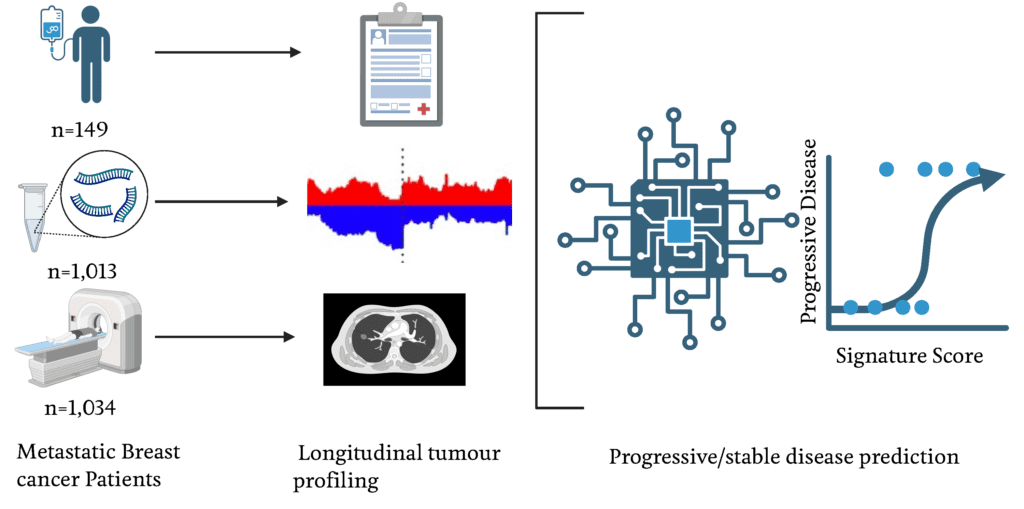
Integration of longitudinal data from patients with metastatic breast cancer, incorporating both static and dynamic biomarkers, to develop a Bayesian learning model capable of predicting treatment response.

.

Future impact

Real-world longitudinal ctDNA monitoring could significantly change how metastatic breast cancer is managed. By providing an early, non-invasive indication of treatment response, clinicians could identify ineffective therapies weeks to months before conventional imaging. This would enable faster treatment changes, reducing unnecessary toxicity and avoiding prolonged exposure to ineffective drugs. The use of low-cost, scalable sequencing also makes this approach feasible for routine clinical practice. If validated prospectively, ctDNA-guided decision-making could support more personalised, dynamic treatment strategies, improve patient outcomes, and optimise healthcare resources by aligning therapy more closely with tumour biology in real time.
.
.
Read more in Molecular Oncology
.

3. A large-scale retrospective study in metastatic breast cancer patients using circulating tumour DNA and machine learning to predict treatment outcome and progression-free survival

  • 1. The local microenvironment suppresses the synergy between irradiation and anti-PD1 therapy in breast-to-brain metastasis
  • 2. Understanding and reversing mammary tumor-driven reprogramming of myelopoiesis to reduce metastatic spread
  • 3. A large-scale retrospective study in metastatic breast cancer patients using circulating tumour DNA and machine learning to predict treatment outcome and progression-free survival
  • 4. Humoral determinants of checkpoint immunotherapy
  • 5. AKR1B10 dictates c-Myc stability to suppress colorectal cancer metastasis via PP2A nitration
  • 6. NNMT inhibition in cancer-associated fibroblasts restores antitumour immunity
  • 7. Paneth-like transition drives resistance to dual targeting of KRAS and EGFR in colorectal cancer
  • 8. Respiratory viral infections awaken metastatic breast cancer cells in lungs
  • 9. DNA fragmentation factor B suppresses interferon to enable cancer persister cell regrowth
Previous
Next
Tags: EACR Top Ten Cancer Research PublicationsHighlights in Cancer Research

Related Posts

“The best scientific event I have ever participated in”: Rafaela’s EACR Travel Grant leads to new opportunities

“The best scientific event I have ever participated in”: Rafaela’s EACR Travel Grant leads to new opportunities

April 20, 2026

The EACR, AACR, and The Mark Foundation for Cancer Research recently teamed up to offer a number of travel grants to help EACR or AACR members...

VIDEO | Streamlining Tumour Interpretation with the Cancer Genome Interpreter

VIDEO | Streamlining Tumour Interpretation with the Cancer Genome Interpreter

April 22, 2026

https://www.youtube.com/watch?v=KdMqmIIgNYo Click above to watch On 9 April 2026, the EACR hosted a free webinar bringing together leading experts to explore the Cancer Genome Interpreter (CGI)...

Patients Shaping Cancer Research – Episode 31 of The Cancer Researcher Podcast

Patients Shaping Cancer Research – Episode 31 of The Cancer Researcher Podcast

April 13, 2026

What does it take to bridge the gap between researchers and patients? In this episode, scientists, oncologists, and patient advocates from Canada, the United States, and...

The Cancer Researcher EACR logo

About Us

The Cancer Researcher is an online magazine for the cancer research community from the European Association for Cancer Research.

The EACR, a registered charity, is a global community for those working and studying in cancer research. Our mission is “The advancement of cancer research for the public benefit: from basic research to prevention, treatment and care.”

RECENT POSTS

Highlights in Cancer Research: November 2022
Features

Highlights in Cancer Research: April 2026

April 28, 2026
“The best scientific event I have ever participated in”: Rafaela’s EACR Travel Grant leads to new opportunities
Community

“The best scientific event I have ever participated in”: Rafaela’s EACR Travel Grant leads to new opportunities

April 20, 2026
The Cancer Researcher

© 2025 EACR

Navigate site

  • About
  • Privacy
  • Main EACR website

Follow us

No Result
View All Result
  • Home
  • About
  • The Cancer Researcher Podcast
  • #KeepResearchCurious

© 2025 EACR