
The Cancer Researcher
  • Home
  • About
  • The Cancer Researcher Podcast
  • #KeepResearchCurious
No Result
View All Result
  • Home
  • About
  • The Cancer Researcher Podcast
  • #KeepResearchCurious
No Result
View All Result
The Cancer Researcher
No Result
View All Result

Highlights in Cancer Research: April 2026

April 28, 2026
Highlights in Cancer Research: November 2022

The EACR’s ‘Highlights in Cancer Research’ is a regular summary of the most interesting and impactful recent papers in cancer research, curated by the Board of the European Association for Cancer Research (EACR).

The list below appears in no particular order, and the summary information has been provided by the authors unless otherwise indicated.

Use the dropdown menu or ‘Previous’ and ‘Next’ buttons to navigate the list.


1. The local microenvironment suppresses the synergy between irradiation and anti-PD1 therapy in breast-to-brain metastasis

  • 1. The local microenvironment suppresses the synergy between irradiation and anti-PD1 therapy in breast-to-brain metastasis
  • 2. Understanding and reversing mammary tumor-driven reprogramming of myelopoiesis to reduce metastatic spread
  • 3. A large-scale retrospective study in metastatic breast cancer patients using circulating tumour DNA and machine learning to predict treatment outcome and progression-free survival
  • 4. Humoral determinants of checkpoint immunotherapy
  • 5. AKR1B10 dictates c-Myc stability to suppress colorectal cancer metastasis via PP2A nitration
  • 6. NNMT inhibition in cancer-associated fibroblasts restores antitumour immunity
  • 7. Paneth-like transition drives resistance to dual targeting of KRAS and EGFR in colorectal cancer
  • 8. Respiratory viral infections awaken metastatic breast cancer cells in lungs
  • 9. DNA fragmentation factor B suppresses interferon to enable cancer persister cell regrowth
Previous
Next

Wischnewski, V. et al. Cell Reports. 44 (3): 115427. (2025).
doi: 10.1016/j.celrep.2025.115427.

Summary of the findings

Brain metastases (BrM) are a serious late-stage complication in patients with breast cancer and are often difficult to treat. Radiotherapy and immunotherapy, particularly anti-PD1 treatment, have shown promising efficacy in tumors outside the brain, and combining these approaches can further improve outcomes. However, whether this strategy works equally well in BrM has remained unclear.
.
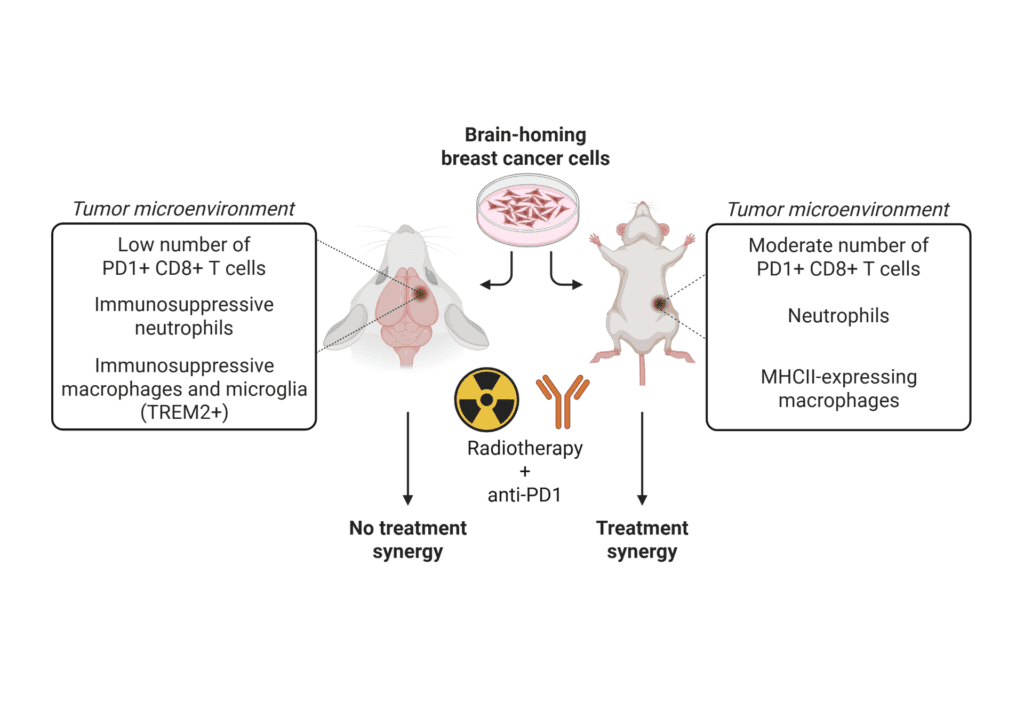
In this study, we therefore investigated how the unique microenvironment of breast cancer-BrM influences the response to combined radiotherapy and immunotherapy. We found that while immune cells, including CD8⁺ T cells, infiltrate breast cancer-BrM, their ability to kill tumor cells is locally suppressed within the brain. Consequently, the addition of a therapeutic anti-PD1 antibody to radiotherapy failed to produce any additional benefit in BrM. By contrast, this combination worked synergistically against genetically identical tumor cells growing outside the brain.
.
Further analyses revealed that tumor-infiltrating neutrophils and Trem2-positive macrophages and microglia can actively suppress T cell function ex vivo. Together, these findings highlight how the local tumor microenvironment in the brain limits the effectiveness of otherwise promising cancer therapies, thereby revealing a key barrier to improving outcomes for patients with brain metastases.
.

Future impact

Our results indicate that improving treatment of BrM will likely require strategies that specifically target local immune suppression in the brain. Inhibition of BrM-infiltrating immunosuppressive myeloid cells could help restore T cell activity and enhance the effectiveness of T cell-targeting therapies as both single agents and combination treatments.

.
More broadly, this research underscores the importance of tailoring cancer therapies to specific anatomical locations. Developing treatments that account for the unique features of the brain may lead to more effective therapeutic approaches for patients with BrM.
.
Read more in Cell Reports

1. The local microenvironment suppresses the synergy between irradiation and anti-PD1 therapy in breast-to-brain metastasis

  • 1. The local microenvironment suppresses the synergy between irradiation and anti-PD1 therapy in breast-to-brain metastasis
  • 2. Understanding and reversing mammary tumor-driven reprogramming of myelopoiesis to reduce metastatic spread
  • 3. A large-scale retrospective study in metastatic breast cancer patients using circulating tumour DNA and machine learning to predict treatment outcome and progression-free survival
  • 4. Humoral determinants of checkpoint immunotherapy
  • 5. AKR1B10 dictates c-Myc stability to suppress colorectal cancer metastasis via PP2A nitration
  • 6. NNMT inhibition in cancer-associated fibroblasts restores antitumour immunity
  • 7. Paneth-like transition drives resistance to dual targeting of KRAS and EGFR in colorectal cancer
  • 8. Respiratory viral infections awaken metastatic breast cancer cells in lungs
  • 9. DNA fragmentation factor B suppresses interferon to enable cancer persister cell regrowth
Previous
Next
Tags: EACR Top Ten Cancer Research PublicationsHighlights in Cancer Research

Related Posts

“A community that actively supports growth, resilience, and global collaboration” – what EACR membership means to a researcher from a low-income country

“A community that actively supports growth, resilience, and global collaboration” – what EACR membership means to a researcher from a low-income country

July 13, 2026

We caught up with Mounia Benbelkacem, a PhD researcher at the Laboratory of Cellular and Molecular Biology, Faculty of Biological Sciences, University of Science and Technology...

“Reinforced my desire to build and develop computational and bioinformatics capacity”- Aniefiok John Udoakang’s Travel Fellowship

“Reinforced my desire to build and develop computational and bioinformatics capacity”- Aniefiok John Udoakang’s Travel Fellowship

July 8, 2026

Aniefiok John Udoakang is a postdoctoral researcher at University of Medical Sciences, Ondo City, Ondo State, Nigeria who received an EACR Travel Fellowship to visit and...

“It seemed like an excellent opportunity to strengthen my project and expand my network.” – Ana Rita Barbosa de Matos’s Travel Fellowship

“It seemed like an excellent opportunity to strengthen my project and expand my network.” – Ana Rita Barbosa de Matos’s Travel Fellowship

July 6, 2026

Ana Rita Barbosa de Matos is a postdoctoral researcher at i3S, Portugal who received an EACR Travel Fellowship to visit and work at VHIO, Spain between...

The Cancer Researcher EACR logo

About Us

The Cancer Researcher is an online magazine for the cancer research community from the European Association for Cancer Research.

The EACR, a registered charity, is a global community for those working and studying in cancer research. Our mission is “The advancement of cancer research for the public benefit: from basic research to prevention, treatment and care.”

Advertisement Advertisement Advertisement
ADVERTISEMENT

RECENT POSTS

GBM cell painting / GBM E13 spheroid
Community

Rethinking drug discovery in glioblastoma

July 16, 2026
Scientific Highlights from ‘Cancer Genomics, Multiomics and Computational Biology’ 2026
News

Scientific Highlights from ‘Cancer Genomics, Multiomics and Computational Biology’ 2026

July 15, 2026
The Cancer Researcher

© 2025 EACR

Navigate site

  • About
  • Privacy
  • Main EACR website

Follow us

No Result
View All Result
  • Home
  • About
  • The Cancer Researcher Podcast
  • #KeepResearchCurious

© 2025 EACR