

The EACR’s ‘Highlights in Cancer Research’ is a regular summary of the most interesting and impactful recent papers in cancer research, curated by the Board of the European Association for Cancer Research (EACR).
The list below appears in no particular order, and the summary information has been provided by the authors unless otherwise indicated.
Use the dropdown menu or ‘Previous’ and ‘Next’ buttons to navigate the list.
Cervilla, Sergi et al. Genome Biology. 27 (1). (2026).
doi: https://doi.org/10.1186/s13059-026-03937-y
Summary of the findings
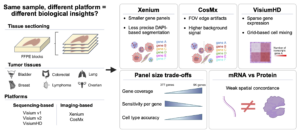
Spatial transcriptomics is reshaping our understanding of tissue organization and cellular context in health and disease, but the growing number of commercial platforms has created a clear need for a technical benchmark to guide their analysis and interpretation.
Here, we systematically benchmark five commercial spatial transcriptomics platforms, including Visium v1, Visium v2/CytAssist, Visium HD, Xenium across both targeted (<400 genes) and high-plex (5K genes) panels, and CosMx, using matched FFPE sections from six human tumor types.
The results reveal platform-specific limitations, from technical artifacts such as background noise to a trade-off in which broader gene panels come at the cost of per-gene sensitivity with direct consequences for the biological conclusions drawn from the data. Finally, comparing gene activity to the corresponding proteins revealed substantial discordance within tissue, suggesting that no single omics layer fully captures the underlying biology.
Future impact
These findings give researchers practical, evidence-based guidance for selecting the right platform and gene panel for their specific biological question, rather than relying on manufacturer claims. The dataset itself is also a useful resource for the community for tool developers, methods evaluators, and researchers planning future spatial studies. Together, this work is likely to inform experimental design standards as spatial technologies move toward wider use in cancer research and, eventually, clinical diagnostics.
.