
The European Association for Cancer Research and Worldwide Cancer Research are happy to announce the recipients of the 2026 EACR-Worldwide Cancer Research Collaboration Fellowships.
The Collaboration Fellowships were launched just before the EACR 2026 Congress in Budapest, and were initiated to help researchers transform connections made at the Congress into meaningful international collaborations. The fellowships provide funding of up to €3,500 to support research visits between laboratories in different countries, enabling scientists to exchange expertise, develop new projects, and establish the foundations for long-term partnerships. The fellowships demonstrate the potential of scientific meetings to bring together researchers with complementary expertise and spark collaborations that may not otherwise have emerged.
- Robin Reschke (National Center for Tumor Diseases Heidelberg) and Keith Flaherty (Massachusetts General Cancer Center, Harvard Medical School), “High-Plex Proteomics for Personalized Prediction of Immunotherapy Outcome”
- Aktan Alpsoy (Middle East Technical University) and Elena Jachetti (Fondazione IRCCS Istituto Nazionale dei Tumori), “PlasticProstate”
- Liang Ying Yu (Institute of Molecular and Cell Biology, A*STAR Research Entities) and Zornitsa Vasileva Kotopanova (University of Manchester), “Bidirectional Exchange of AquIRE and MS-CETSA Expertise to Develop a Joint Project Investigating Oxaliplatin-Induced Changes in RNA–Protein Interactions”
- Jana Loptien (University Medical Center Hamburg-Eppendorf) and Guillaume Jacquemet (University of Turku, Åbo Akademi University), “Flow microscopy-based analysis to investigate RBC-mediated tumor cell migration and extravasation capacity in pancreatic ductal adenocarcinoma (PDAC)”
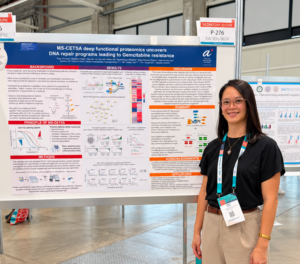
One collaborative pair who have been awarded a fellowship are Liang Ying Yu and Zornitsa Vasileva Kotopanova, who connected at the EACR Congress and identified an opportunity to combine their research knowledge to investigate cancer drug resistance.
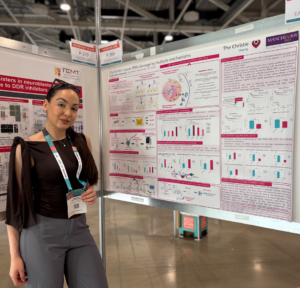
Reflecting on the Congress connection, Ying Yu said: “One conversation at the EACR Congress initiated a collaboration combining our expertise in protein functional state profiling and RNA biology. I’m excited to exchange technical know-how, integrate our scientific approaches and develop joint research projects on cancer drug resistance. I hope this fellowship will spark a lasting international partnership.”
Looking ahead to the research visit, Zornitsa (Zoe) said: “Hosting the EACR Collaboration Fellow Dr Liang Ying Yu at such a pivotal moment in their career is a fantastic experience. I am really looking forward to working side-by-side at the bench, exchanging technical insights, and integrating our complementary workflows. Building this bridge between our labs not only advances our current cancer research goals but also establishes a strong, lasting partnership for future collaborative projects.”
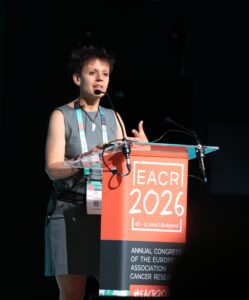
Another fellowship will support a collaboration between Aktan Alpsoy and Elena Jachetti, who will work together to investigate lineage plasticity in prostate cancer.
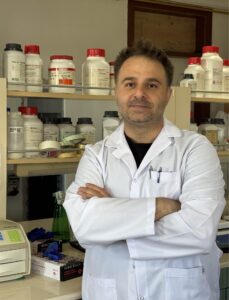
Elena highlighted the benefits of bringing compatible research backgrounds together: “I am delighted to host Aktan in my group thanks to this Collaboration Fellowship, which offers a valuable opportunity to bring complementary expertise together and establish a new scientific collaboration. I look forward to exchanging ideas and combining our perspectives to better understand lineage plasticity in prostate cancer and explore new therapeutic opportunities.”
Aktan reflected on the potential impact of the collaboration: “I am grateful to receive the Collaboration Fellowship, which allows me to join Elena’s group as a short-term visiting researcher. I look forward to investigating lineage transitions in prostate cancer together, hoping our shared efforts advance our practical understanding of the processes and identify new therapeutically actionable vulnerabilities for this aggressive disease.”
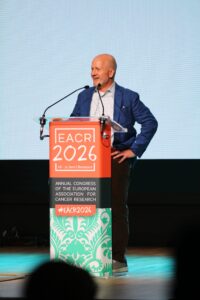
A third fellowship has been awarded following a connection made between Keith Flaherty and Robin Reschke at the EACR 2026 Congress. Their collaboration will bring together expertise in proteomics, translational cancer immunology and precision oncology to identify biomarkers of response and resistance to immunotherapy.
Describing the origins of the project, Keith Flaherty said: “Robin and I met at EACR 2026 in Budapest, and the complementarity between his high-plex proteomics and our work on determinants of therapeutic resistance was immediately clear. The project that came out of that conversation is to define circulating proteomic signatures of response and resistance to checkpoint inhibition. I’m grateful to EACR for making the visit possible.”
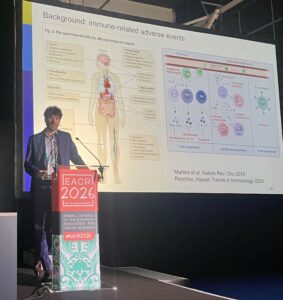
Robin welcomed the opportunity to work with a notable researcher in the field: “I am honored to receive the EACR-Worldwide Cancer Research Collaboration Fellowship and to have the opportunity to collaborate with Professor Keith Flaherty, a leading researcher in my field, whom I had the pleasure of meeting following our talks at EACR 2026 in Budapest.
By combining our complementary expertise in translational cancer immunology and precision oncology, we aim to advance our shared research goals and contribute to the development of more personalized cancer treatments.”
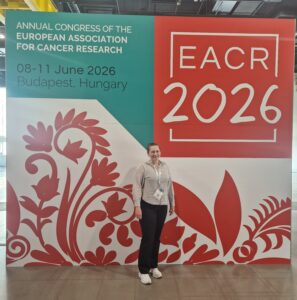
The programme will also support a collaboration involving Jana Loptien and Guillaume Jacquemet, focused on advancing research into metastatic progression through the exchange of specialist microscopy expertise.
Jana emphasised the value of learning new techniques through the fellowship: “I am really looking forward to learning new microscopy technologies thanks to this fellowship. More importantly, this new collaboration between our laboratories will greatly advance research on metastatic progression in cancer. It’s very inspiring to be part of it.”
Guillaume added a note championing shared discovery: “I’m looking forward to welcoming Jana to our lab and working together to better understand how cancer cells spread. This fellowship gives us time to share imaging methods, learn from each other and test new ideas.
I hope the visit will help build a lasting collaboration between our groups. Many thanks to EACR and Worldwide Cancer Research for supporting this collaboration.”
The EACR–Worldwide Cancer Research Collaboration Fellowships were established from a shared belief that bringing researchers together across borders can accelerate progress against cancer. By providing support for international research visits, the programme aims to give promising new collaborations the opportunity to grow, generate new ideas, and develop into lasting scientific partnerships.
Our Travel Fellowship applications are open year-round in order to fund similar opportunities. If you are interested in applying for the Travel Fellowship scheme, please head to our website for more information: EACR Travel Fellowships.