

The EACR’s ‘Highlights in Cancer Research’ is a regular summary of the most interesting and impactful recent papers in cancer research, curated by the Board of the European Association for Cancer Research (EACR).
The list below appears in no particular order, and the summary information has been provided by the authors unless otherwise indicated.
Use the dropdown menu or ‘Previous’ and ‘Next’ buttons to navigate the list.
Shulman, Eldad D et al. Cell. 189 (14): 4225-4240.e25. (2026).
doi: 10.1016/j.cell.2026.04.023
Summary of the findings
Spatial transcriptomics maps gene activity within a tumour, revealing the tumour microenvironment: how cancer, immune and supporting cells are organised. These maps can uncover biomarkers of prognosis and treatment response, but direct measurement is too costly and labour-intensive for the large cohorts needed to discover and validate them.
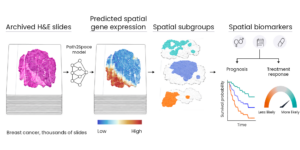
We developed Path2Space, an artificial intelligence model that uses routine pathology slides to predict where genes are active. Trained on breast tumours with matched spatial transcriptomics data, it robustly predicted spatial expression for almost 5,000 genes. It captured the local mix of cell types and generalised across three independent datasets.
In a cohort of almost 1,000 breast tumours, the predicted maps revealed recurring tissue neighbourhoods. Their proportions defined three groups marked by proliferation, high immune activity, or low immune activity. The low immune group had the poorest disease-free survival, a finding reproduced in an independent cohort of 141 patients.
We predicted response to chemotherapy and trastuzumab, which targets HER2, across independent cohorts. Path2Space showed that tumours in which regions of high and low HER2 activity were more intermixed responded better to trastuzumab. Biomarkers from pathology images alone matched or outperformed predictors based on measured molecular and clinical data.
Future impact
Path2Space makes spatial biomarker discovery feasible in large cohorts that would be too costly to profile directly, opening existing pathology archives to large-scale exploration of the tumour microenvironment and the search for biomarkers of prognosis and treatment response.
As suitable matched datasets emerge, the framework may also be extended to other cancer types and to spatial protein or DNA methylation patterns. With careful prospective validation, biomarkers derived from routine pathology images could ultimately reduce reliance on additional molecular testing and bring personalised treatment guidance within reach of more patients.
.