


The EACR’s ‘Highlights in Cancer Research’ is a regular summary of the most interesting and impactful recent papers in cancer research, curated by the Board of the European Association for Cancer Research (EACR).
The list below appears in no particular order, and the summary information has been provided by the authors unless otherwise indicated.
Use the dropdown menu or ‘Previous’ and ‘Next’ buttons to navigate the list.
Uhl, Leonie et al. Cell. 189 (5): 1371-1388.e29. (2026).
doi: 10.1016/j.cell.2025.12.019
Summary of the findings
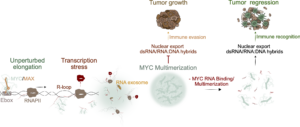
MYC is a major driver of tumorigenesis, and its aberrant expression correlates with poor patient prognosis. Canonically, MYC binds together with its heterodimerization partner MAX to virtually all active promoters, thereby regulating gene expression. We now show that, upon transcriptional stress, which is particularly encountered by highly proliferative cancer cells, MYC undergoes a phase transition, shifting from its cognate promoter sites onto nascent RNAs. MYC directly binds these RNAs, promoting the formation of MYC multimers and concentrating the nuclear exosome within these assemblies. This process limits the accumulation and cytosolic export of immunogenic RNAs, including dsRNA and RNA:DNA hybrids, thus preventing the activation of innate immune signaling and enabling immune evasion. Specifically, among the four identified MYC RNA binding regions, RBRIII prevents loading of RNA:DNA hybrids onto the pattern-recognition receptor TLR3 and subsequent activation of the TBK1 signaling axis.
Future impact
By demonstrating that RBRIII is crucial for pancreatic tumor growth in vivo, we uncovered a previously unrecognized vulnerability of MYC-driven cancers. Importantly, this function can be uncoupled from MYC’s canonical role in transcriptional regulation, as mutations within RBRIII impaired MYC RNA binding and multimerization while preserving promoter occupancy and transcriptional activity. Targeting MYC RNA binding may therefore provide a strategy to selectively interfere with its oncogenic function, restoring innate immune recognition while sparing its mitogenic capacity.
.