
The Cancer Researcher
  • Home
  • About
  • The Cancer Researcher Podcast
  • #KeepResearchCurious
No Result
View All Result
  • Home
  • About
  • The Cancer Researcher Podcast
  • #KeepResearchCurious
No Result
View All Result
The Cancer Researcher
No Result
View All Result

Highlights in Cancer Research: September 2026

September 9, 2026
Highlights in Cancer Research: September 2026

The EACR’s ‘Highlights in Cancer Research’ is a regular summary of the most interesting and impactful recent papers in cancer research, curated by the Board of the European Association for Cancer Research (EACR).

The list below appears in no particular order, and the summary information has been provided by the authors unless otherwise indicated.

Use the dropdown menu or ‘Previous’ and ‘Next’ buttons to navigate the list.


Jump to section

6. First-in-human testing of a mutant KRAS vaccine for pancreatic cancer interception in high-risk cohorts

  • 1. MYC binding to nascent RNA suppresses innate immune signaling by R-loop-derived RNA-DNA hybrids
  • 2. A technical comparison of spatial transcriptomics platforms across six cancer types
  • 3. AI-predicted spatial transcriptomics unlocks breast cancer biomarkers from pathology
  • 4. Targeting cancer-specific mutations with RNA-triggered chromatin shredding
  • 5. Plasma signals of lung tumor promotion for molecular cancer prevention
  • 6. First-in-human testing of a mutant KRAS vaccine for pancreatic cancer interception in high-risk cohorts

Haldar, S.D. et al. Cancer Discovery. OF1–OF14. (2026).
doi: 10.1158/2159-8290.CD-25-2245

Summary of the findings

Pancreatic ductal adenocarcinoma (PDAC) remains one of the deadliest cancers, underscoring the need for novel strategies to intercept disease progression from precancer lesions. Pancreatic cancer is particularly well suited to immune interception because oncogenic KRAS mutations arise in the majority of precancer lesions. Furthermore, progression from precursor lesions to invasive cancer often occurs over many years and is accompanied by increasing immune suppression. This provides an opportunity to vaccinate individuals at high-risk before immune evasion and invasive disease develop.

In this study, we evaluated a mutant KRAS peptide vaccine in individuals at high risk for PDAC due to known familial predisposition and/or pathogenic germline variants. Vaccination was well tolerated and generated durable mutant KRAS-specific T cell responses for up to two years in those who had long-term samples available. Notably, pancreatic cystic lesions or IPMNs showed stabilization or regression more frequently among vaccinated participants than in a clinically comparable unvaccinated cohort in an exploratory analysis. Overall, these findings provide the first clinical evidence supporting the safety, immunogenicity, and feasibility of vaccine-based pancreatic cancer interception.
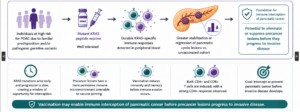
The figure was AI-assisted.

Future impact

These results establish a foundation for further evaluation of whether vaccination can eliminate or suppress pancreatic precursor lesions before they progress to invasive cancer. Ongoing studies will define how vaccine-induced T cells engage precursor lesions and identify biomarkers and rational combination strategies to enhance interception..

.
Read more in Cancer Discovery.

.

.
Jump to section

6. First-in-human testing of a mutant KRAS vaccine for pancreatic cancer interception in high-risk cohorts

  • 1. MYC binding to nascent RNA suppresses innate immune signaling by R-loop-derived RNA-DNA hybrids
  • 2. A technical comparison of spatial transcriptomics platforms across six cancer types
  • 3. AI-predicted spatial transcriptomics unlocks breast cancer biomarkers from pathology
  • 4. Targeting cancer-specific mutations with RNA-triggered chromatin shredding
  • 5. Plasma signals of lung tumor promotion for molecular cancer prevention
  • 6. First-in-human testing of a mutant KRAS vaccine for pancreatic cancer interception in high-risk cohorts
Page 6 of 6
Previous 123456 Next
Tags: EACR Top Ten Cancer Research PublicationsHighlights in Cancer Research

Related Posts

VIDEO | Rapid and accurate pan-cancer subtyping using RNA-sequencing

VIDEO | Rapid and accurate pan-cancer subtyping using RNA-sequencing

July 23, 2026

Click above to watch On 20 July 2026, the EACR hosted a webinar in collaboration with Oxford Nanopore Technologies, one of our valued EACR Industry Partners....

Scientific Highlights from ‘Cancer Genomics, Multiomics and Computational Biology’ 2026

Scientific Highlights from ‘Cancer Genomics, Multiomics and Computational Biology’ 2026

July 15, 2026

The EACR's Cancer Genomics, Multiomics and Computational Biology conference (Essen, 12–14 May 2026) centred on integrating high-resolution genomic and multi-omic data with advanced computational and AI-driven...

EACR 2026 Annual Congress in review: “Exceptional networking opportunities and invaluable knowledge sharing”

EACR 2026 Annual Congress in review: “Exceptional networking opportunities and invaluable knowledge sharing”

August 3, 2026

We were delighted to welcome the cancer research community to Budapest, Hungary for the EACR Annual Congress 2026: Innovative Cancer Science between 08 - 11 June...

The Cancer Researcher EACR logo

About Us

The Cancer Researcher is an online magazine for the cancer research community from the European Association for Cancer Research.

The EACR, a registered charity, is a global community for those working and studying in cancer research. Our mission is “The advancement of cancer research for the public benefit: from basic research to prevention, treatment and care.”

Advertisement Advertisement Advertisement
ADVERTISEMENT

RECENT POSTS

Highlights in Cancer Research: September 2026
Highlights in Cancer Research

Highlights in Cancer Research: September 2026

September 9, 2026
“Encouraged me to approach my research from a broader perspective”: Gohar Sevoyan’s Travel Fellowship
Community

“Encouraged me to approach my research from a broader perspective”: Gohar Sevoyan’s Travel Fellowship

September 8, 2026
The Cancer Researcher

© 2025 EACR

Navigate site

  • About
  • Privacy
  • Main EACR website

Follow us

No Result
View All Result
  • Home
  • About
  • The Cancer Researcher Podcast
  • #KeepResearchCurious

© 2025 EACR