
The Cancer Researcher
  • Home
  • About
  • The Cancer Researcher Podcast
  • #KeepResearchCurious
No Result
View All Result
  • Home
  • About
  • The Cancer Researcher Podcast
  • #KeepResearchCurious
No Result
View All Result
The Cancer Researcher
No Result
View All Result

Highlights in Cancer Research: September 2026

September 9, 2026
Highlights in Cancer Research: September 2026

The EACR’s ‘Highlights in Cancer Research’ is a regular summary of the most interesting and impactful recent papers in cancer research, curated by the Board of the European Association for Cancer Research (EACR).

The list below appears in no particular order, and the summary information has been provided by the authors unless otherwise indicated.

Use the dropdown menu or ‘Previous’ and ‘Next’ buttons to navigate the list.


Jump to section

4. Targeting cancer-specific mutations with RNA-triggered chromatin shredding

  • 1. MYC binding to nascent RNA suppresses innate immune signaling by R-loop-derived RNA-DNA hybrids
  • 2. A technical comparison of spatial transcriptomics platforms across six cancer types
  • 3. AI-predicted spatial transcriptomics unlocks breast cancer biomarkers from pathology
  • 4. Targeting cancer-specific mutations with RNA-triggered chromatin shredding
  • 5. Plasma signals of lung tumor promotion for molecular cancer prevention
  • 6. First-in-human testing of a mutant KRAS vaccine for pancreatic cancer interception in high-risk cohorts
Zeng, Jingkun et al. Nature. 656: 199-206. (2026).
doi: 10.1038/s41586-026-10738-7

Summary of the findings

Most of the mutations that drive cancer sit in proteins that conventional drugs cannot grip. p53 is the clearest case: alterations appear in 40–50% of cancers overall, yet the mutant protein offers no obvious pocket to bind, and efforts to restore its normal function have proved difficult. We asked whether such a mutation could instead be exploited at the RNA level, using the mutant transcript not as something to destroy but as a trigger.

Cas12a2 is a CRISPR nuclease that, once its guide RNA pairs with a matching transcript, becomes indiscriminate and attacks whatever nucleic acids are nearby. We found that in human cells this collateral activity lands on chromatin: after recognising its target mRNA, Cas12a2 cut nucleosomal DNA, provoked a DNA-damage response, and pushed cells into arrest and death.

We used this to go after several undruggable alterations. In particular, we showed this approach could selectively p53 mutations. Guides aimed at p53 R248Q or R280K killed cells carrying those substitutions while cells expressing wild-type p53 kept growing, with roughly 100-fold selectivity over an unrelated p53 mutant — a single nucleotide was enough to separate tumour from normal. Lipid nanoparticles carrying cas12a2 mRNA and guide RNA reduced tumour burden in mouse models of liver and lung cancer.
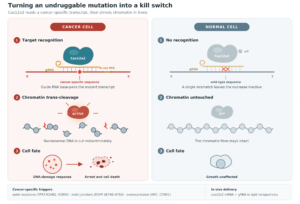
Cas12a2 turns a cancer-specific transcript into a kill switch. In a cancer cell, the guide RNA base-pairs with a mutant or overexpressed transcript and switches on the nuclease, which then cuts nucleosomal DNA indiscriminately; the resulting DNA damage drives cell-cycle arrest and death. In a normal cell, a single mismatch with the wild-type transcript leaves the nuclease inactive, chromatin intact and growth unaffected.

Future impact

The approach is programmable: reaching a new target means writing a new guide, not designing a new drug. That points well beyond the mutations we tested. Nearly every tumour driven by a TP53 mutation keeps expressing the mutant transcript in essentially every cell, so a trigger of this kind sidesteps the heterogeneity that limits many targeted therapies. And because Cas12a2 processes its own guide array, several transcripts could be targeted in one delivery, limiting escape through loss of any single one.
.
Read more in Nature.

.

.
Jump to section

4. Targeting cancer-specific mutations with RNA-triggered chromatin shredding

  • 1. MYC binding to nascent RNA suppresses innate immune signaling by R-loop-derived RNA-DNA hybrids
  • 2. A technical comparison of spatial transcriptomics platforms across six cancer types
  • 3. AI-predicted spatial transcriptomics unlocks breast cancer biomarkers from pathology
  • 4. Targeting cancer-specific mutations with RNA-triggered chromatin shredding
  • 5. Plasma signals of lung tumor promotion for molecular cancer prevention
  • 6. First-in-human testing of a mutant KRAS vaccine for pancreatic cancer interception in high-risk cohorts
Page 4 of 6
Previous 123456 Next
Tags: EACR Top Ten Cancer Research PublicationsHighlights in Cancer Research

Related Posts

VIDEO | Rapid and accurate pan-cancer subtyping using RNA-sequencing

VIDEO | Rapid and accurate pan-cancer subtyping using RNA-sequencing

July 23, 2026

Click above to watch On 20 July 2026, the EACR hosted a webinar in collaboration with Oxford Nanopore Technologies, one of our valued EACR Industry Partners....

Scientific Highlights from ‘Cancer Genomics, Multiomics and Computational Biology’ 2026

Scientific Highlights from ‘Cancer Genomics, Multiomics and Computational Biology’ 2026

July 15, 2026

The EACR's Cancer Genomics, Multiomics and Computational Biology conference (Essen, 12–14 May 2026) centred on integrating high-resolution genomic and multi-omic data with advanced computational and AI-driven...

EACR 2026 Annual Congress in review: “Exceptional networking opportunities and invaluable knowledge sharing”

EACR 2026 Annual Congress in review: “Exceptional networking opportunities and invaluable knowledge sharing”

August 3, 2026

We were delighted to welcome the cancer research community to Budapest, Hungary for the EACR Annual Congress 2026: Innovative Cancer Science between 08 - 11 June...

The Cancer Researcher EACR logo

About Us

The Cancer Researcher is an online magazine for the cancer research community from the European Association for Cancer Research.

The EACR, a registered charity, is a global community for those working and studying in cancer research. Our mission is “The advancement of cancer research for the public benefit: from basic research to prevention, treatment and care.”

Advertisement Advertisement Advertisement
ADVERTISEMENT

RECENT POSTS

Highlights in Cancer Research: September 2026
Highlights in Cancer Research

Highlights in Cancer Research: September 2026

September 9, 2026
“Encouraged me to approach my research from a broader perspective”: Gohar Sevoyan’s Travel Fellowship
Community

“Encouraged me to approach my research from a broader perspective”: Gohar Sevoyan’s Travel Fellowship

September 8, 2026
The Cancer Researcher

© 2025 EACR

Navigate site

  • About
  • Privacy
  • Main EACR website

Follow us

No Result
View All Result
  • Home
  • About
  • The Cancer Researcher Podcast
  • #KeepResearchCurious

© 2025 EACR