
The Cancer Researcher
  • Home
  • About
  • The Cancer Researcher Podcast
  • #KeepResearchCurious
No Result
View All Result
  • Home
  • About
  • The Cancer Researcher Podcast
  • #KeepResearchCurious
No Result
View All Result
The Cancer Researcher
No Result
View All Result

Highlights in Cancer Research: December 2025

December 8, 2025
Highlights in Cancer Research: November 2022

The EACR’s ‘Highlights in Cancer Research’ is a regular summary of the most interesting and impactful recent papers in cancer research, curated by the Board of the European Association for Cancer Research (EACR).

The list below appears in no particular order, and the summary information has been provided by the authors unless otherwise indicated.

Use the dropdown menu or ‘Previous’ and ‘Next’ buttons to navigate the list.


7. Nerve-to-cancer transfer of mitochondria during cancer metastasis

  • 1. Long-Term Latency of Highly Mutated Cells in Normal Mouse Skin Is Reversed by Exposure to Tumor Promoters and Chronic Tissue Damage
  • 2. PPP2R1A mutations portend improved survival after cancer immunotherapy
  • 3. Neutrophils physically interact with tumor cells to form a signaling niche promoting breast cancer aggressiveness
  • 4. Spatial mapping of transcriptomic plasticity in metastatic pancreatic cancer
  • 5. Impaired T cell and neoantigen retention in time-serial analysis of metastatic non-small cell lung cancer in patients unresponsive to TIL cell therapy
  • 6. The source of dietary fat influences anti-tumour immunity in obese mice
  • 7. Nerve-to-cancer transfer of mitochondria during cancer metastasis
  • 8. Stromal lipid species dictate melanoma metastasis and tropism
  • 9. TIM3+ breast cancer cells license immune evasion during micrometastasis outbreak
  • 10. IL-17A-secreting γδ T cells promote resistance to CDK4/CDK6 inhibitors in HR+HER2- breast cancer via CX3CR1+ macrophages
Previous
Next

Hoover, G. et al. Nature. 644: 252–262. (2025).

doi: 0.1038/s41586-025-09176-8.

Summary of the findings

This study reveals that nerves metabolically support cancer progression by directly transferring mitochondria to tumor cells. Using neuron–cancer cocultures and in vivo lineage tracing, we show that neuronal mitochondria integrate into cancer cells, enhancing their respiratory capacity, stemness phenotype, and oxidative metabolism associated with improved redox balance and survival under common metastatic stressors such as oxidative and shear stresses. Chemical denervation with Botox in situ demonstrates the prevalence of these transfers in vivo and confirms that neural input is essential for maintaining cancer cell bioenergetics. Using the MitoTRACER genetic engineering approach, which permanently labels the transfer of mitochondria between cells and enables their fate to be tracked in vivo, we identified a distinct population of “recipient” cancer cells that are significantly enriched at metastatic sites, confirming that mitochondrial transfer provides a selective advantage during dissemination. Together, these findings identify the nerve–cancer interface as a key metabolic conduit that fuels metastasis and introduce MitoTRACER as a powerful tool to trace organelle exchange both in vitro and in complex tissues. By uncovering how Botox-induced denervation disrupts this mitochondrial support, this work establishes a conceptual and therapeutic framework to target cancer metabolism through neural modulation.

.
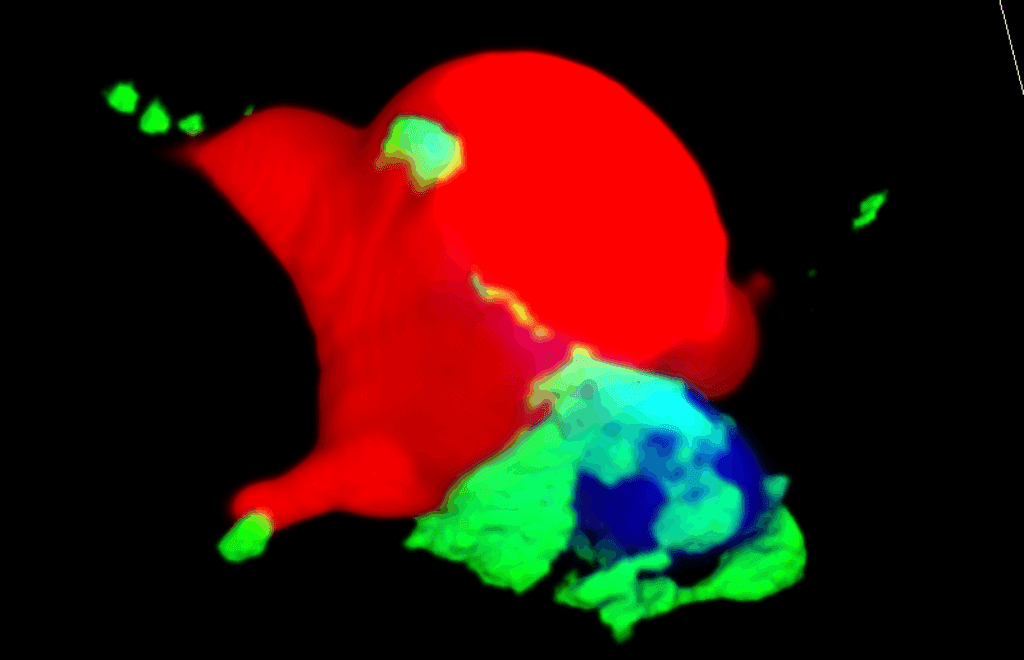
3D confocal reconstruction of nerve-to-cancer mitochondria transfer. High-resolution confocal imaging of a dorsal root ganglion (DRG) neuron expressing fluorescently labeled mitochondria (green) in coculture with breast cancer cells (red). The 3D reconstruction reveals the physical transfer of neuronal mitochondria into adjacent cancer cells through direct neuron–tumor contacts. Individual mitochondrial structures are visualized within the cytoplasm of the recipient cancer cells, confirming the intercellular transfer of the organelles.

.

Future impact

This study establishes a new understanding of metastatic dissemination by revealing that neuronal mitochondria transfer fuels the metabolic fitness required for cancer spread. Previous approaches could not conditionally and permanently label these transfer events or distinguish recipient from naïve cancer cells. The MitoTRACER system overcomes this limitation, enabling the long-term tracking of recipient cells and the identification of those that seed metastases. By targeting this nerve–cancer metabolic axis through Botox denervation or inhibition of mitochondrial transfer, metastasis could be selectively restrained. This work redefines metastasis as a neuro-metabolic process amenable to therapeutic modulation.


.Read more in Nature
.

7. Nerve-to-cancer transfer of mitochondria during cancer metastasis

  • 1. Long-Term Latency of Highly Mutated Cells in Normal Mouse Skin Is Reversed by Exposure to Tumor Promoters and Chronic Tissue Damage
  • 2. PPP2R1A mutations portend improved survival after cancer immunotherapy
  • 3. Neutrophils physically interact with tumor cells to form a signaling niche promoting breast cancer aggressiveness
  • 4. Spatial mapping of transcriptomic plasticity in metastatic pancreatic cancer
  • 5. Impaired T cell and neoantigen retention in time-serial analysis of metastatic non-small cell lung cancer in patients unresponsive to TIL cell therapy
  • 6. The source of dietary fat influences anti-tumour immunity in obese mice
  • 7. Nerve-to-cancer transfer of mitochondria during cancer metastasis
  • 8. Stromal lipid species dictate melanoma metastasis and tropism
  • 9. TIM3+ breast cancer cells license immune evasion during micrometastasis outbreak
  • 10. IL-17A-secreting γδ T cells promote resistance to CDK4/CDK6 inhibitors in HR+HER2- breast cancer via CX3CR1+ macrophages
Previous
Next


Tags: EACR Top Ten Cancer Research PublicationsHighlights in Cancer Research

Related Posts

“The best scientific event I have ever participated in”: Rafaela’s EACR Travel Grant leads to new opportunities

“The best scientific event I have ever participated in”: Rafaela’s EACR Travel Grant leads to new opportunities

April 20, 2026

The EACR, AACR, and The Mark Foundation for Cancer Research recently teamed up to offer a number of travel grants to help EACR or AACR members...

VIDEO | Streamlining Tumour Interpretation with the Cancer Genome Interpreter

VIDEO | Streamlining Tumour Interpretation with the Cancer Genome Interpreter

April 22, 2026

https://www.youtube.com/watch?v=KdMqmIIgNYo Click above to watch On 9 April 2026, the EACR hosted a free webinar bringing together leading experts to explore the Cancer Genome Interpreter (CGI)...

Patients Shaping Cancer Research – Episode 31 of The Cancer Researcher Podcast

Patients Shaping Cancer Research – Episode 31 of The Cancer Researcher Podcast

April 13, 2026

What does it take to bridge the gap between researchers and patients? In this episode, scientists, oncologists, and patient advocates from Canada, the United States, and...

The Cancer Researcher EACR logo

About Us

The Cancer Researcher is an online magazine for the cancer research community from the European Association for Cancer Research.

The EACR, a registered charity, is a global community for those working and studying in cancer research. Our mission is “The advancement of cancer research for the public benefit: from basic research to prevention, treatment and care.”

RECENT POSTS

“The best scientific event I have ever participated in”: Rafaela’s EACR Travel Grant leads to new opportunities
Community

“The best scientific event I have ever participated in”: Rafaela’s EACR Travel Grant leads to new opportunities

April 20, 2026
VIDEO | Streamlining Tumour Interpretation with the Cancer Genome Interpreter
Features

VIDEO | Streamlining Tumour Interpretation with the Cancer Genome Interpreter

April 22, 2026
The Cancer Researcher

© 2025 EACR

Navigate site

  • About
  • Privacy
  • Main EACR website

Follow us

No Result
View All Result
  • Home
  • About
  • The Cancer Researcher Podcast
  • #KeepResearchCurious

© 2025 EACR