The EACR’s ‘Highlights in Cancer Research’ is a regular summary of the most interesting and impactful recent papers in cancer research, curated by the Board of the European Association for Cancer Research (EACR).
The list below appears in no particular order, and the summary information has been provided by the authors unless otherwise indicated.
Use the dropdown menu or ‘Previous’ and ‘Next’ buttons to navigate the list.
3. Neutrophils physically interact with tumor cells to form a signaling niche promoting breast cancer aggressiveness
Camargo, S., Moskowitz., O. et al. Nature. 6: 540-558. (2025).
doi: 10.1038/s43018-025-00924-3.
Summary of the findings
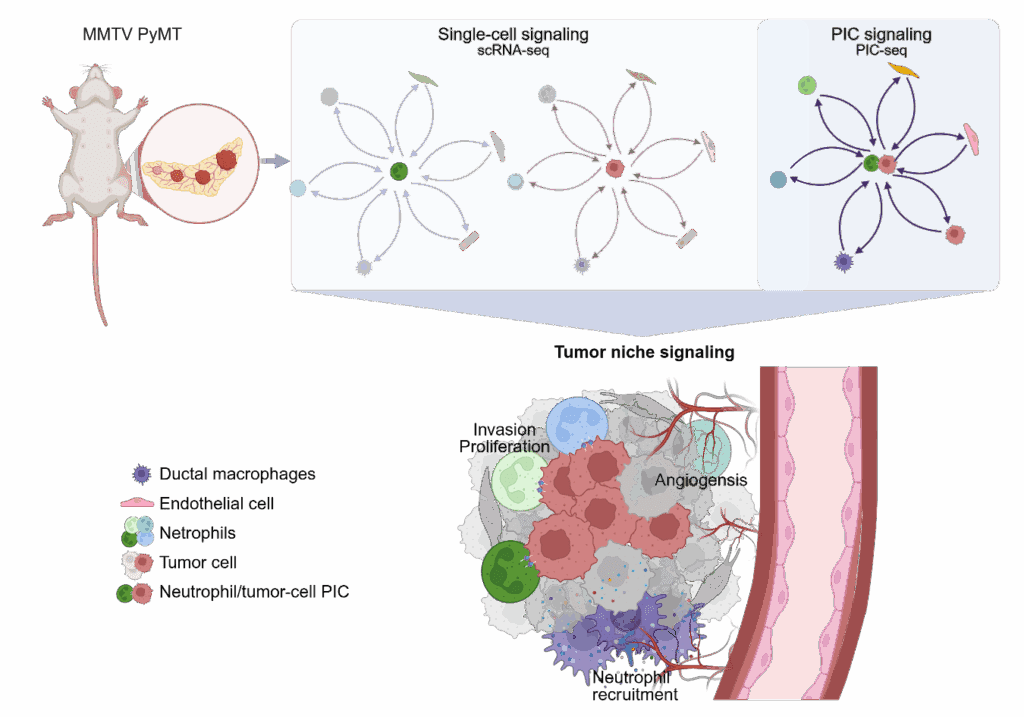
During cancer progression, intercellular communication forms complex signaling networks that sustain tumor growth. As the mammary gland undergoes ongoing tissue reorganization during physiology, the MMTV-PyMT mouse model was used to explore cellular and molecular dynamics across developmental stages and during carcinogenesis. By investigating secreted and physical interactions in the breast tumor microenvironment (TME), this study identified neutrophil-tumor cell physical interaction as a key driver of breast cancer aggressiveness. An integrative approach combining Ligand-Receptor analysis from single-cell RNA sequencing (scRNA-seq) with physically interacting cell sequencing (PIC-seq) data enabled construction of intercellular signaling networks under normal and malignant conditions.
.
The analysis revealed that neutrophils display heterogeneous and dynamic transcriptional states. They appear during early mammary gland development and re-emerge during carcinogenesis in association with tumor cells. Interaction maps uncovered a perivascular signaling niche where neutrophils are recruited by tumor-associated macrophages and physically interact with tumor cells. These interactions induce cancer cell proliferation, invasiveness, and angiogenesis. Notably, molecular signatures exclusively expressed by the TME-neutrophils and induced by their physical interaction with tumor cells were linked with poorer survival of patients with advanced breast cancer. Overall, these findings reveal an unrecognized mechanism of neutrophils sustaining mammary oncogenesis and highlight neutrophil-related therapeutic targets and biomarkers.
.
Intercellular interaction analysis using scRNA-seq, PIC-seq, and functional validations uncover a perivascular niche where neutrophils induce pro-tumoral activity in the breast TME via physical interaction with tumor cells. Created in BioRender. Graupera, M. (2025) https://BioRender.com/
.
Future impact
This study advances understanding of breast cancer biology by uncovering a novel mechanism through which neutrophils contribute to tumor progression. By defining the physical and secreted intercellular signals derived from neutrophil-tumor crosstalk, it establishes a new framework for studying the tumor microenvironment. The study also uncovers neutrophil heterogeneity and stage-specific transcriptional states, providing insight into both neutrophil biology and breast cancer dynamics, therefore highlighting molecular signatures as potential biomarkers of poor prognosis. Therapeutically, targeting the recruitment or signaling functions of neutrophils may represent a promising strategy to disrupt tumor-supportive niches and improve patient outcomes.
Magdalena Sznurkowska was the 2024 recipient of an EACR-AstraZeneca Postdoctoral Fellowship, funding that is awarded for a period of up to three years to support excellent...
" provided practical insights into leadership, communication, negotiation, and career development that directly align with the challenges of establishing and leading an independent multidisciplinary research program....
About Us
The Cancer Researcher is an online magazine for the cancer research community from the European Association for Cancer Research.
The EACR, a registered charity, is a global community for those working and studying in cancer research. Our mission is “The advancement of cancer research for the public benefit: from basic research to prevention, treatment and care.”


 Summary of the findings
 Summary of the findings