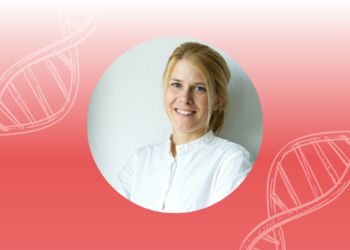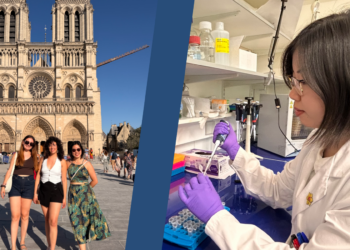

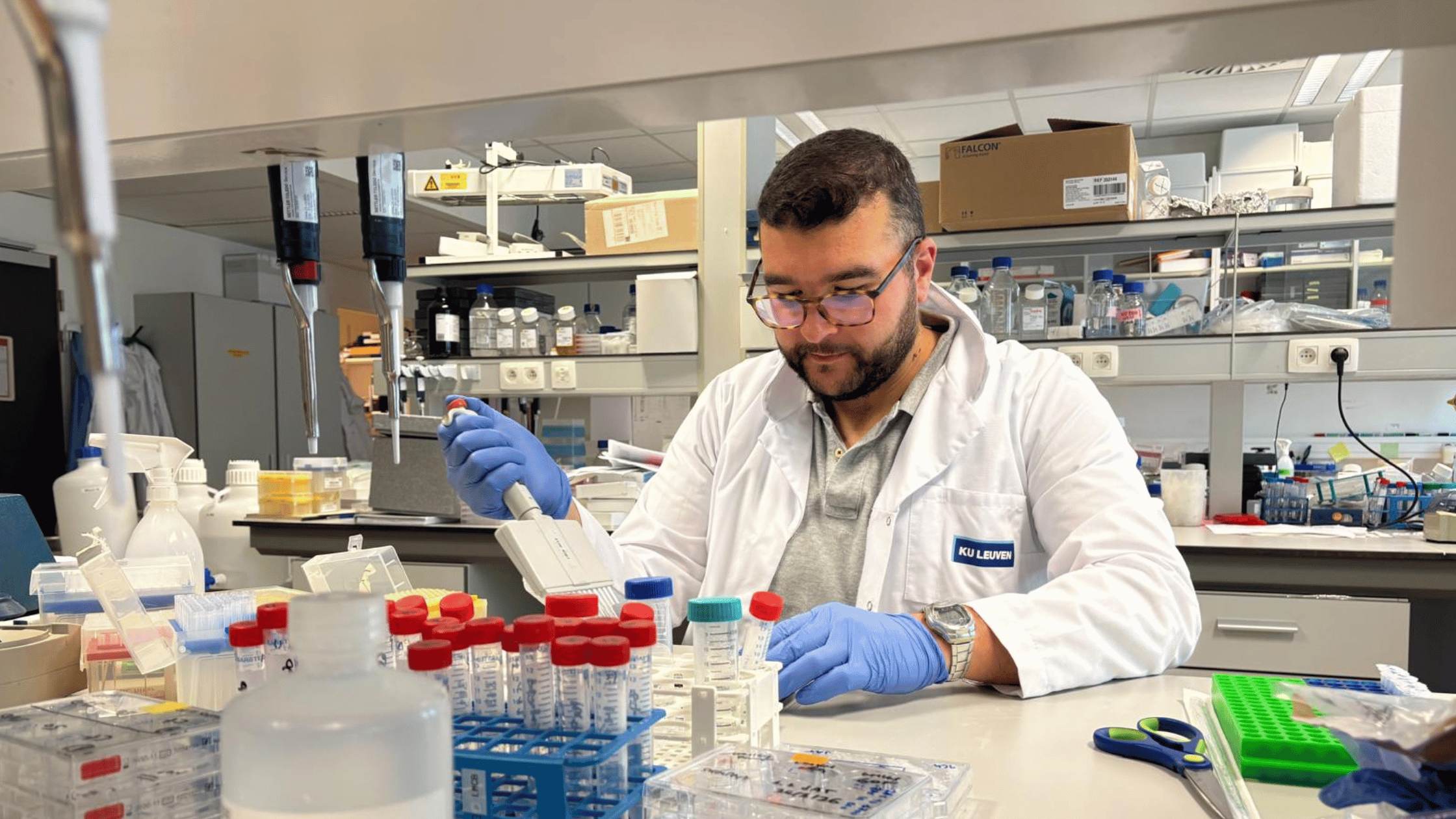
José Antonio Torres Alcaide is a PhD student at the Spanish National Cancer Research Center (CNIO) who received an EACR Travel Fellowship to visit and work at the VIB-KU Leuven Center for Cancer Biology in Belgium from March to May 2026.
The EACR, with support from Worldwide Cancer Research, provides Travel Fellowships of up to €3,500 to enable early-career cancer researchers to gain new skills through a short-term visit to a lab or research group in another country.
You can read about other Travel Fellows and their experiences here.
Tell us a little bit about your research.
My research focuses on blocking a protein called MIDKINE (MDK), which helps cancer spread and hides tumours from the immune system. We study this primarily in melanoma, one of the most aggressive skin cancers, where MDK plays a key role in metastasis and resistance to immunotherapy. To do this, I have tested multiple approaches, from drugs that stop the protein being made or released, to specially designed antibodies, and most recently, AI-generated minibinders that block MDK with greater precision. The ultimate goal is that by inhibiting this protein, we could make immunotherapy work better and prevent cancer from becoming resistant to treatment, opening the door to broader applications across multiple tumour types and inflammatory diseases.
Why did you decide to apply for an EACR Travel Fellowship?
I applied because I saw it as an outstanding opportunity to fund my research stay at the VIB–KU Leuven Center for Cancer Biology. The EACR is one of the most prestigious scientific societies in Europe, with an exceptional track record in supporting and disseminating cancer research. Being awarded an EACR fellowship carries real scientific recognition, and I felt it would be a meaningful addition to my career development.
Why did you choose the host lab?
Choosing their lab was therefore a straightforward decision: if you want to learn about melanoma plasticity in Europe, there is no better place.
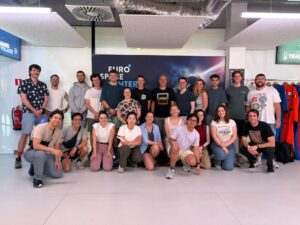
The Marine laboratory is one of the world’s leading groups in tumour plasticity research, particularly in melanoma. In our home lab, we have long followed their work on melanoma cell state dynamics, therapy response, and immunotherapy resistance; they are a global reference. Choosing their lab was therefore a straightforward decision: if you want to learn about melanoma plasticity in Europe, there is no better place.
My home institution (Spanish National Cancer Research Center (CNIO), Spain) and my host lab (VIB-KU Leuven Center for Cancer Biology, Belgium) were similar in many ways, but the ecosystem around VIB–KU Leuven CCB is particularly rich. The proximity and tight collaboration between research institutes, the university, and clinical hospitals creates a highly translational environment.
I appreciate that VIB–KU Leuven organised events such as social hours and gatherings within the research centre, and that I had the great opportunity to live in the UNESCO World Heritage Groot Begijnhof of Leuven. The location itself was a highlight, as the site regularly hosted community gatherings and concerts, which gave me a real sense of belonging to the local community.
Can you summarise the research you did or what you learned on your visit?
During my stay at the Marine laboratory, I investigated the roles of Midkine (MDK) and Pleiotrophin (PTN) in melanoma cell state dynamics. Using a panel of human melanoma cell lines spanning the full spectrum from melanocytic to mesenchymal states, I characterised MDK and PTN expression and performed gain- and loss-of-function experiments to assess their impact on cell state identity markers.
I also received hands-on training in two cutting-edge technologies developed in the lab: ORIGAMI, a flow cytometry-based morphometric assay that tracks cancer cell state diversity and therapy-induced plasticity using two biophysical parameters; and a genetic dual-reporter system using synthetic locus control regions to monitor melanoma cell state transitions. Finally, I leveraged patient-derived single-cell datasets to interrogate MDK and PTN expression in the context of immunotherapy response. The visit provided key scientific insights and a powerful methodological toolkit to be implemented at my home institution.
Describe a ‘typical day’ on your visit.
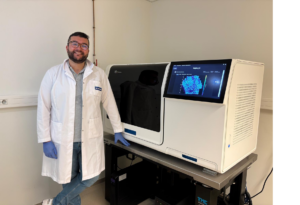
A typical day began with a scientific discussion with Hadrien de Blander, the postdoctoral researcher who guided me throughout the visit. We would review the latest results and plan the next experimental steps together. The rest of the day was usually spent in the cell culture lab, performing flow cytometry, or working at the confocal microscope. I also had the opportunity to learn from other ongoing projects in the lab, including patient sample processing and single-cell analyses, which broadened my perspective considerably.
Did you have a personal mentor or anyone who particularly helped you?
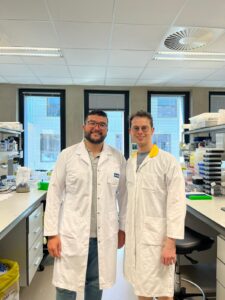
Hadrien de Blander was my main guide throughout the three months. He is the first author of the paper describing ORIGAMI as a platform for morphometric-based melanoma plasticity studies, so learning directly from him was exceptional. Beyond his technical expertise, what struck me most was his passion for science, his relentless curiosity and genuine love for discovery were truly contagious and had a lasting effect on how I approach my own work.
How has the trip inspired you in your research and career?
The visit represented a complete shift in how I think about research. Being exposed to scientists from different backgrounds and hearing diverse scientific opinions helped me view my own project from new angles. The Marine lab culture is characterised by constant intellectual exchange and a continuous flow of ideas, something I have actively tried to bring back to my daily lab life. It reinforced the value of openness and collaborative thinking.
For my research, it has opened exciting new directions within my doctoral work. Integrating the concept of melanoma cell states into my thesis adds significant depth and creates a new experimental framework in which I can validate the MDK inhibitors I have been developing. For my career, experiencing a world-class research environment, observing how a leading group operates, and building an international network have been among the most enriching outcomes of the entire visit.
Is there anything else you’d like to mention?
I would like to highlight that the experience was exceptional both scientifically and personally. One remarkable aspect of the Marine lab is its cultural diversity, the team brought together people from across Europe and beyond, including Mexico, creating an environment rich in different perspectives and experiences. That multicultural atmosphere was genuinely inspiring.
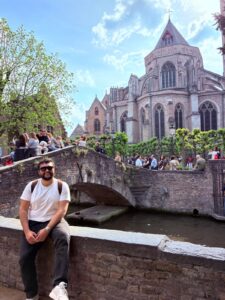
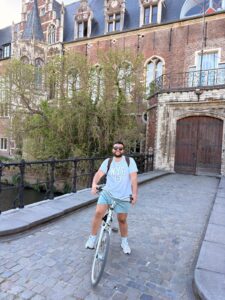
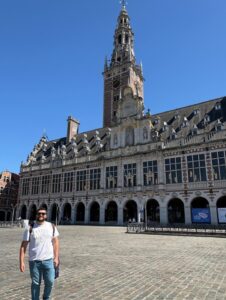
On a personal level, the visit also gave me the chance to explore Belgium and discover its remarkable beauty, its historic cities, green landscapes, and rich culture. This experience has forged a real connection with the country, and I am certain I will return.
Want to find out more?

If you are interested in applying for the Travel Fellowship scheme, please click here for more information: EACR Travel Fellowships