
The Cancer Researcher
  • Home
  • About
  • The Cancer Researcher Podcast
  • #KeepResearchCurious
No Result
View All Result
  • Home
  • About
  • The Cancer Researcher Podcast
  • #KeepResearchCurious
No Result
View All Result
The Cancer Researcher
No Result
View All Result

Highlights in Cancer Research: December 2025

December 8, 2025
Highlights in Cancer Research: November 2022

The EACR’s ‘Highlights in Cancer Research’ is a regular summary of the most interesting and impactful recent papers in cancer research, curated by the Board of the European Association for Cancer Research (EACR).

The list below appears in no particular order, and the summary information has been provided by the authors unless otherwise indicated.

Use the dropdown menu or ‘Previous’ and ‘Next’ buttons to navigate the list.


4. Spatial mapping of transcriptomic plasticity in metastatic pancreatic cancer

  • 1. Long-Term Latency of Highly Mutated Cells in Normal Mouse Skin Is Reversed by Exposure to Tumor Promoters and Chronic Tissue Damage
  • 2. PPP2R1A mutations portend improved survival after cancer immunotherapy
  • 3. Neutrophils physically interact with tumor cells to form a signaling niche promoting breast cancer aggressiveness
  • 4. Spatial mapping of transcriptomic plasticity in metastatic pancreatic cancer
  • 5. Impaired T cell and neoantigen retention in time-serial analysis of metastatic non-small cell lung cancer in patients unresponsive to TIL cell therapy
  • 6. The source of dietary fat influences anti-tumour immunity in obese mice
  • 7. Nerve-to-cancer transfer of mitochondria during cancer metastasis
  • 8. Stromal lipid species dictate melanoma metastasis and tropism
  • 9. TIM3+ breast cancer cells license immune evasion during micrometastasis outbreak
  • 10. IL-17A-secreting γδ T cells promote resistance to CDK4/CDK6 inhibitors in HR+HER2- breast cancer via CX3CR1+ macrophages
Previous
Next

Pei, G., Min, J. et al. Nature. 642: 212–221. (2025).
doi: 10.1038/s41586-025-08927-x.

Summary of the findings

Pancreatic cancer remains one of the most lethal malignancies, largely due to its propensity for systemic dissemination and its profound cellular heterogeneity. Despite these challenges, the mechanisms by which tumour cells adapt to diverse metastatic niches and evade immune surveillance have remained elusive, particularly from a spatial perspective. In this study, we applied spatial transcriptomics to a uniquely valuable cohort of primary tumours and multi-organ metastases obtained through rapid autopsy. By mapping clonal architecture, lineage plasticity, and tumour microenvironmental features, we delineated striking site-specific transcriptional adaptations, including pronounced intra-patient distinctions between liver and lung metastases. Notably, even within the same organ – most prominently in the liver – clonal architecture and lineage plasticity often diverged across metastatic foci, underscoring the remarkable heterogeneity of tumour dissemination. Importantly, the study identified a robust association between basal-like tumour states and TGFB1-expressing myofibroblastic cancer-associated fibroblasts (myCAFs), which orchestrate plasma-cell exclusion through CXCR4–CXCL12 signaling. Validation across patient-derived organoids and cross-species models further underscored the dynamic crosstalk between tumour lineages and their stromal ecosystems. These insights not only reveal the profound spatial heterogeneity underlying therapy-refractory pancreatic cancer but also highlight stromal-tumour interactions as actionable vulnerabilities for future therapeutic development.
.
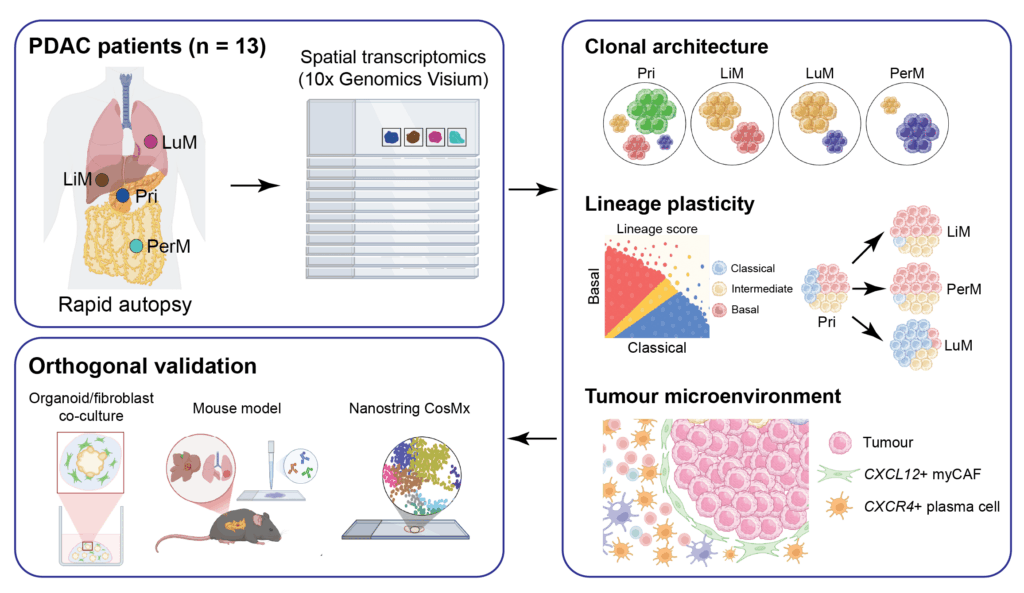
Schematic overview of the study. The cohort consists of primary pancreatic ductal adenocarcinoma (PDAC) and matched liver (LiM), lung (LuM), and peritoneal (PerM) metastases from 13 patients. We investigated transcriptomic heterogeneity by analyzing clonal architecture, lineage plasticity, and the tumor microenvironment. Our findings were cross-validated through orthogonal approaches, including organoid/fibroblast co-culture, an autochthonous mouse model, and a separate spatial molecular imaging platform (CosMx).

.

Read more in Nature
.

4. Spatial mapping of transcriptomic plasticity in metastatic pancreatic cancer

  • 1. Long-Term Latency of Highly Mutated Cells in Normal Mouse Skin Is Reversed by Exposure to Tumor Promoters and Chronic Tissue Damage
  • 2. PPP2R1A mutations portend improved survival after cancer immunotherapy
  • 3. Neutrophils physically interact with tumor cells to form a signaling niche promoting breast cancer aggressiveness
  • 4. Spatial mapping of transcriptomic plasticity in metastatic pancreatic cancer
  • 5. Impaired T cell and neoantigen retention in time-serial analysis of metastatic non-small cell lung cancer in patients unresponsive to TIL cell therapy
  • 6. The source of dietary fat influences anti-tumour immunity in obese mice
  • 7. Nerve-to-cancer transfer of mitochondria during cancer metastasis
  • 8. Stromal lipid species dictate melanoma metastasis and tropism
  • 9. TIM3+ breast cancer cells license immune evasion during micrometastasis outbreak
  • 10. IL-17A-secreting γδ T cells promote resistance to CDK4/CDK6 inhibitors in HR+HER2- breast cancer via CX3CR1+ macrophages
Previous
Next


Tags: EACR Top Ten Cancer Research PublicationsHighlights in Cancer Research

Related Posts

How the EACR Congress inspired translational innovation and the launch of a spin-out company

How the EACR Congress inspired translational innovation and the launch of a spin-out company

May 14, 2026

EACR member Munitta Muthana provides some insight into her team’s experience at EACR 2025 in Lisbon, and how it catalysed the momentum and vision for their...

How Nerves Shape Cancer: From Energy Rewiring to Metastasis – Episode 32 of The Cancer Researcher Podcast

How Nerves Shape Cancer: From Energy Rewiring to Metastasis – Episode 32 of The Cancer Researcher Podcast

May 11, 2026

In recent years, the neuronal component of the cancer microenvironment and the metabolic plasticity of cancer cells have become increasingly recognised as essential for cancer progression....

Highlights in Cancer Research: November 2022

Highlights in Cancer Research: April 2026

April 28, 2026

The EACR's 'Highlights in Cancer Research' is a regular summary of the most interesting and impactful recent papers in cancer research, curated by the Board of...

The Cancer Researcher EACR logo

About Us

The Cancer Researcher is an online magazine for the cancer research community from the European Association for Cancer Research.

The EACR, a registered charity, is a global community for those working and studying in cancer research. Our mission is “The advancement of cancer research for the public benefit: from basic research to prevention, treatment and care.”

Advertisement Advertisement Advertisement
ADVERTISEMENT

RECENT POSTS

How the EACR Congress inspired translational innovation and the launch of a spin-out company
Career

How the EACR Congress inspired translational innovation and the launch of a spin-out company

May 14, 2026
“This technique is highly complex and would not have been possible to perform in my lab”: María Martínez Fernández’s EACR Travel Fellowship
Community

“This technique is highly complex and would not have been possible to perform in my lab”: María Martínez Fernández’s EACR Travel Fellowship

May 12, 2026
The Cancer Researcher

© 2025 EACR

Navigate site

  • About
  • Privacy
  • Main EACR website

Follow us

No Result
View All Result
  • Home
  • About
  • The Cancer Researcher Podcast
  • #KeepResearchCurious

© 2025 EACR