
We met in Budapest, Hungary for the EACR 2026 Congress between 08-11 June 2026. This EACR conference covered a wide array of topics across the spectrum of cancer research, including: ageing and cancer, biological rhythms and its impact on cancer therapy, cell death mechanisms, genomic instability, mechanisms of tumour metastasis, tumour heterogeneity at the single cell level, and much more on further cutting-edge topics. Watch our video recap here!
Supported by Worldwide Cancer Research, we were delighted to award 50 Travel Grants to help cancer researchers in need of financial assistance to attend the event.
Scroll through our Travel Grant award winners’ personal excerpts below.
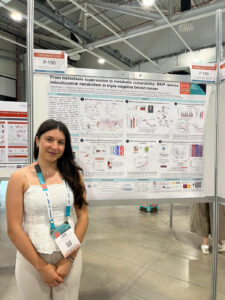
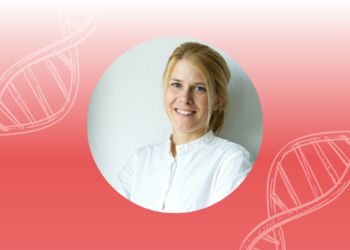
Joana Filipa Barbosa Pinheiro: Receiving the EACR Travel Grant was incredibly important because it made it possible for me to attend this congress. One of the highlights of the meeting was having the opportunity to present my work during the Spotlight Poster Session. It was an exciting experience that allowed me to discuss my research with many researchers, receive valuable feedback, and connect with other early-career scientists. Together with the inspiring talks, networking opportunities, and the chance to explore Budapest, it made this a truly memorable experience. I am very grateful to the EACR for making this possible and for supporting early-career researchers like me.
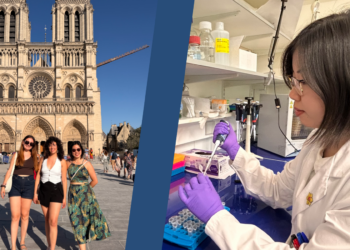
Yasemin Öztemur Islakoğlu: One of the most valuable aspects of the travel grant was that the application process was straightforward and the funding was provided in advance. Receiving the financial support before the congress made attendance much more accessible and significantly reduced the financial burden, allowing me to focus entirely on the scientific and networking opportunities the meeting offered. I had the opportunity to meet friends and collaborators from different laboratories.
Overall, the congress was a highly valuable experience both scientifically and personally. It broadened my perspective on cancer research and strengthened my motivation to continue working in this field. The travel grant made it possible for me to attend this international meeting, which would otherwise have been difficult, and I am very very grateful for this support.
Siti Munira Abd Jalil: I would like to express my sincere gratitude to EACR for providing the travel grant that made my attendance possible. As a researcher from Malaysia, the opportunity to participate in a major international cancer research congress was both professionally valuable and personally meaningful. It allowed me to present my work on an international stage, learn from leading experts in the field, and connect with researchers from around the world.
The experience also came at an important stage in my career, as I recently completed my PhD and am transitioning towards leading larger cancer research initiatives within the Ministry of Health Malaysia. Attending the congress reinforced my motivation to pursue impactful, collaborative research and reminded me of the importance of contributing to the global effort to improve outcomes for people affected by cancer. I am grateful to have been part of such an inspiring and supportive scientific community.
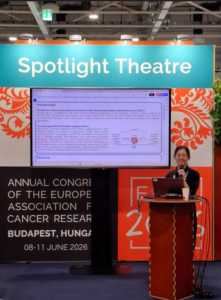
Yihan Xu: I found the “Meet the Editors Panel Discussion” to be one of the most valuable sessions of the congress. As an early-career researcher, it was very helpful to learn about the priorities and decision-making processes of different journals, as well as their views on the use of AI in data analysis and manuscript writing. The discussion also provided insight into how journals are working to improve the peer-review process and reduce long turnaround times.
One topic that particularly caught my attention was the development of AI tools to detect AI-generated figures. As AI becomes increasingly powerful, I think such tools will be important for maintaining research integrity and preventing the scientific community from being misled by fabricated or manipulated results.
Tong Zhao: I found the Industry Exhibition very useful. I spoke with specialists from different companies, especially those providing sequencing-related products and services. These conversations helped me realise that different technologies are not simply interchangeable tools; they often reflect different research priorities, such as resolution, throughput, sample requirements, cost, cell-type specificity or clinical relevance.
This gave me a more practical understanding of how technical choices can shape experimental design and influence the type of biological conclusions that can be drawn. It also helped me think more broadly about my own future direction, both in terms of research planning and in understanding the connection between academic cancer research and the biomedical industry.
Wendy Montero: I am so grateful to the EACR because this congress truly changed my life, my perspectives and motivated me even more to continue in cancer research. I had the opportunity to exchange contacts that will possibly allow me to apply for a postdoc position in the future and continue the process I’m currently on. I feel very fortunate to have been able to attend the congress.
Guilherme Faria Nadaline: I would like to thank the EACR for the travel grant, which covered my travel and accommodation and so made my full participation possible. Attending the EACR 2026 Congress has had an overwhelmingly positive impact on my work and on my professional development — through the exposure and the conversations it gave me, but also through the new possibilities it has opened up for my research. I look forward to attending the next EACR Congress in Bilbao.