
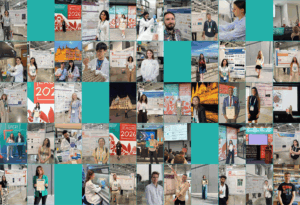
We met in Budapest, Hungary for the EACR 2026 Congress between 08-11 June 2026. This EACR conference covered a wide array of topics across the spectrum of cancer research, including: ageing and cancer, biological rhythms and its impact on cancer therapy, cell death mechanisms, genomic instability, mechanisms of tumour metastasis, tumour heterogeneity at the single cell level, and much more on further cutting-edge topics. Watch our video recap here!
Supported by Worldwide Cancer Research, we were delighted to award 50 Travel Grants to help cancer researchers in need of financial assistance to attend the event.
Scroll through our Travel Grant award winners’ personal excerpts below.
Davey Li: The opportunities to discuss and connect with speakers and other attendees was one of my favourite aspects of the congress. The EACR 2026 congress fostered a collaborative infrastructure despite having so many attendees from many countries. The small table networking session discussing how to navigate being a physician-scientist with Dr. Daniel Kirschenbaum as well having the opportunity to discuss single-cell and spatial atlasing approaches with Dr. Moritz Mall were definitely some of my highlights. I also really enjoyed the early career session as it provided an opportunity to meet other researchers at my training level allowing us to develop friendships that deepened as we attended the congress and explored Budapest together.
Loan Vulliard: The congress social event was a real highlight. I reconnected with multiple former colleagues and acquaintances, and it was lovely to catch up on where our respective paths have led and how it brought us each to cancer research. I also spent time with colleagues from my current institute, the DKFZ, which is often harder to do at home than at a meeting abroad. The leadership session by Arkaitz Carracedo was valuable for networking of a different kind: his frank discussion of mentoring, hiring for attitude and adapting one’s leadership style gave me concrete language for conversations about building a group, which is exactly where my career is heading.
Federica Spaggiari: I really enjoyed the networking event for early career researchers which took place on the first day of the congress. It was a great opportunity to meet people at a similar career stage and to discuss our achievements as well as our struggles trying to find our future path. The moderator gave us great advice on how to deal with insecurities, manage the workload, and keep our motivation. At the end of the session, I felt truly enriched by the discussion and grateful for the people I had the chance to meet.
Klara Emily Ruth Ueberschär: I really enjoyed my poster session. I was able to have great conversations with potential collaborators that brought very insightful new ideas that could improve my project. When talking to the representatives of the different companies I was also able to explore some ideas further.
Monika Homolya: I met researchers working in the field I would like to continue in after my PhD, and I am also considering doing a short research internship before I finish my degree. It was great to learn about labs in other countries that I had not come across before and that are working on topics I am really passionate about. I exchanged contact information with several researchers and am planning to organize a short internship during the final year of my PhD.
Ebru Kırmızıay: One of the most valuable networking highlights was the opportunity to discuss my research with two professors from my home country, Türkiye. They showed genuine interest in my project and left the door open for possible PhD opportunities in the future, which was very encouraging for me. I also connected with researchers from abroad who work on malignant pleural mesothelioma or G2/M cell cycle regulation. We shared our experiences, discussed experimental challenges, and exchanged ideas on how we could improve our experimental approaches. Another memorable interaction was with the presenter of the poster displayed next to mine, who kindly shared mentor-like advice and personal experiences from academia. This conversation was especially encouraging and helped me feel more confident about continuing in research. Overall, these interactions gave me new perspectives and motivation for the next steps of my academic journey
Amen Shamim: The congress provided several valuable networking opportunities. As a bioinformatician, I found that my expertise complemented the predominantly biology-focused audience, with many researchers expressing interest in collaborating on multi-omics projects. Several attendees were also keen to connect because of our well-characterized patient cohort in MIBC, and I had productive discussions about potential future collaborations.
One of the highlights was presenting my poster. Although the formal poster sessions were scheduled for one hour in the morning and one hour in the evening, there was continuous interest throughout the day. Many researchers spent much time for discussing my work, making it difficult to leave my poster for extended periods. While it was a busy and demanding experience, it was extremely rewarding to see such strong interest in my research findings. The constructive discussions, positive feedback, and new professional connections made this one of the most valuable aspects of attending the congress.
Rungdawan Wongsamart: When I visited the posters, I met another researcher, Amen Shamim, from the University of Manchester. She is originally from Pakistan and then completed her master’s degree in Korea. I was impressed by her work in Mathematics and Bioinformatics. We had a long conversation about our research as well as our experiences as Asian women in Western academic environments and found that we shared many similar experiences. At the end of our conversation, she told me that if I ever have any omics data to analyze, she can provide guidance on how this would work – I really appreciated it.
Marin Bont: A memorable networking moment was unexpectedly meeting someone I knew from my time at UCSF, where I completed my final internship. It was great to reconnect and catch up over dinner. During our conversation, he told me about software he had developed to automatically measure the number of viable organoids during drug screening experiments. This tool could be highly valuable for our own research, as it addresses a challenge we currently face. We discussed potential applications for our work, and we are now exploring whether there are opportunities for future collaboration.
Valentina Rossi: The EACR congress offered me many valuable opportunities for networking. I connected with more than 20 new contacts on LinkedIn, including researchers working in my field as well as people from other scientific areas, both in academia and industry. I also had the opportunity to speak with company representatives and learn more about career paths outside academia. One of the most exciting highlights was meeting a leading expert in the protein family I study, who was very open to a potential collaboration. I also had several stimulating discussions with researchers during the poster sessions and was even offered a postdoctoral position in a very interesting group!
Yihan Xu: During the poster session, several researchers working on fibroblast heterogeneity visited my poster. We had in-depth discussions and shared some of our latest unpublished findings. I was surprised to discover that we had obtained similar results, some of which may challenge current views in the literature. These conversations increased my confidence in the robustness of my findings and helped identify research directions worth exploring further.
I also had the opportunity to ask a question during the tumour microenvironment symposium. The speaker was enthusiastic about the topic and shared details of a manuscript their group is currently preparing that directly addresses this question. This was a valuable networking opportunity and provided useful insight into ongoing developments in the field.
Ilaria Mengoli: I participated in the career development session, joining Dr. Maria M. Caffarel’s table which was discussing how to create interdisciplinary collaborations at early career stages. We had a very engaging discussion, and Dr. Caffarel was really open to listen to us. During the social dinner I took the opportunity to speak further with her, and I really appreciated her enthusiasm and support.
Florian Jokisch: A major networking highlight of the congress was the opportunity to meet a principal investigator from Spain whose work closely aligns with my own research interests. As we both study the same cancer type and share similar scientific questions, I was particularly eager to discuss my project, exchange ideas, and explore opportunities for collaboration. Our conversation led to discussions about applying for an EACR Collaborative Fellowship, which would allow me to visit his laboratory and develop joint research projects in the future. This potential collaboration is especially exciting because it could broaden my scientific expertise and strengthen my international research network. Furthermore, it may create opportunities for a future postdoctoral position in a research field that I am highly passionate about. As an early-career researcher, building such connections and exploring long-term collaborative opportunities is invaluable, making this one of the most meaningful outcomes of attending the congress.
Alex Jordan: The poster sessions were a fantastic way to meet and network with fellow cancer researchers from all around the world. I really enjoyed presenting my poster to peers, where I received lots of valuable feedback, but the main highlight was visiting everyone else’s posters! It’s incredibly interesting to see the range of important research being carried out around Europe and a real opportunity to learn and apply new ideas to my own project.