
The Cancer Researcher
  • Home
  • About
  • The Cancer Researcher Podcast
  • #KeepResearchCurious
No Result
View All Result
  • Home
  • About
  • The Cancer Researcher Podcast
  • #KeepResearchCurious
No Result
View All Result
The Cancer Researcher
No Result
View All Result

Highlights in Cancer Research: September 2026

September 9, 2026
Highlights in Cancer Research: September 2026

The EACR’s ‘Highlights in Cancer Research’ is a regular summary of the most interesting and impactful recent papers in cancer research, curated by the Board of the European Association for Cancer Research (EACR).

The list below appears in no particular order, and the summary information has been provided by the authors unless otherwise indicated.

Use the dropdown menu or ‘Previous’ and ‘Next’ buttons to navigate the list.


Jump to section

1. MYC binding to nascent RNA suppresses innate immune signaling by R-loop-derived RNA-DNA hybrids

  • 1. MYC binding to nascent RNA suppresses innate immune signaling by R-loop-derived RNA-DNA hybrids
  • 2. A technical comparison of spatial transcriptomics platforms across six cancer types
  • 3. AI-predicted spatial transcriptomics unlocks breast cancer biomarkers from pathology
  • 4. Targeting cancer-specific mutations with RNA-triggered chromatin shredding
  • 5. Plasma signals of lung tumor promotion for molecular cancer prevention
  • 6. First-in-human testing of a mutant KRAS vaccine for pancreatic cancer interception in high-risk cohorts

Uhl, Leonie et al. Cell. 189 (5): 1371-1388.e29. (2026).
doi: 10.1016/j.cell.2025.12.019

Summary of the findings

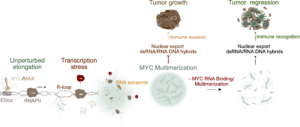
MYC is a major driver of tumorigenesis, and its aberrant expression correlates with poor patient prognosis. Canonically, MYC binds together with its heterodimerization partner MAX to virtually all active promoters, thereby regulating gene expression. We now show that, upon transcriptional stress, which is particularly encountered by highly proliferative cancer cells, MYC undergoes a phase transition, shifting from its cognate promoter sites onto nascent RNAs. MYC directly binds these RNAs, promoting the formation of MYC multimers and concentrating the nuclear exosome within these assemblies. This process limits the accumulation and cytosolic export of immunogenic RNAs, including dsRNA and RNA:DNA hybrids, thus preventing the activation of innate immune signaling and enabling immune evasion. Specifically, among the four identified MYC RNA binding regions, RBRIII prevents loading of RNA:DNA hybrids onto the pattern-recognition receptor TLR3 and subsequent activation of the TBK1 signaling axis.
Future impact

By demonstrating that RBRIII is crucial for pancreatic tumor growth in vivo, we uncovered a previously unrecognized vulnerability of MYC-driven cancers. Importantly, this function can be uncoupled from MYC’s canonical role in transcriptional regulation, as mutations within RBRIII impaired MYC RNA binding and multimerization while preserving promoter occupancy and transcriptional activity. Targeting MYC RNA binding may therefore provide a strategy to selectively interfere with its oncogenic function, restoring innate immune recognition while sparing its mitogenic capacity.

.

Read more in Cell.

.

.
Jump to section

1. MYC binding to nascent RNA suppresses innate immune signaling by R-loop-derived RNA-DNA hybrids

  • 1. MYC binding to nascent RNA suppresses innate immune signaling by R-loop-derived RNA-DNA hybrids
  • 2. A technical comparison of spatial transcriptomics platforms across six cancer types
  • 3. AI-predicted spatial transcriptomics unlocks breast cancer biomarkers from pathology
  • 4. Targeting cancer-specific mutations with RNA-triggered chromatin shredding
  • 5. Plasma signals of lung tumor promotion for molecular cancer prevention
  • 6. First-in-human testing of a mutant KRAS vaccine for pancreatic cancer interception in high-risk cohorts
Page 1 of 6
Previous 123456 Next
Tags: EACR Top Ten Cancer Research PublicationsHighlights in Cancer Research

Related Posts

Recipients announced for the 2026 EACR-Worldwide Cancer Research Collaboration Fellowships

Recipients announced for the 2026 EACR-Worldwide Cancer Research Collaboration Fellowships

October 30, 2026

We're delighted to announce the recipients of the 2026 EACR-Worldwide Cancer Research Collaboration Fellowships. These new Collaboration Fellowships were created to help researchers transform new connections...

VIDEO | Transcriptome and repertoire profiling of infiltrating γδ T cells to decode tumor escape at single cell resolution

VIDEO | Transcriptome and repertoire profiling of infiltrating γδ T cells to decode tumor escape at single cell resolution

October 22, 2026

Click above to watch "It was very informative, the speakers were brilliant and easy to follow" – feedback from a participant On 07 October 2026, the...

VIDEO | The Evolving ADC Landscape: From Monotherapies to Rational Combinations and Next-Generation Platforms

VIDEO | The Evolving ADC Landscape: From Monotherapies to Rational Combinations and Next-Generation Platforms

October 22, 2026

Click above to watch "High-quality, relevant content with clear insights from industry experts, useful for my translational cancer research." – feedback from a participant On 29...

The Cancer Researcher EACR logo

About Us

The Cancer Researcher is an online magazine for the cancer research community from the European Association for Cancer Research.

The EACR, a registered charity, is a global community for those working and studying in cancer research. Our mission is “The advancement of cancer research for the public benefit: from basic research to prevention, treatment and care.”

Advertisement Advertisement Advertisement
ADVERTISEMENT

RECENT POSTS

“The free registration allowed me to attend a conference that would otherwise have been difficult to access”
Community

“The free registration allowed me to attend a conference that would otherwise have been difficult to access”

November 10, 2026
Beyond the Award: The Rising Star Award Recipients
Career

Beyond the Award: The Rising Star Award Recipients

November 4, 2026
The Cancer Researcher

© 2025 EACR

Navigate site

  • About
  • Privacy
  • Main EACR website

Follow us

No Result
View All Result
  • Home
  • About
  • The Cancer Researcher Podcast
  • #KeepResearchCurious

© 2025 EACR