
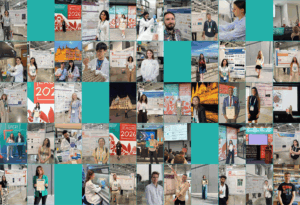
We met in Budapest, Hungary for the EACR 2026 Congress between 08-11 June 2026. This EACR conference covered a wide array of topics across the spectrum of cancer research, including: ageing and cancer, biological rhythms and its impact on cancer therapy, cell death mechanisms, genomic instability, mechanisms of tumour metastasis, tumour heterogeneity at the single cell level, and much more on further cutting-edge topics. Watch our video recap here!
Supported by Worldwide Cancer Research, we were delighted to award 50 Travel Grants to help cancer researchers in need of financial assistance to attend the event.
Scroll through our Travel Grant award winners’ personal excerpts below.
Ghanapriya Devi Yengkhom: A major highlight of the conference for me was the opportunity to see leading experts in the field present their research in person. While I have long followed their published work, hearing it presented directly and having the chance to discuss the science with them offered a far richer perspective than reading papers alone. I was also fortunate to attend the sessions by the Pezcoller Award winners, which were truly inspiring. As a woman in STEM, I find moments like these a powerful reminder of the community I am part of, and they continue to motivate me in my own research journey.
Nazım Arda Keleş: The highlight for me was the opening session, where the emphasis on patient involvement in cancer research made a strong impression. As researchers, we often become absorbed in the molecular details and lose sight of the people our work is ultimately meant to help. Hearing how patients can actively shape research priorities, rather than being only the subjects of study, reframed how I think about my own project. I left the session motivated to keep the patient’s point of view at the centre of my scientific questions.
Pin Yuan Lin: My personal highlight of the congress was the opportunity to meet and learn from many leading experts in cancer research. Among all the inspiring sessions, I was especially impressed by Dr. Johanna A. Joyce’s presentation, “Unraveling the Complexity of Cancer Ecosystems.” Her ability to clearly communicate complex scientific concepts, together with the elegant experimental design and impactful research findings, was truly inspiring. The lecture not only broadened my understanding of the tumor microenvironment but also motivated me to think more critically and creatively about my own research.
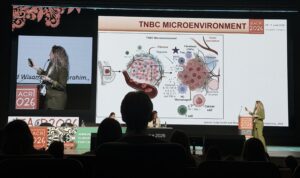
Sendegul Yildirim: The greatest highlight of the congress was delivering an oral presentation in one of the main auditoriums. Standing on stage and sharing my work with hundreds of cancer researchers from around the world was an unforgettable experience. It was both exciting and deeply rewarding to present research that represents years of dedication and hard work. As an early-career academic, this was one of the proudest moments of my scientific journey and gave me even greater motivation for my future research.
Kelsy Prest: Definitely the “Meet the Editors” sessions. I found these absolutely invaluable and was trying to write down every word they said. It was such a unique experience to be in a room with editors from leading journals and hear directly how they would like research to be presented and pitched to them. I had never had an opportunity like that before, and it was incredibly cool!
I also really enjoyed the grant-writing session. I came away with several practical tips that I will definitely use when preparing future grant applications, and I was excited to learn about the grant-writing masterclasses and resources available to support early-career researchers. Both sessions provided insights that I know will benefit me throughout my research career.
Daiana Drehmer: One of the personal highlights of the congress was the opportunity to attend career development sessions alongside the scientific program. I found these sessions particularly valuable because they covered topics that are often not discussed in depth during traditional research meetings, including funding opportunities, patient engagement in research, and career planning.
Siti Munira Abd Jalil: One of the biggest highlights of the congress was presenting my research poster on PKN2-driven mechanotransduction in triple-negative breast cancer. It was incredibly rewarding to discuss my work with researchers from different backgrounds and receive thoughtful questions and feedback. As someone who has spent several years working on this project during my PhD, seeing genuine interest from the international cancer research community was both encouraging and validating. One of the poster viewers actually recognised me from a review paper that I wrote during my PhD and that really made my day.
Jana Löptien: My personal highlight at the EACR 2026 congress was the networking lunch as part of the career development session for early-career scientists. At our table, we had an open discussion about navigating the academic world and finding the right career path. We discussed how to manage one’s own and others’ expectations, how to handle pressure, and how to cope with long working hours. We were able to share our experiences, aims, and concerns openly and learn from each other. We also shared our concerns about balancing career and family. It was reassuring to discuss these topics together and equally inspiring to see that everyone was so passionate about their scientific research.
Guilherme Faria Nadaline: One major — and somewhat unexpected — highlight was the career development programme. I took part in a discussion on how the culture of a laboratory is built, hosted by Eduard Batlle. I was already familiar with his work on organoids and was eager to meet him, but what I most wanted to hear about was not the science: it was how he approaches collaboration, both within and outside his group, and what each of us can do to positively reinforce the environments in which we carry out our work. The conversation with him and with the other people at that table gave me very practical insight into lab organisation and mentorship, and I have carried it into my own work over the past month.