

The EACR’s ‘Highlights in Cancer Research’ is a regular summary of the most interesting and impactful recent papers in cancer research, curated by the Board of the European Association for Cancer Research (EACR).
The list below appears in no particular order, and the summary information has been provided by the authors unless otherwise indicated.
Use the dropdown menu or ‘Previous’ and ‘Next’ buttons to navigate the list.
Li, Y. R. et al. Cancer Discovery. 15 (6): 1115–1128. (2025).
doi: 10.1158/2159-8290.CD-24-1379.
 Summary of the findings
 Summary of the findings
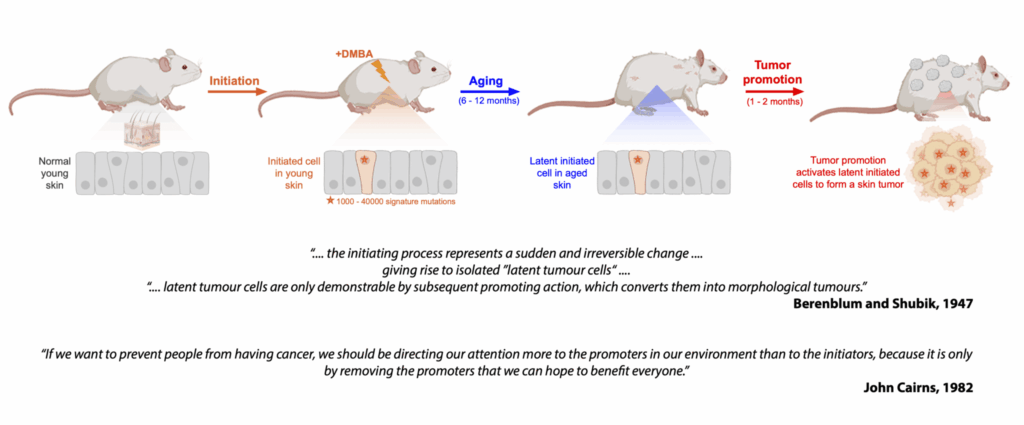
Environmental factors play a major role in causing human cancers, either by inducing mutations in critical cancer genes, by causing tissue damage and chronic inflammation, or a combination of both of these processes. Almost a century ago, the concept of multistage carcinogenesis was introduced, by showing that cancer can be induced in two separate operational phases called “initiation”, induced by a single treatment of mouse skin with chemicals that directly damage DNA to cause gene mutations, and “promotion” accomplished by repeated treatment with extracts of plants that caused chronic inflammation and tissue damage. Promotion alone did not cause any tumors to develop, suggesting that these chemicals act on pre-initiated cells in the target tissue. A critical observation was that the time between initiation and the start of promotion could be very long (up to at least one year), suggesting that genetic events induced by the single mutagen treatment are permanent, and that these genetically altered cells lie dormant in the skin without leading to cancer development.
.
In this study by Li et al, these historical studies were replicated and extended, showing that a single treatment with a potent mutagen (in this case Dimethylbenzanthracene, or DMBA) could induce >40,000 mutations genome wide in single cells, but this high mutation burden, which included activating mutations in strong cancer driver genes such as Hras, was not sufficient for cancer development. These single mutated cells lay dormant for 6-12 months, but were activated by subsequent chronic treatment with 12-O-tetradecanoyl-phorbol-acetate (TPA), the classical tumor promoter used in the early studies. Likewise, genetic activation of Hras or Kras mutations in mouse skin transgenic models was also not sufficient for tumor development, but required tissue wounding by TPA treatment or skin wounding. Even when initiation was carried out during embryonic development, by treating pregnant mice systemically with DMBA, no tumors subsequently developed unless the skins were treated with TPA at the adult stage. These data suggest that normal cell division during development and adult tissue turnover is not sufficient for promotion, but tissue damage is required to reverse the latency and cause tumor outgrowth.
.
These data, based on classical studies of chemical carcinogenesis, resonate with many recent studies demonstrating that human tissues are replete with cancer-associated mutations, but these rarely progress to the stage of tumor development. Our data demonstrate that highly mutated cells carrying strong driver mutations are not removed by cell competition with surrounding normal cells, but remain dormant until exposed to chronic tissue damage and factors that cause tumor promotion. Our observations suggest that identification and characterization of environmental tumor promoters, and elucidation of their mechanisms of action, can provide important routes to cancer prevention.
.
.