

The EACR’s ‘Highlights in Cancer Research’ is a regular summary of the most interesting and impactful recent papers in cancer research, curated by the Board of the European Association for Cancer Research (EACR).
The list below appears in no particular order, and the summary information has been provided by the authors unless otherwise indicated.
Use the dropdown menu or ‘Previous’ and ‘Next’ buttons to navigate the list.
doi: 10.1016/j.ccell.2025.04.001.
 Summary of the findings
 Summary of the findings
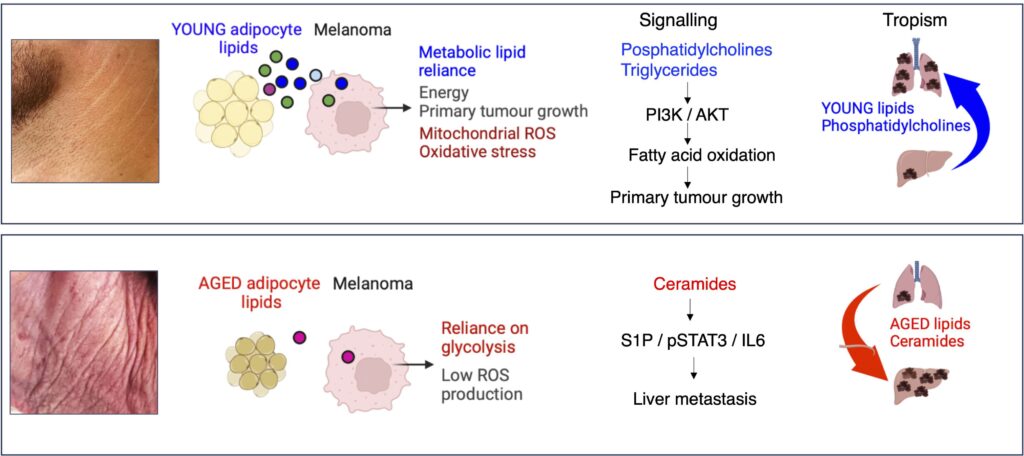
This study reveals a central role for stromal lipid availability in shaping melanoma metabolism, metastatic potential, and organ tropism, with clear age-related differences. Adipocytes from young skin contain and secrete more total lipids than aged adipocytes; melanoma cells take up and use these lipids, adjusting their consumption and oxidative phosphorylation (OxPhos). The resulting OxPhos state (higher in young-skin, lower in aged) sets metastatic pace and favours distinct destinations (lung, liver, or brain). Melanoma cells exposed to more lipids in young skin, leading to high OxPhos, are less metastatic, and more easily seed the lung. In contrast, melanoma in lipid-poor aged skin, leading to moderate OxPhos, rapidly metastasises to the liver. Age-specific lipid species taken up from the tumour microenvironment also activate cancer-cell–intrinsic signalling pathways critical for cancer–immunity interactions. In young skin, phosphatidylcholines drive PI3K/AKT and the OxPhos pathways; whereas in the aged skin, ceramides activate the S1P/IL6 and liver tropism. Blocking OxPhos, stromal lipid uptake or IL6 signalling impairs melanoma metastasis. Importantly, human visceral metastases to organs follow non-random pathways and are age-specific; and the time to progression to liver metastases, which particularly afflict the elderly, is shorter than the time to establish other solid organ metastases.
.
Future impact