
The Cancer Researcher
  • Home
  • About
  • The Cancer Researcher Podcast
  • #KeepResearchCurious
No Result
View All Result
  • Home
  • About
  • The Cancer Researcher Podcast
  • #KeepResearchCurious
No Result
View All Result
The Cancer Researcher
No Result
View All Result

Highlights in Cancer Research: December 2025

December 8, 2025
Highlights in Cancer Research: November 2022

The EACR’s ‘Highlights in Cancer Research’ is a regular summary of the most interesting and impactful recent papers in cancer research, curated by the Board of the European Association for Cancer Research (EACR).

The list below appears in no particular order, and the summary information has been provided by the authors unless otherwise indicated.

Use the dropdown menu or ‘Previous’ and ‘Next’ buttons to navigate the list.


1. Long-Term Latency of Highly Mutated Cells in Normal Mouse Skin Is Reversed by Exposure to Tumor Promoters and Chronic Tissue Damage

  • 1. Long-Term Latency of Highly Mutated Cells in Normal Mouse Skin Is Reversed by Exposure to Tumor Promoters and Chronic Tissue Damage
  • 2. PPP2R1A mutations portend improved survival after cancer immunotherapy
  • 3. Neutrophils physically interact with tumor cells to form a signaling niche promoting breast cancer aggressiveness
  • 4. Spatial mapping of transcriptomic plasticity in metastatic pancreatic cancer
  • 5. Impaired T cell and neoantigen retention in time-serial analysis of metastatic non-small cell lung cancer in patients unresponsive to TIL cell therapy
  • 6. The source of dietary fat influences anti-tumour immunity in obese mice
  • 7. Nerve-to-cancer transfer of mitochondria during cancer metastasis
  • 8. Stromal lipid species dictate melanoma metastasis and tropism
  • 9. TIM3+ breast cancer cells license immune evasion during micrometastasis outbreak
  • 10. IL-17A-secreting γδ T cells promote resistance to CDK4/CDK6 inhibitors in HR+HER2- breast cancer via CX3CR1+ macrophages
Previous
Next

Li, Y. R. et al. Cancer Discovery. 15 (6): 1115–1128. (2025).
doi: 10.1158/2159-8290.CD-24-1379.

Summary of the findings

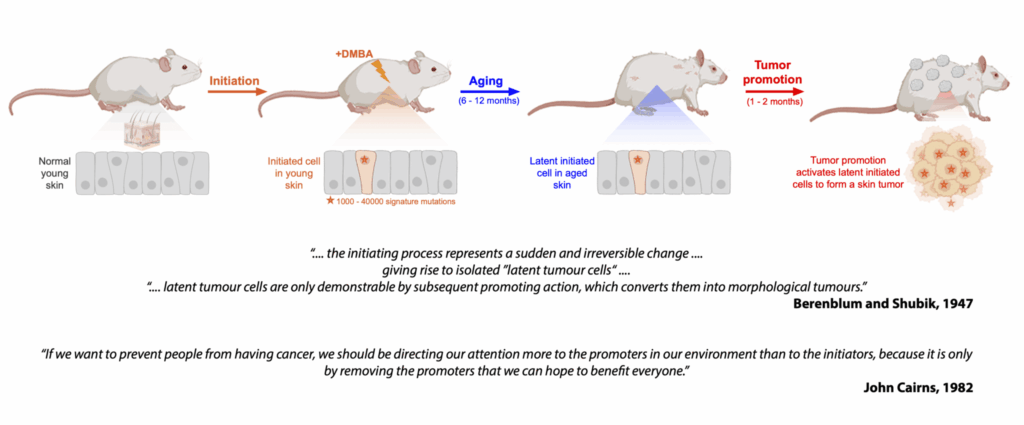
Environmental factors play a major role in causing human cancers, either by inducing mutations in critical cancer genes, by causing tissue damage and chronic inflammation, or a combination of both of these processes. Almost a century ago, the concept of multistage carcinogenesis was introduced, by showing that cancer can be induced in two separate operational phases called “initiation”, induced by a single treatment of mouse skin with chemicals that directly damage DNA to cause gene mutations, and “promotion” accomplished by repeated treatment with extracts of plants that caused chronic inflammation and tissue damage. Promotion alone did not cause any tumors to develop, suggesting that these chemicals act on pre-initiated cells in the target tissue. A critical observation was that the time between initiation and the start of promotion could be very long (up to at least one year), suggesting that genetic events induced by the single mutagen treatment are permanent, and that these genetically altered cells lie dormant in the skin without leading to cancer development.
.
In this study by Li et al, these historical studies were replicated and extended, showing that a single treatment with a potent mutagen (in this case Dimethylbenzanthracene, or DMBA) could induce >40,000 mutations genome wide in single cells, but this high mutation burden, which included activating mutations in strong cancer driver genes such as Hras, was not sufficient for cancer development. These single mutated cells lay dormant for 6-12 months, but were activated by subsequent chronic treatment with 12-O-tetradecanoyl-phorbol-acetate (TPA), the classical tumor promoter used in the early studies. Likewise, genetic activation of Hras or Kras mutations in mouse skin transgenic models was also not sufficient for tumor development, but required tissue wounding by TPA treatment or skin wounding. Even when initiation was carried out during embryonic development, by treating pregnant mice systemically with DMBA, no tumors subsequently developed unless the skins were treated with TPA at the adult stage. These data suggest that normal cell division during development and adult tissue turnover is not sufficient for promotion, but tissue damage is required to reverse the latency and cause tumor outgrowth.
.
These data, based on classical studies of chemical carcinogenesis, resonate with many recent studies demonstrating that human tissues are replete with cancer-associated mutations, but these rarely progress to the stage of tumor development. Our data demonstrate that highly mutated cells carrying strong driver mutations are not removed by cell competition with surrounding normal cells, but remain dormant until exposed to chronic tissue damage and factors that cause tumor promotion. Our observations suggest that identification and characterization of environmental tumor promoters, and elucidation of their mechanisms of action, can provide important routes to cancer prevention.
.
.

.
Read more in Cancer Discovery
.

1. Long-Term Latency of Highly Mutated Cells in Normal Mouse Skin Is Reversed by Exposure to Tumor Promoters and Chronic Tissue Damage

  • 1. Long-Term Latency of Highly Mutated Cells in Normal Mouse Skin Is Reversed by Exposure to Tumor Promoters and Chronic Tissue Damage
  • 2. PPP2R1A mutations portend improved survival after cancer immunotherapy
  • 3. Neutrophils physically interact with tumor cells to form a signaling niche promoting breast cancer aggressiveness
  • 4. Spatial mapping of transcriptomic plasticity in metastatic pancreatic cancer
  • 5. Impaired T cell and neoantigen retention in time-serial analysis of metastatic non-small cell lung cancer in patients unresponsive to TIL cell therapy
  • 6. The source of dietary fat influences anti-tumour immunity in obese mice
  • 7. Nerve-to-cancer transfer of mitochondria during cancer metastasis
  • 8. Stromal lipid species dictate melanoma metastasis and tropism
  • 9. TIM3+ breast cancer cells license immune evasion during micrometastasis outbreak
  • 10. IL-17A-secreting γδ T cells promote resistance to CDK4/CDK6 inhibitors in HR+HER2- breast cancer via CX3CR1+ macrophages
Previous
Next


Tags: EACR Top Ten Cancer Research PublicationsHighlights in Cancer Research

Related Posts

Using AI to bridge chemistry, proteomics and precision medicine: Episode 28 of The Cancer Researcher Podcast

Using AI to bridge chemistry, proteomics and precision medicine: Episode 28 of The Cancer Researcher Podcast

January 16, 2026

Our guest in this episode is Bernhard Küster, Professor at the Technical University of Munich, Director of the Bavarian Biomolecular Mass Spectrometry Center and Co-Director of...

European cancer research needs renewed urgency, say EACR and EACS leaders in Nature Cancer article

European cancer research needs renewed urgency, say EACR and EACS leaders in Nature Cancer article

December 10, 2025

René Bernards (EACR Past President) and Johanna Joyce (EACR President Elect), together with Michael Baumann and Anton Berns, have written a new commentary highlighting the urgent...

Research Focus: How Dietary Fats Shape Immune Defenses Against Cancer – Episode 27 of The Cancer Researcher Podcast

Research Focus: How Dietary Fats Shape Immune Defenses Against Cancer – Episode 27 of The Cancer Researcher Podcast

December 8, 2025

What you eat – specifically the type of fat – might matter for how well your immune system can fight cancer under conditions of obesity. In...

The Cancer Researcher EACR logo

About Us

The Cancer Researcher is an online magazine for the cancer research community from the European Association for Cancer Research.

The EACR, a registered charity, is a global community for those working and studying in cancer research. Our mission is “The advancement of cancer research for the public benefit: from basic research to prevention, treatment and care.”

RECENT POSTS

“It is a journey rather than a race toward a single endpoint”: Interview with Ayelet Erez, winner of the 2026 Pezcoller-Marina Larcher Fogazzaro-EACR Women in Cancer Research Award
Community

“It is a journey rather than a race toward a single endpoint”: Interview with Ayelet Erez, winner of the 2026 Pezcoller-Marina Larcher Fogazzaro-EACR Women in Cancer Research Award

January 19, 2026
Using AI to bridge chemistry, proteomics and precision medicine: Episode 28 of The Cancer Researcher Podcast
Features

Using AI to bridge chemistry, proteomics and precision medicine: Episode 28 of The Cancer Researcher Podcast

January 16, 2026
The Cancer Researcher

© 2025 EACR

Navigate site

  • About
  • Privacy
  • Main EACR website

Follow us

No Result
View All Result
  • Home
  • About
  • The Cancer Researcher Podcast
  • #KeepResearchCurious

© 2025 EACR