
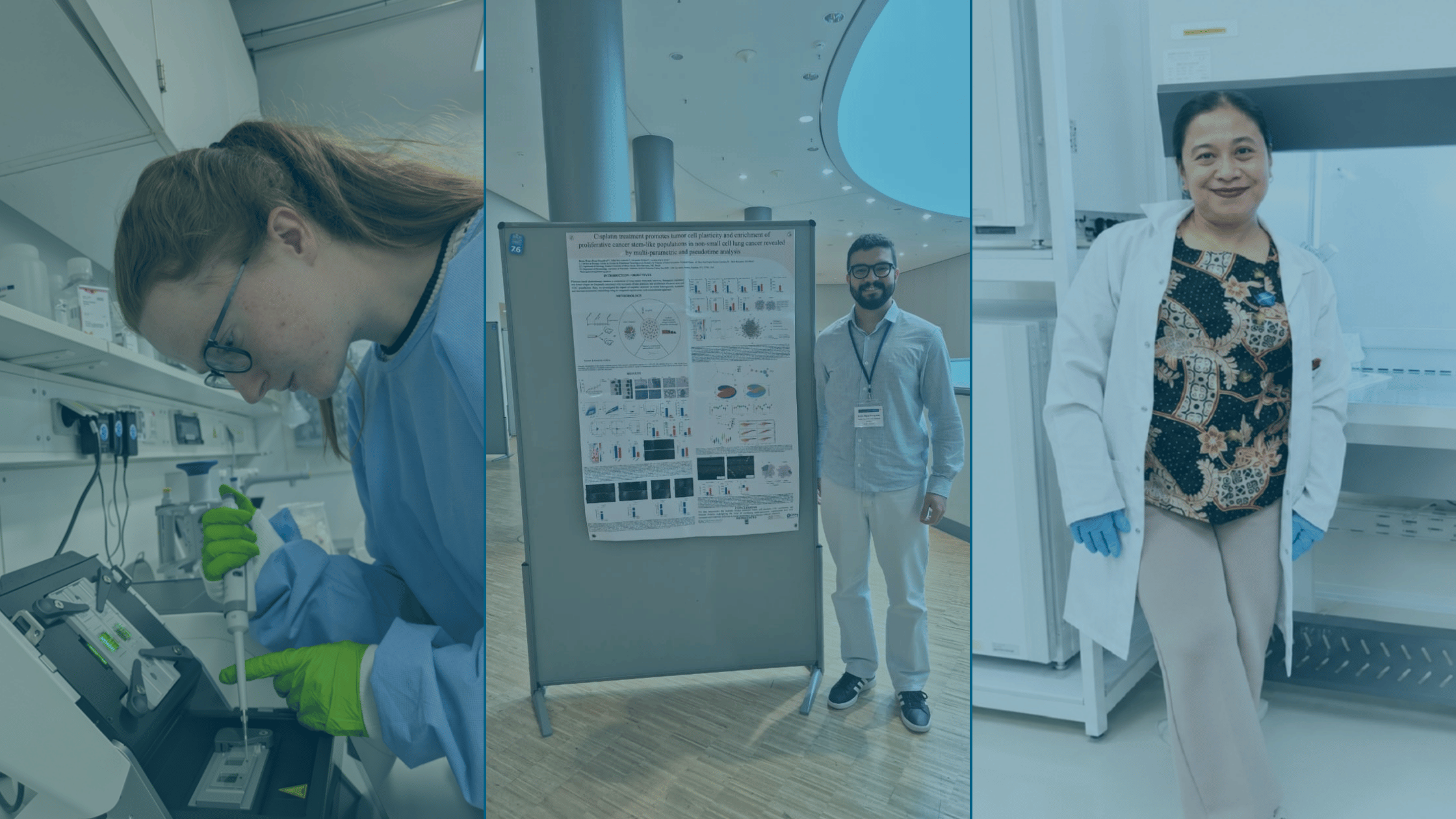
We met in Essen, Germany for the EACR Conference Cancer Genomics, Multiomics and Computational Biology between 12 and 14 May 2026. This EACR conference covered the latest breakthroughs in cancer genomics, multiomics and computational biology with a cutting-edge programme covering machine learning and artificial intelligence, single cell and spatial analysis of cancers, cell plasticity, cancer immune genomics, data integration and convergence, epigenetics, and genomic instability.
Supported by Worldwide Cancer Research, we were delighted to award several Travel Grants to help cancer researchers in need of financial assistance to attend the event.
Read on to learn about their experience of the conference.
Paula Zickler
PhD Student, German Cancer Research Center (DKTK/DKFZ), Germany
Research
Cancer treatment affects not only tumour cells but also the surrounding tissue, which can influence whether a therapy succeeds or fails. In my research, I use spatial transcriptomics, a technology that measures which genes are active and where they are located. This allows us to create detailed maps of tumours, revealing characteristics of individual cells and helping us understand how they interact with one another. By comparing samples collected before and after treatment, we aim to identify patterns linked to treatment response and resistance. Ultimately, this work could help develop personalised treatments and improve outcomes for lung cancer patients.
What was a personal highlight of the conference for you?
A personal highlight was attending a conference where the scientific focus aligned so closely with my own research interests. The strong emphasis on multiomics, computational biology, and spatial technologies meant that relevant topics were present throughout the entire program. This exposed me to a wide range of approaches, challenges, and perspectives that are directly applicable to my work. Overall, I left with a number of new ideas for my own research.
Were there any networking moments that stood out to you?
One of the most rewarding aspects of the conference was the opportunity to exchange experiences and discuss common challenges and analytical approaches with researchers working on similar topics. A particular highlight was discussing my research with one of the conference speakers, whose work has had a major influence on my project. He visited my poster, and we had a detailed discussion about my results and analyses. It was very encouraging and gave me several new perspectives to consider in my project.
How was this conference different from others you have attended?
I appreciated the emphasis on scientific exchange beyond the talks themselves. In particular, I enjoyed the concept of a second poster viewing opportunity the morning after the initial poster presentations. It gave attendees time to revisit posters, continue conversations, and reflect on ideas from the previous day with a fresh perspective. In addition, there was a short interactive session which encouraged participants to engage in non-work-related conversations, making it easier to establish connections that later facilitated scientific discussions.
The conference also increased my confidence in the overall direction of my analyses.
How has the conference inspired you in your research?
Several analytical approaches appeared repeatedly across talks which addressed questions similar to those in my own project, which encouraged me to explore some of these methods. This has already allowed me to strengthen and extend several of my core findings. The conference also increased my confidence in the overall direction of my analyses. As I am currently the only person in my lab working extensively with Visium HD spatial transcriptomics and sequencing data, it can be difficult to assess how my analytical choices compare with those used by bioinformatic-focused groups. Seeing that many researchers were applying conceptually similar approaches reassured me that I am on the right track.
Bryan Ôrtero Perez Gonçalves
Postdoctoral Researcher, Ezequiel Dias Foundation, Brasil
Research
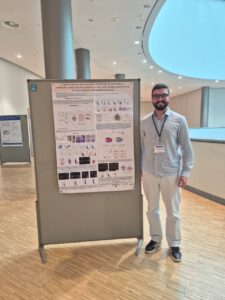
My research focuses on understanding why lung cancer can return after chemotherapy. Although cisplatin is widely used to treat lung cancer, some tumour cells survive and become more aggressive. Using experimental models and computational analysis, I found that chemotherapy can promote the emergence of cancer stem-like cells, a small population capable of resisting treatment and driving tumour relapse and metastasis. I have also observed changes in the tumour environment that may help cancer cells escape the immune system. Our goal is to better understand these mechanisms and contribute to the development of more effective therapies against treatment-resistant lung cancer.
What was a personal highlight of the conference for you?
One of the personal highlights of the conference was the opening lecture by Nick McGranahan from University College London. His presentation on phenotypic plasticity in cancer strongly connected with my own research interests and with the work I presented during the conference on chemotherapy-induced cellular plasticity and cancer stem cells. I was also particularly inspired by the talk from Veronique Calleja from HAWK Biosystems, which focused on spatial analysis of immune checkpoints in non-small cell lung cancer (NSCLC), a tumour subtype I studied during my PhD and addressed in my poster presentation. Finally, being recognised as one of the EACR Travel Grant recipients during the closing session was a very meaningful and motivating moment in my scientific career.
Were there any networking moments that stood out to you?
One of the networking highlights of the conference was the opportunity to speak with Veronique Calleja after her presentation. Her work on spatial analysis of immune checkpoints in non-small cell lung cancer (NSCLC) was particularly interesting to me because I have a strong research interest in this tumour subtype. I was also very impressed by the presentation from Carlos Caldas from University of Cambridge, who presented his group’s breast cancer research in a very clear and elegant way. In addition, the lecture on cancer cell plasticity by Nick McGranahan was one of my favorite talks of the conference and highly relevant to my own research area.
How was this conference different from others you have attended?
This conference stood out from others I have attended because of the exceptional quality of the scientific presentations and discussions. The talks combined strong experimental data with innovative computational and translational approaches, creating a highly stimulating environment for learning and scientific exchange. Another important difference was the diversity of the participants and speakers. The conference brought together researchers from many different countries and scientific backgrounds, not only from the European Union. As a Brazilian researcher and one of the EACR Travel Grant recipients, I felt truly welcomed and represented within the international cancer research community. This diversity greatly enriched the networking opportunities and allowed valuable interactions between scientists working on distinct but complementary areas of cancer research.
I felt truly welcomed and represented within the international cancer research community.
When you got home, was there anything from the conference that you immediately wanted to tell your colleagues about?
One of the first things I wanted to discuss with my colleagues after returning home was how strongly spatial biology approaches are currently shaping cancer research. This topic appeared repeatedly throughout the conference, especially in studies investigating the tumour microenvironment and epithelial–mesenchymal transition (EMT). I was particularly interested in how researchers are integrating spatial analysis with transcriptomics, imaging, and immune profiling to better understand tumour heterogeneity and therapy resistance. Since my own research focuses on tumour plasticity and chemotherapy-induced changes in the tumour microenvironment, these discussions were highly relevant and inspiring. The conference reinforced the importance of combining experimental and computational approaches to study cancer in a more dynamic and spatially resolved way, and I believe these ideas may help guide future projects in our group.
Is there anything else you would like to mention?
I would like to sincerely thank the EACR and Worldwide Cancer Research for the opportunity to attend this conference through the Travel Grant programme. As an early-career researcher from Brazil, a low/middle-income country, receiving this award was extremely meaningful to me, both professionally and personally. I was genuinely very happy and honored when I received the news that I had been selected as one of the Travel Grant recipients. Support initiatives like this are essential for increasing diversity and inclusion in science, allowing young researchers from different parts of the world to participate in high-level scientific discussions, present their work internationally, and build valuable collaborations. This experience was highly motivating and reinforced my commitment to pursuing a scientific career in cancer research. As an early-career EACR member, I also hope to apply for future Travel Grants and continue participating in inspiring scientific events like this one, which are extremely important for my professional and scientific development.
Ika Nurlaila
Early career research scientist, Research Center for Vaccine and Drugs, The National Research and Innovation Agency (BRIN), the Republic of Indonesia
Research
Our immune system can naturally recognise and destroy cancer, but this process often fails because cancer cells hide from immune recognition. My research focuses on the antigen processing machinery—a network of genes that helps immune cells “see” cancer. Many patients become resistant to immunotherapy because parts of this system stop working, yet most studies examine only one gene at a time. I investigate how these genes work together, particularly in Indonesian patients, whose immune profiles are largely missing from global databases. Understanding these overlooked differences could help develop more efficient and inclusive cancer immunotherapies.
What was a personal highlight of the conference for you?
One of my personal highlights was realising how fast precision oncology is evolving and how much we still need to catch up. Although remarkable progress in cancer treatment deserves celebration, it has not completely removed the fear that comes with the disease. Many inspiring speakers, especially experts in genomics and bioinformatics, showed how combining advanced technologies with practical analysis is helping identify more accurate biomarkers for personalised treatment. What impressed me most was that they did not only study cancer itself but also carefully redefined what “normal” truly looks like, making comparisons far more reliable. It reminded me that countries like Indonesia need to build evidence that is based on our own population. Only then can we develop precision medicine that truly reflects our biological uniqueness and benefits our people.
What stood out most was how conversations with complete strangers quickly evolved into meaningful professional connections.
Were there any networking moments that stood out to you?
From the very first day, I found it easy to build professional relationships with researchers who shared similar interests. Several poster presenters welcomed my invitation to explore future collaborations and potential joint funding opportunities. I was also encouraged that some invited speakers expressed interest in delivering webinars with my home institution, creating a starting point for broader scientific collaboration. What stood out most was how conversations with complete strangers quickly evolved into meaningful professional connections. I believe some of these interactions may grow into long-term collaborations, extending well beyond the conference itself and creating lasting value for future research.
How was this conference different from others you have attended?
This conference felt different because my participation was fully supported by EACR, allowing me to attend the entire programme and engage in every discussion. I also had the opportunity to present my previous research in my poster presentation (of which a manuscript is now being written) which offered a perspective that differs from many existing reports. As the conference strongly focused on genomics and bioinformatics, it gave me direct exposure to how leading experts are developing more sensitive cancer biomarkers and improving prediction models using large-scale data. Its smaller format also made a real difference, creating meaningful opportunities to interact personally with speakers and fellow researchers to build genuine scientific connections.
How has the conference inspired you in your research?
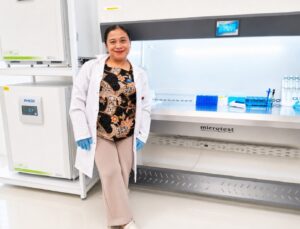
The conference inspired me in many ways beyond the science itself. I met early-career researchers with fresh ideas and creative approaches, while senior experts were remarkably approachable and generous in sharing their experiences. What impressed me most was their openness to discussing challenges, exchanging perspectives, and exploring future collaborations, including opportunities for global funding. As someone from Indonesia, where we are working hard to strengthen cancer research, this mindset was especially meaningful. It reminded me that impactful science is rarely achieved alone. Even the most accomplished researchers acknowledged that they do not have all the answers, and that collaboration across disciplines, institutions, and countries is essential to solving complex problems and advancing precision medicine.
It reminded me that impactful science is rarely achieved alone.
When you got home, is there anything from the conference that you immediately wanted to tell your colleagues about?
When I returned home, the first thing I shared with my colleagues was not a new technique or dataset, but the mindset of the researchers I met. Despite being internationally renowned, they remained humble, open to new ideas, and willing to question their own assumptions whenever evidence suggested a different direction. They were not only knowledgeable but also remarkably creative. That left a lasting impression on me. I believe successful research is not only about having a strong concept but also about the mindset behind it. In many ways, our attitude as researchers determines how far our science can go.
Have you brought back any specific knowledge that has benefited your research?
One of the first things I shared with my colleagues was a presentation on peritumoral tissue transcriptomics (PTT). It offered a possible explanation for why APM gene expression sometimes appears only slightly different between normal and cancer tissues. Since the presenter and I share an interest in the tumour microenvironment, we continued discussing the topic after the session, which made the experience even more valuable. I also shared broader advances in transcriptomic analysis and modeling strategies. Together, these discussions encouraged us to rethink our approach and explore our own omics data more deeply to better understand the unique biology of our population.
Is there anything else you would like to mention?
This conference opened a new window for me and broadened the way I think about my research. Beyond learning about emerging findings and hypotheses (many of which are still awaiting publication), I built connections with researchers who share the same broad scientific goals from different perspectives. Those discussions helped us identify complementary expertise and explore funding opportunities we could pursue together. One immediate possibility is a joint funding program involving my home institution, BRIN. I left the conference with not only new knowledge, but also new partnerships that I hope will grow into meaningful international collaborations.
Interested in EACR Conferences and further Travel Grants?
We organise a variety of excellent cancer research conferences, both in person and virtual, where the latest research topics and interaction for participants are the very highest priorities.
To assist researchers who need financial assistance to attend our in-person conferences, we offer EACR-Worldwide Cancer Research Travel Grants. Recipients also get the opportunity to present their work as an oral or poster presentation. Each Travel Grant includes a free registration and funds to support travel and accommodation costs.
Make sure you add the dates of upcoming EACR Conferences to your diary now. Don’t forget we offer EACR member discounts on all of our registration fees