
Have you ever wondered how things in the universe work? If there is magic around us? Guess what- there is something very similar to magic, called science. Like wizards exploring the secrets of magic, scientists sacrifice years of their lives to master the specific knowledge and like in the magical world, family and society usually don’t understand what scientists actually do (those muggles!). Similarly to cauldrons and wands, scientists also use magical objects like laboratory flasks and microscopes, and exploring ancient spells and dark forces looks very much like investigating mysteries of the universe or the origins of life. Researchers sometimes also try to cast a spell if you know what I mean . Both wizards and scientists are driven by curiosity, however, like in the magical world of J.K. Rowling there are several obstacles underway.
 The Dementors aka Funding Pressures
 The Dementors aka Funding Pressures
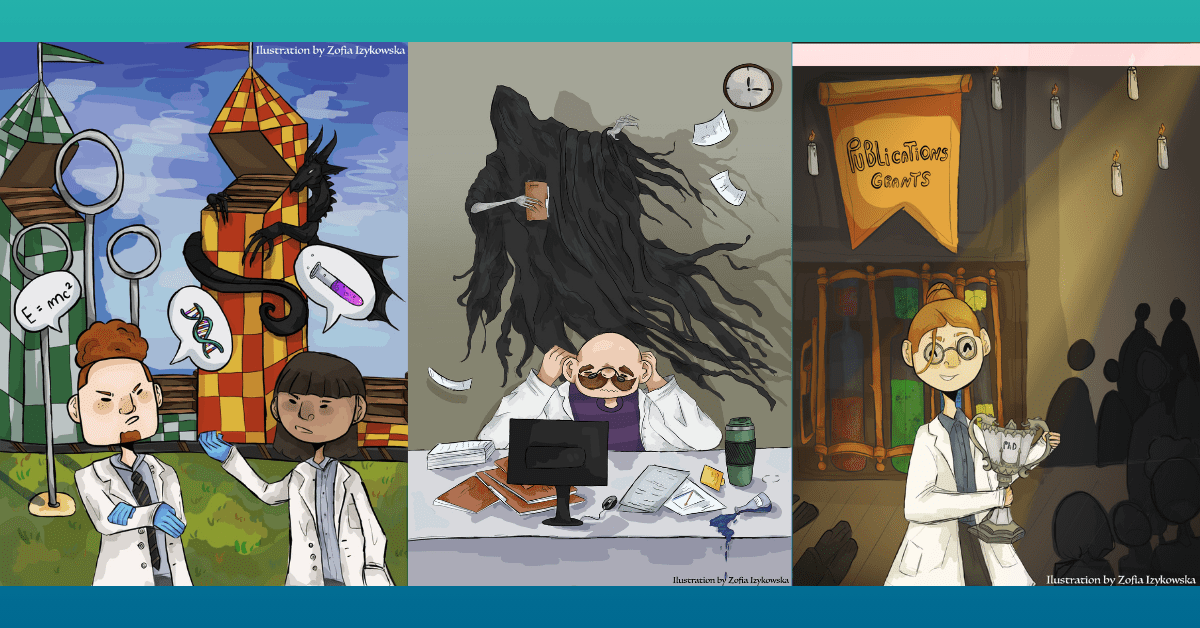
Just like in the magical world where Dementors (really scary creatures) are fed by sucking happiness from wizards, funding pressures do the same to scientists. Scientists are forced to obtain funds for their research which leads to pressure from the environment, in which you are only successful with a grant. This conviction combined with strong competition does not stimulate curiosity or sharing ideas with other groups. What it does stimulate is the feeling of uncertainty regarding the future. The small chances of obtaining a grant mean that some scientists when submitting their applications, adjust their research to the requirements of competitions and experts’ expectations rather than go for their innovative ideas. Scientists may also avoid undertaking risky, ambitious research for fear that it will end in failure and result in the need to return received funds.
The Triwizard Tournament aka Publication Demands
 The Triwizard Tournament aka Publication Demands
Publication demands very much resemble the magical tournament, in which wizards compete against each other in different tasks testing their intelligence, skills, and cleverness to gain the main prize. The difficult publishing process, involving detailed reviews, frequent rejections, and the need to stay up to date in a rapidly changing field, sometimes forces scientists to choose popular research topics rather than risky, but innovative ones. Moreover, the demand for frequent publications in high-quality journals, while managing the need for quantity, might as well make scientists feel like they are constantly competing in a high-stakes tournament, where the ultimate goal is to publish rather than to explore new ideas.
House Cup aka Career Milestone
 House Cup aka Career Milestone
House cup in Harry Potter’s world is a distinction awarded to one of the four houses that obtained the most points during the school year at Hogwarts. This can be easily compared to career milestones of scientists, such as obtaining a title that strongly relates to career advancement and job satisfaction. The pursuit of achieving career milestones can sometimes overshadow the passion for discovery that led to the research in the first place. Scientists may choose projects that will quickly lead to career advancement over projects driven solely by their curiosity.
So how to maintain curiosity in dark times?
For some researchers, it may be the help from a supportive mentor, like Dumbledore’s mentorship of Harry Potter, who encourages risk-taking and exploration of the unknown pathway. For others, it may be a strong sense of purpose or a passion for a field of study that acts as a protective force (patronus ), maintaining curiosity even in the darkest of times. After all, it is all about facing “the choice between what is right and what is easy” (Harry Potter and the Goblet of Fire, J.K. Rowling).
About the author:
 About the author:
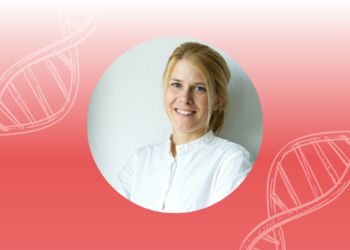
Since 2018, she has been associated with the Institute of Human Genetics Polish Academy of Sciences, where she carried out research on the molecular basis of cutaneous T-cell lymphomas, which was part of her doctoral dissertation. She gained experience during foreign scientific internships in Great Britain and in the Netherlands. Currently, her research focuses on the molecular basis of hematological cancers as well as cell therapy. She is the head of her own project focusing on overcoming CAR-T cell exhaustion.
About this article
This is one of our shortlisted entries for the 2024 EACR Science Communication Prize themed around our #KeepResearchCurious campaign. Choosing a winner was incredibly difficult and we’re delighted to share our shortlist with you.
The images in this article were illustrated by Zofia Izykowska.