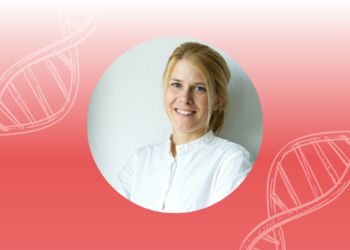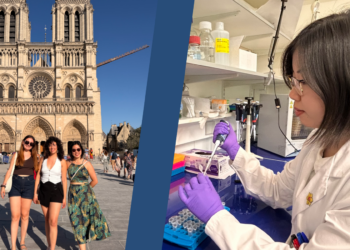

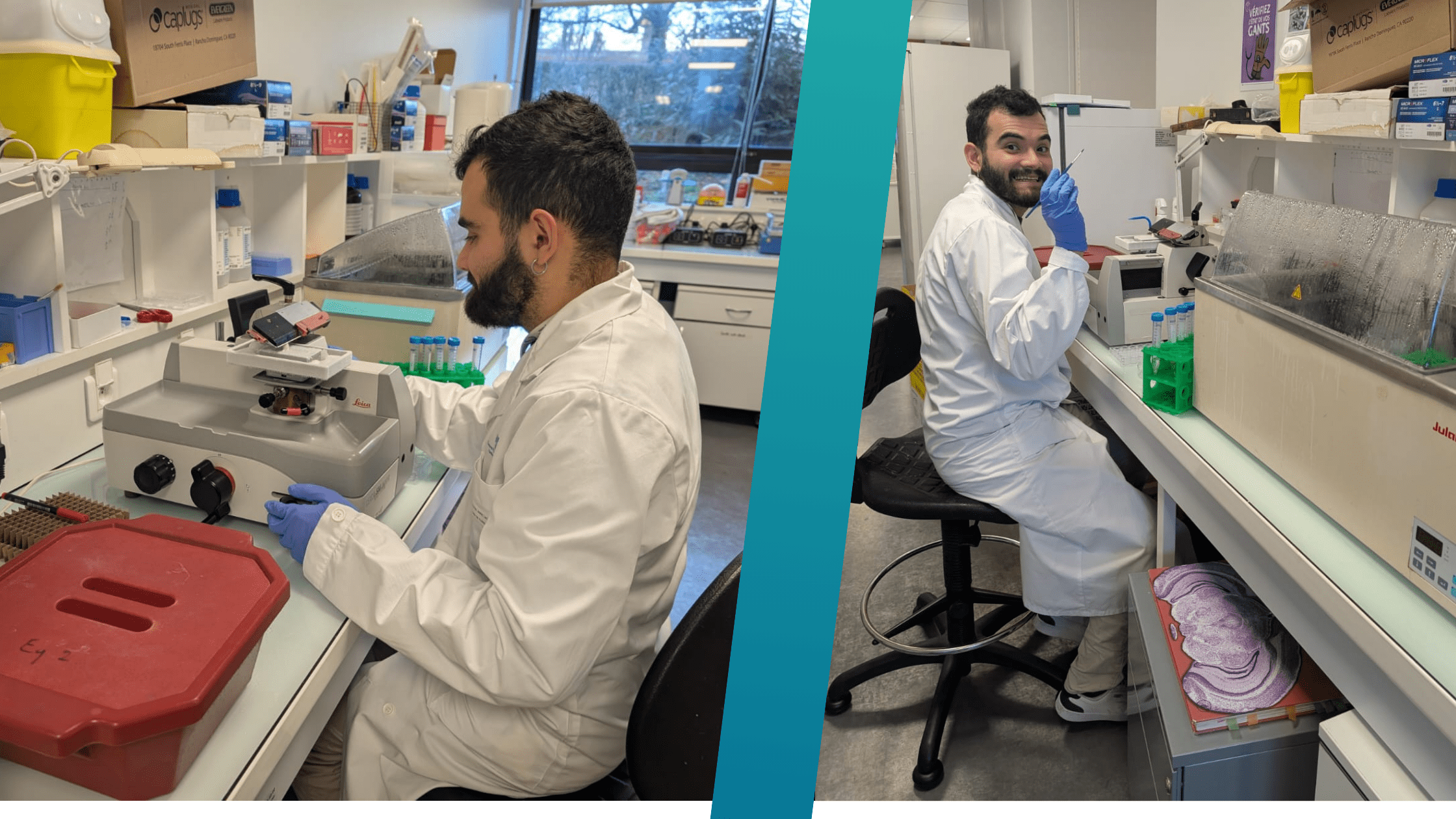
Alejandro Collado Solé is a PhD student at CNIO in Spain who received an EACR Travel Fellowship to visit and work at INSERM in France between September and December 2024.
The EACR, with support from Worldwide Cancer Research, provides Travel Fellowships of up to €3,500 to enable early-career cancer researchers to gain new skills through a short-term visit to a lab or research group in another country.
You can read about other Travel Fellows and their experiences here.

Job title: PhD student
Home institute: CNIO, Spain
Host institute: INSERM, France
Dates of visit: 18 September – 18 December 2024
Research: Breast cancer is a leading cause of cancer-related deaths in women, with sex hormones playing a key role in its progression. Our research focuses on RANK signaling pathway, which is known for its role in breast cancer. Since RANK is also present in the brain, we aim to understand how RANK inhibition affects breast cancer by an impairment of brain-tumour communication. As the brain regulates hormone production, we are investigating whether RANK inhibition influences the neuroendocrine system and, consequently, breast cancer.
Why did you choose to apply for an EACR Travel Fellowship?
I applied for the EACR Travel Fellowship to collaborate with a leading neuroendocrinology research group and strengthen my expertise in this field. My thesis project investigated the role of RANK signaling in the regulation of systemic sex hormones and its impact on breast cancer. This motivated me to pursue a research stay in a lab specializing in the neuroendocrine system. The fellowship provided me with the opportunity to acquire advanced knowledge and techniques to address this crucial aspect of my research, allowing me to gain valuable insights both in the lab and for my career.
Why did you choose the host lab?
Vincent Prevot’s lab is one of the most recognised in the field of neuroendocrinology. His group is at the forefront of research on brain-periphery communication and sexual hormone regulation. Given my interest in the role of RANK signaling in regulating sexual hormone, his lab was the ideal place to learn new techniques and approaches to develop my project. Their expertise allowed me to gain insights that were not possible in my home lab.
“I am excited to apply everything I have learned to my ongoing research”
Can you summarise the research you did?
In the laboratory, I learned how to section the brain to identify the location of neurons involved in the regulation of sex hormones. I gained experience in sectioning frozen mouse brains and performing free-floating immunostaining to localise these neurons. Additionally, I learned the iDISCO technique, a tissue clearing method that enables three-dimensional imaging of whole brains by making them transparent while preserving their structure and allowing immunostaining. This technique enabled me to clear whole brains and stain neuronal cells to observe their distribution throughout the whole brain.
What were you able to do that you could not have achieved in your home lab?
At the CNIO, my group focuses on mammary gland development and breast cancer, and we don’t have experience in brain biology or the regulation of sexual hormone production. In contrast, at the Vincent Lab, I had the opportunity to work in a laboratory with expertise in neuroendocrinology. The experience I gained has been invaluable and has allowed me to bring new knowledge back to my home lab, enriching my scientific career.

Did you have a personal mentor or anyone who particularly helped you?
From day one, Nathalie Journiac, a senior scientist in the Vincent Lab, welcomed me warmly and helped me throughout my stay. She taught me various techniques, introduced me to the lab, and worked with me on brain sectioning and immunostaining, while providing valuable insights into my project. Nathalie also offered advice on city life. Gaetan Ternier, a postdoc in the Paolo Giacobini group and an expert in 3D imaging, taught me with the iDISCO technique and provided support in scientific aspects during my stay. Both were incredibly valuable during my time in Lille.
Is there anything else you’d like to mention?
I would like to express my gratitude to the EACR for supporting this research stay, as well as to Vincent Prévot’s lab for welcoming me and providing such an enriching learning experience. This fellowship has been a pivotal step in my scientific career, and I am excited to apply everything I have learned to my ongoing and future research.
Want to find out more?

If you are interested in applying for the Travel Fellowship scheme, please click here for more information: EACR Travel Fellowships.