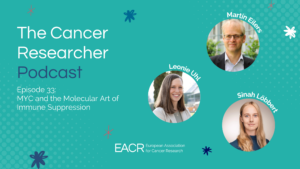
MYC is one of the most important and best known oncogenic drivers in human cancer. Researchers have continuously focused on understanding MYC’s biology in greater detail: from how it regulates gene transcription, to how it interacts with RNA, chromatin, and the tumour microenvironment. The study we discuss today from Martin Eiler’s lab at University of Wurzburg adds an unexpected dimension to that picture, connecting connects three areas that are often considered separately: transcriptional stress, R-loop biology, and innate immune sensing.
This episode focuses on the following publication in Cell (doi: 10.1016/j.cell.2025.12.019).
🔗 Read more about the publication here
🔗 Access transcripts for all our episodes at magazine.eacr.org/podcast
Our guests in this episode
- Martin Eilers, Chair of Biochemistry and Molecular Biology at the University of Würzburg, Germany
- Leonie Uhl, Theodor Boveri Institute, Department of Biochemistry and Molecular Biology, Biocenter, University of Würzburg
- Sinah Löbbert, Theodor Boveri Institute, Department of Biochemistry and Molecular Biology, Biocenter, University of Würzburg / Mildred Scheel Early Career Center, University Hospital Würzburg
Listen here, scroll down for the transcript and subscribe now via Spotify, Apple Podcasts, Amazon Music/Audible, Deezer or YouTube so you’ll never miss an episode. You can find all episodes and their transcripts here.
Our host is Dr. Alexandra Boitor, EACR Scientific Manager.
Episode transcript
Alexandra: Hi everyone and welcome to episode 33 of ‘The Cancer Researcher’ Podcast brought to you by the European Association for Cancer Research.
I am your host, Alexandra Boitor, Scientific Manager at the EACR and in this episode we will discuss some research featured in the EACR’s Highlights in Cancer Research.
To set the stage for today’s conversation, I’ll start by reminding you of a few key aspects regarding the oncogene MYC.
MYC is one of the most important and best-known oncogenic drivers in human cancer. Its activity is increased across many tumour types either directly, through mutations or amplifications of the MYC gene itself, or indirectly through alterations in the signalling pathways that regulate it. Once activated, MYC can profoundly reshape the biology of a tumour, promoting cell growth, proliferation, changing the metabolism of the tumour, and promoting survival.
In many cancers, tumours remain dependent on elevated MYC activity throughout their development and progression. This has made MYC an attractive research topic and therapeutic target for decades.
Researchers have continuously focused on understanding MYC’s biology in greater detail, from how it regulates gene transcription to also how it interacts with RNA, chromatin, and the tumour microenvironment.
The study we discuss today adds an unexpected dimension to that picture, revealing how MYC may help cancer cells avoid detection by the immune system. To further discuss this, I have here with me Prof. Martin Eilers, Dr. Leonie Uhl, and Dr. Sinah Löbbert, from Theodor Boveri Institute, Department of Biochemistry and Molecular Biology, Biocenter, University of Würzburg.
In this episode we will discuss their paper entitled ‘MYC binding to nascent RNA suppresses innate immune signaling by R-loop-derived RNA-DNA hybrids’ published in Cell and featured in the EACR Highlights in Cancer Research.
Let’s dive into today’s topic.
Hello everyone, and welcome to the Cancer Researcher Podcast. It’s great having you here today. Hello Martin.
Martin: Hi Alexandra
Alexandra: Hello Leonie.
Leonie: Hi, nice to meet you.
Alexandra: And hi Sinah.
Sinah: Hi.
Alexandra: It’s wonderful to have you here and to have this opportunity to discuss your research with you. To get the conversation started, could you tell us more about MYC’s ability to enable tumours to evade immune detection? This might not be the role that MYC is best known for, so I think it would be really helpful to begin by understanding where this idea comes from.
Martin: So maybe I can take this question. I think work from many laboratories over decades had established two key findings, and that is that most tumours express, for one reason or the other, elevated and deregulated levels of MYC, and that the tumour growth depends on these very high levels. And while this had been established, it was much less clear why this is actually the case.
Decades ago, work from people like Gerard Evan, Dean Felsher, and Stephen Baylin had begun to show that, in a range of tumour models, ranging from lymphoma to lung carcinoma to pancreatic carcinoma, the dependence on high levels of MYC was tightly limited to providing tumours with the ability to escape the immune system.
This was a new perspective on MYC function. It became immediately clear that this was true in many model systems, and this raised then the question for our work.
Alexandra: Thank you, Martin. You’ve been interested in the biology of MYC proteins since your postdoctoral work with Professor Michael Bishop at UCSF, and your lab focuses on uncovering the roles of MYC in tumour progression and the mechanistic insights into how MYC acts. However, MYC is usually discussed as a DNA binding transcription factor and transcriptional amplifier, as far as I understand.
So what first suggested that MYC might also have an RNA dependent role, and what made you look into the RNA dependent role of MYC to explain the role that it plays in the immune evasion?
Leonie: There were a couple of evidences or findings that suggested that MYC has an RNA-dependent role, or is at least involved in RNA-dependent processes. So, the first one came up during the preparation of a previous manuscript, Solvie et al., where we showed that MYC undergoes phase transition in response to transcriptional stress. And in this context, we could also see that, in this phase-separated state, MYC is in close proximity to a variety of RNA processing and degradation factors, whereas it loses proximity to all kinds of canonical factors that MYC is usually associated with when it regulates transcription. So, for the first time I would say, showed us that there is a redistribution going on that might be connected to a functional change for MYC as well. At the same time it was interesting because our department could already show, a couple of years ago, that also the paralog MYCN is able to bind RNA directly.
And there was also some evidence from other groups showing that transcription factors in general are able to bind RNA. But what was interesting, in this context, is that most of the other labs, showed evidence that this RNA binding function of transcription factor is rather associated with its transcriptional functions and enhances transcription. But this possibility we excluded early on during our studies because mainly saw RNA association under periods of transcriptional stress where transcription is rather shut down and not promoted actually. This was also the reason why we then further looked into how MYC actually deals with this transcriptional stress, how it is involved in DNA damage.
Since transcriptional stress is also associated with the accumulation of aberrant RNA structures such as double-stranded RNAs or R-loops, which can induce this innate immune signalling, we then further looked into this as well.
Alexandra: Pardon my question because it might be a quite naive one. Should we think of this as MYC acquiring a new function in response to stress or would your research reveal a function that was previously hidden by its canonical association with chromatin?
Martin: I would say there are two answers to this. The first is that MYC is evolutionary an old protein, and it’s actually not that conserved. But what is conserved is a series of short sequence elements, which we call MYC boxes. They’re conserved almost completely throughout evolution.
And if we now look which domains mediate RNA binding, these are all these so-called MYC boxes. So I think we can safely assume that RNA binding is inherent in its function, right from the get-go. Maybe not in Drosophila, but in all vertebrate organisms. But also, you know, you say canonical function in chromatin, and it’s actually not completely clear what it does there, right?
Because of course, as you correctly stated earlier, it has always been viewed as a transcription factor, but it really binds to absolutely every gene which is actively transcribed, even if it does not affect its expression. So, there have always been lingering questions about what exactly the role of MYC at its bound target genes is, and so it has never been quite a consensus of what the canonical role of MYC on chromatin actually is.
And in that respect, I think these findings go a large step towards answering this question.
Alexandra: The paper describes a switch in MYC behaviour when transcription elongation is perturbed. What is the cellular stress that triggers this switch? How does MYC change its behaviour, and why is that important?
Sinah: Yeah, so we showed that, for example, cellular stress, which we trigger by inhibition of the PHAT complex. So the PHAT complex is important to reorganise the nucleosomes to facilitate the polymerase to transcribe. Therefore the stress here would be a transcriptional stress, and therefore we perturb transcription elongation.
And when we do so, then RNA production and processing can become uncoupled and then lead to unwanted accumulation of intronic RNAs. This can be an important trigger actually, so MYC then moves away from its usual DNA binding sites and then binds to this newly made RNA, and here it was shown that it multimerises.
And this is important because before, our lab was able to show that these multimers were helping cells to cope with transcriptional stress induced by replication stress. And now the new study also adds now an immune aspect. So we show that this RNA bound MYC recruits the RNA degradation machinery to R-loops and thereby limits accumulation of RNA-DNA hybrids, which then could otherwise activate the immune system.
So, in other words, MYC basically helps tumour cells to manage their stress and prevents this stress or accumulating RNAs from activating the innate immune response.
Alexandra: Thank you Sinah. Your data indicates that MYC globally relocalises from canonical DNA sites to nascent RNA. What evidence most convincingly demonstrates that this is a genuine redistribution rather than simply an indirect consequence of transcriptional stress?
Leonie: Well, I would say, at least in parts, the redistribution of MYC is actually an indirect consequence of transcriptional stress. And I think this also makes kind of sense in the context of phase separation, particularly, because for phase condensates to form, there usually needs to be a trigger or a seed that, for example, initiates the formation of these condensates somewhere in the cell or in the nucleus.
And we actually found that the accumulating RNAs, double-stranded RNAs or R-loops, that occur in response to transcriptional stress are inducing or triggering the whole process. Although I should say that not only RNA is involved, but we also know that MYC has intrinsic properties to phase separate.
Also, post-translational modifications can play a role, but I think all these changes, ultimately driving MYC into multimerisation, are changes that are connected to the transcriptional stress that arises in cancer cells.
Alexandra: Thanks Leonie. Could you walk us through how MYC recognises nascent RNA and how this interaction drives its multimerisation and functional transition from a DNA-bound transcription factor to an RNA-associated complex?
Leonie: Yeah. I think the RNA accumulation is then, kind of, giving the seed for phase separation, which then drags also other proteins into these condensates and recruits, for example, RNA degradation factors such as the nuclear exosome.
But with regard to the functional advantage of the state. In general, phase separation, provides a higher order level of cellular organisation. That usually helps to make certain processes more efficient by bringing the components, together. I think this also applies here because the exosome, also on its own, is able to deal with aberrant RNAs, with R-loops, and stuff like that. But the phase separation of MYC in a cancer cell context helps to deal with these enormous stress rates that are occurring in cells and makes these processes more efficient.
Alexandra: If you’d allow me to take a step back, why does MYC form higher order multimers or condensates in this context? What would be the functional advantage of this state?
Martin: I think the work we’ve shown, it is a little bit, exactly as Leonie said, we believe that this is a function to concentrate, on the one end the degradation machinery, around structures like aberrant RNA. So, it’s a way to concentrate and also to compartmentalise, right, these processes.
It directs them into a certain environment and excludes other factors. For example, RNA polymerase transcription possible factors are excluded from this condensate, so it’s a way to separate things. But I think it’s fair to say, and this is I think in reference to work by many of the colleagues of the field, that while our work unequivocally shows the role of RNA binding, and we maybe can come back to the question of therapeutic consequences.
But I think it’s also fair to acknowledge that the precise role of condensate formation, of multimer formation, is still discussed in the field. It’s actually discussed for many other nuclear factors. So I think our work also points to a lot of new questions, which are raised this way.
Alexandra: Let’s turn our attention to R-loops for a moment. I’m mindful of the fact that some of our listeners might be working in different fields of cancer research. So I was wondering if you could clarify a bit, what are R-loops, and why do they matter for the innate immune signalling? How do R-loop derived RNA-DNA hybrids relate to TLR3 once we move a bit forward with the conversation and with TBK1 activation?
Sinah: Yeah, so an R-loop in general is just a three-stranded structure, which is made of an RNA-DNA hybrid, plus a second displaced single-stranded DNA. For example, it can form during transcription when the newly made RNA pairs back with the DNA, where it was basically copied from, and then displaces the other DNA strand.
These structures are not inherently harmful. They just happen during transcription, and they can also help to regulate gene expression and participate in DNA repair. The problem is only when their formation, and persistence or removal, gets out of balance. So there’s not just a simple structural boundary that distinguishes normal from immunogenic R-loops, but there is some evidence that stability can play a major role in this.
The Cimprich lab showed that especially persistent R-loops can be cut out by nucleases and then these hybrids go to the cytoplasm, where they can activate receptors such as TLR3, which would then activate TBK1 and downstream innate immune signalling.
Alexandra: One of the most striking findings in your paper is that a particular RNA binding region, RBR3, is required for this immune-suppressing activity. What does RBR3 recognise or accomplish mechanistically, and why is it essential for MYC’s immune-suppressive function?
Leonie: That’s a really good point. We were also quite happy and also surprised when we uncovered that this region plays such an important role. And I still remember also the day when we got the results from our mouse experiments showing that only six point mutations in RBR3 had similar effects to those of complete MYC depletion in terms of tumour regression.
And this was, of course, striking because RBR3 is located within a region of MYC that, so far, had not been associated with any other function of MYC. This also gave us the opportunity, or the possibility, to generate what we call a split of function mutant. And we could show that by simply mutating six residues within RBR3, the split of function mutant was still able to fulfill its canonical transcriptional function.
So, it was still able to bind DNA and regulate gene expression, but it was largely impaired in RNA binding and therefore also multimerisation. Using this mutant, we were then basically able to really show that the immune suppressive phenotype of MYC is mediated directly by its RNA binding and multimerisation function. That was really nice to see.
Martin: Maybe I can add one little aspect, which has emerged since this work has been published. The term RBR3 implicates that there’s also RBR1 and RBR2. And we’ve now since then expanded our analysis in studying MYC mutants which are more deficient, because they’re deficient in all three RNA binding domains. And this actually uncovers yet another fascinating phenotype and that is these mutants are unable to control the metabolism of double-stranded RNAs, particularly RNAs which emerge from repetitive elements. And now suddenly in a tumour cell which expresses mutants, these are also loaded on pattern recognition receptors.
In detail, they have a completely different biology and also metabolism than the R-loops. So I think this study will continue to uncover absolutely unanticipated aspects of MYC function. We’re very excited. It turns out also that the loss of the immunosuppressive phenotype becomes even stronger if we mutate these additional regions.
Alexandra: It definitely sounds like a very interesting research direction. Could mutations or post-translational modifications that alter RBR3 or one or two, as you said you’ve started looking into that as well, activity occur naturally in human cancers? Have you found evidence that tumours select for enhanced RNA binding by MYC?
Leonie: With regard to post-translational modifications, definitely yes. So we found that RNA binding regions overlap with regions that are either degrons, or that contain degrons or target sites. For example, for ubiquitination, enzymes such as UBR5, UE1, or FBXW7, which means that it is very likely that RNA binding of MYC and ubiquitination, but potentially also other post-translational modifications such as phosphorylation, may interfere or potentially also contribute to RNA binding.
This is also interesting because these regulatory pathways, and post-translation modification, are usually or often altered in cancer cells as well, alongside with MYC amplification, for example. There are also a couple of hotspots mutations within the MYC protein that overlap, to a certain extent, with our RNA binding regions, particularly RNA binding region one, which is close to MYC box one.
There could also be potential interference, but we haven’t really looked into this yet. Also with regard to the last part of the question, I don’t think we have hard evidence yet that tumours specifically select for enhanced RNA binding by MYC, but we definitely consider this a plausible possibility that would be interesting to follow up, also with regard to therapeutic approaches in the end.
Alexandra: To clarify another RBR3 related aspect. From your paper, I understand that in cultured pancreatic cancer cells, disrupting RBR3 had relatively limited effects on proliferation, whereas in vivo tumour growth was strongly impaired. What does this tell us about the contribution of the immune microenvironment to the phenotype?
Sinah: Yeah, I would say it tells us a lot. It strongly suggests that the immune microenvironment is the major driver of this phenotype. Leonie just described our excitement when we saw that the RBR3 mutant in vivo had similar effects to the MYC depletion. So I think, yeah, the immune microenvironment is mainly the reason why we see this phenotype.
Yeah, that’s basically it. I think it’s the major driver of this.
Alexandra: Thanks Sinah. Leonie earlier mentioned a potential therapeutic importance of this study and I was wondering, in your opinion, what are the key biomarkers of response? Would you look for R-loop accumulation, cytosolic RNA-DNA hybrids, TBK1 activation, interferon stimulated genes, or a particular immune cell state?
Sinah: Yeah, I think these are all very good suggestions for biomarkers. Most of the things we try to address in the paper, basically in cellular. So we showed that there’s accumulation of R-loops, and also of RNA-DNA hybrids in the cytoplasm, together with TLR3 already. We also were able to show TBK1 activation. So yeah, that’s why I think this is, kind of, good biomarkers.
However, this is not completely trivial in vivo. I mean, one could maybe do immunohistochemistry for R-loops of these tumours. But of course, accumulation of RNA-DNA hybrids in the cytoplasm would be even more convincing than just R-loop accumulation because this can have several reasons. So I think this would be a great way to address the downstream phenotype to check interferon signalling and immune cell states, which I think one could do with a single-cell RNA sequencing.
Alexandra: MYC has previously been connected to immune evasion, but mostly through transcriptional control of cytokines, antigen presentation, or immune cell interactions. How does this RNA dependent mechanism change the way we should think about MYC driven immune suppression?
Martin: So nothing which our study shows contradicts the previous data. Indeed, as we just discussed, the main downstream effect of this is TBK1. TBK1 is a transcription regulator of the NF-κB and the interferon pathway. So the transcription readout, of the pathway we describe, is the expression of cytokine genes, for example.
So, that simply adds a new mechanistic aspect to this. I think one more important aspect is that colleagues of ours have clearly shown that repression of cytokine expression, this is mainly work by Dan Murphy, is mediated by another non-canonical function of MYC, the MYC-MIST complex.
And what this really shows is that in pancreatic cancer two non-canonical functions of MYC drive immune evasion. So what it appears, at least in this tumour state or in this tumour entity, the canonical MYC-MAX heterodimer is maybe not so much a driver of oncogenesis, but more like a reservoir from which these tumours can take MYC to carry out these non-canonical functions.
So I think together these studies paint a coherent picture and open really new ways of therapy for these tumours.
Alexandra: Moving the conversation slightly towards the clinical impact of your study. I wanted to ask, given that many therapies perturb transcription replication or RNA processing, could such treatments that are currently used in the clinic increase R-loops and expose a vulnerability in tumours that depend on MYC’s RNA binding function?
Sinah: I think that’s a great question, and it’s very much about balance because of this dual function of MYC driving tumourigenesis, but also being protective to the tumour cells. So, could these treatments expose a vulnerability? I think yes, that’s a possibility. So if a treatment would increase the burden of problematic RNA or R-loops in a tumour, they would become more dependent on MYC’s RNA binding function.
And therefore, together with blocking this protective function, this could actually turn the transcriptional stress into damage or an immune response that would help with tumour clearance. So combining these treatments with selective inhibition of MYC-RNA binding still remains to be tested, but I think would be an exciting opportunity.
Alexandra: And on a similar note, is it possible that some transcriptional therapies strengthen MYC-dependent immune camouflage by driving MYC into its RNA-bound state?
Sinah: Yeah. So that’s basically the other side of this mechanism. Treatment like this, that causes intronic RNA and Alu accumulation, could also just promote MYC’s RNA-bound multimeric state, which then leads to recruitment of the RNA processing machinery and therefore clearance of these immunogenic RNAs, which then would not help in tumour therapy of course.
We also have to maybe look a bit closer into these transcriptional therapies because I think different transcriptional targeting drugs will also produce different outputs. So I think one has to look really carefully into what happens to transcription and whether it makes sense then to combine this with selective inhibition of MYC-RNA binding.
Alexandra: So in this context, and as you’ve pointed out earlier, the study identifies MYC-RNA binding as a potentially targetable vulnerability. What would an effective therapeutic intervention need to do, in your opinion?
Martin: I think all our data say unequivocally that a therapeutic would have to block MYC-dependent RNA degradation, because otherwise immunogenic RNAs and immunogenic RNA-DNA hybrids would accumulate. I think that’s what this study shows without any doubt. It’s a little less clear whether just blocking multimerisation would achieve the same thing.
The precise role of what these compartments, which are formed by multimerisation, do still needs a little bit of further work and will maybe lead to other exciting findings. But unequivocally, blocking RNA degradation will be a potential therapeutic. I think that’s a major excitement here, how to achieve that.
It has been notoriously difficult to, for example block DNA binding by MYC with small molecule inhibitors. And I think the finding that now there’s a distinct domain, which probably has some structure, opens simply the possibility to find new modalities, which can dock onto the RNA binding domain and, for example, recruit a degrader, a molecule or something.
So, finding the precise modality is the next step, but definitely blocking RNA binding, or removing the RNA-bound MYC forms, is the next way to go
Alexandra: MYC is generally a difficult therapeutic target because it is so important in normal proliferating tissue. Could selectively inhibiting the RNA dependent function provide a therapeutic window while preserving, or at least avoiding, complete inhibition of canonical MYC activity?
Martin: Yes. I think this is the two major aspect of our study. On the one hand it now says that there are simply new complexes, which may enable to dock on small molecules. But the second thing is exactly this, that it now says we’ll be able to target MYC oncogenic functions, at least in pancreatic but probably also in other tumours, while preserving its canonical function, which drives proliferation of normal tissues. That’s clearly a very clean separation of function and I think, in this way, there is a very strong stimulus now to revisit MYC as a therapeutic target.
Alexandra: Thank you so much, I really enjoyed reading your paper. Even more so I enjoyed having this chat with you and the opportunity to understand your research at a deeper level, beyond the paper. I really appreciate this opportunity.
So thank you very much for giving your time to our listeners to learn more from your research.
Martin: Thank you. Very cool.
Alexandra: We really hope that you enjoyed listening to this fantastic research story and that you learned something new from us today. If you have any follow-up questions regarding this conversation, please don’t hesitate to contact Martin by email.
If you’re interested in oncogenic signalling or RNA regulation in cancer, join us at EACR 2027 in Bilbao from the 14th to the 17th of June 2027. The Annual Congress of the European Association for Cancer Research is a four day congress dedicated to basic, preclinical and translational cancer research across a wide breadth of topics. The programme next year includes Symposia on epigenetic and RNA regulation in cancer, signalling in cancer, oncogenic signalling beyond cancer and revisiting MYC, Symposium where Prof Eilers will present the latest updates from his lab. Abstract submission opens on the 1st of December 2026 and abstract submissions are accepted until the 2nd of March 2027. Find more at https://2027.eacr.org/
Please subscribe to our podcast so you won’t miss an episode. You can find The Cancer Researcher on your podcast platform of choice. Subscribe and tell your friends about it. And don’t forget that you can also find us on BlueSky, Instagram, Facebook, and LinkedIn.
We welcome feedback and suggestions for other topics or preferred guests through our feedback form, which you can find on our website at www.eacr.org/podcast.
Until next time.
Enjoyed it? Stay curious with The Cancer Researcher Podcast. Subscribe now via Spotify, Apple Podcasts, Amazon Music/Audible, Deezer or YouTube so you’ll never miss an episode. You can find all episodes and their transcripts here.
Suggest a topic for a future episode: What would you love to learn more about? Click here to give us your topic suggestions in a short online form. We warmly welcome your ideas and input!