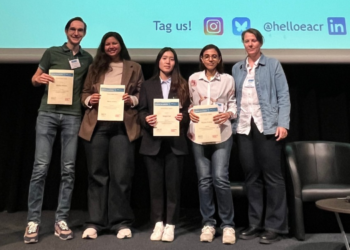

The EACR-Mark Foundation-Pezcoller Foundation Rising Star Award is open to EACR members with an unfunded Score ‘A’ cancer-related project from the previous year’s ERC Starting Grant calls. Established in 2023, this prestigious award aims to support pioneering projects that can have a transformative impact on the cancer research field.
The awardee receives funding of up to €100,000 to begin their project, and the award is intended to bridge the period before re-submission to the ERC. Following acceptance, the awardee is invited to give a talk at the EACR Congress as well as at the Pezcoller Foundation in Trento, Italy.
Isidro Cortés-Ciriano (2023)
 When he received the EACR Rising Star Award in 2023, Isidro Cortés-Ciriano was a Research Group Leader at EMBL-EBI. His work focused on understanding how the interplay between genetic diversity and immunosurveillance shapes the evolution and immunogenicity of human cancers.
Three years later, Isidro has taken on a major new leadership role as Oxford University’s first Little Princess Trust Professor of Paediatric Oncology. In this position, he is establishing a new research programme within the Department of Paediatrics, bringing together expertise from cancer biology, data science, drug development, and clinical research.
His focus has expanded towards improving outcomes for children with cancer by accelerating the translation of biological discoveries into new therapies. Reflecting on the appointment, he emphasised the opportunity to bring together multidisciplinary expertise to develop more effective and less toxic treatments, while building collaborations across Oxford and the wider childhood cancer research community.
“This landmark moment in my career reflects the generosity and support of so many people: I am ever grateful to my mentors for their training and guidance, my talented team members and our fantastic collaborators across the UK and overseas, our funders(!) and, most importantly, the inspirational patients and their families with whom we have had the privilege of working over the years. Their commitment to improving outcomes for patients with cancer is one that we share, and it is the beacon that will continue to guide us every day.” – Isidro
Stamatis Papathanasiou (2024)
 In late 2023, Stamatis Papathanasiou, Group Leader at the Institute of Molecular Biology (IMB) in Mainz, received the 2024 Rising Star Award for his proposal, ‘Mechanisms of cellular response to errors in mitosis: a new, non-genetic approach to an old question.’
“The Rising Star Award has been transformational for us during the first year of establishing our lab. Apart from financially supporting our research, the main reason was that it provided exposure of our research to the scientific community of cancer research in Europe and worldwide.” – Stamatis Papathanasiou
His initial research sought to understand how errors during cell division could cause heritable transcriptional dysregulation and epigenetic instability, which can in turn contribute to cell senescence, ageing and cancer.
Stamatis received the ERC Starting Grant the following year, and has been able to further establish his research career and his lab with this prestigious award. He continues to lead his laboratory at IMB, where his group is developing new, innovative approaches and builds upon the novel methods they have recently established, such as a new experimental and computational framework that links phenotype to function at the single-cell level (“Look-Seq2”) and advanced cellular systems for long-term tracking of mis-segregated chromosomes.
“This is exciting news for our lab. Funding from the ERC opens new avenues for our research towards unravelling previously unknown ways in which the cell responds to errors in mitosis.” – Stamatis Papathanasiou on receiving the ERC Starting Grant
The impact of this research is reflected in a growing publication record. In 2026, Stamatis co-authored a paper in Science demonstrating that DNA-protein cross-links can promote cGAS-STING-driven premature ageing and embryonic lethality. Earlier, in 2025, he and colleagues published a methodology for transgenerational tracking of chromosomes originating from micronuclei. Together, these studies demonstrate a continued focus on understanding how chromosome instability influences cellular ageing and disease.
Marta Kovatcheva (2025)
 Marta Kovatcheva received the EACR Rising Star Award in 2025 while serving as a Group Leader at the AIRC Institute of Molecular Oncology (IFOM) in Milan.
Her award-winning proposal was titled: ‘Controlling epithelial cell plasticity during tissue regeneration using one-carbon metabolism’. The project addressed a fundamental question in cancer biology: how cells that temporarily revert to a more flexible, regenerative state following tissue injury may contribute to tumour development.
“Receiving this award is an incredible honour. I am truly humbled and grateful to have been chosen, especially considering the extraordinary caliber and creativity of the applicants. Experimentally speaking, this recognition is a very exciting opportunity for the lab to embark on some of our most ambitious research lines, which we hope will significantly contribute to our understanding of cancer initiation and progression. I am especially looking forward to the opportunity to share our work at the annual EACR Meeting, at the Pezcoller Foundation, and with the Mark Foundation community; these organisations embody the spirit of collaboration and excellence in cancer research.
“I believe that the greatest strides in our research tend to emerge from fruitful conversations, inspiring ideas, and meaningful collaborations, and I am deeply grateful to the Rising Star Award for providing recognition and the impetus to propel our work forward.” – Marta Kovatcheva
Today, Marta continues to lead her laboratory at IFOM as a tenure-track Group Leader. Her team uses in vivo lineage-tracing models alongside multi-omic approaches to determine whether injury-induced dedifferentiated epithelial cells directly contribute to tumourigenesis, how this process alters epigenetic states, and whether these cellular fates can be manipulated through 1-carbon metabolism manipulation.
In addition to advancing her research programme, Marta has become an increasingly visible member of the cancer research community. Since receiving the award, she has spoken at the 2025 and 2026 EACR Congresses in Lisbon and Budapest, delivered a lecture at the CIBIO Department in Trento, spoke at the 3rd MIA-Portugal Ageing Spring School in Coimbra, was a keynote speaker at The 4th Young Scientist Cancer Congress in Toulouse, and was an organiser of the 10th Annual International Cell Senescence Association Conference in Rome, reflecting the growing reach of her impactful work on cell plasticity, ageing, and cancer.
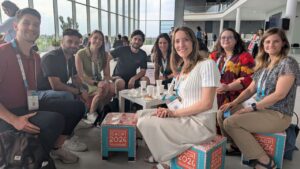
“I had a wonderful time hosting a roundtable at the Career Development Session at the European Association for Cancer Research (EACR) Annual Congress in Budapest. I shared my own experience of starting my lab at IFOM and we talked about the challenges and privileges of the academic career path. So much enthusiasm and inspiration — the future of science is in good hands 😊” – Marta Kovatcheva
Daniel Kirschenbaum (2026)
 The most recent recipient of the Rising Star Award is Daniel Kirschenbaum, who received the award in 2026. Daniel was selected for his innovative research proposal on understanding the dynamic behaviour of immune cells in brain tumours. By combining clinical insight with innovative single-cell technologies, he aims to reveal how immune responses unfold in real time.
“I am truly honoured to receive this prestigious award, and humbled to be selected from among so many outstanding applicants. It is especially encouraging that the selection committee recognised our scientific vision and approach. This award represents tremendous support and will enable us to push the boundaries of how we study immune cells in cancer. It will allow us to pursue our most ambitious experiments and explore the spatiotemporal control of immune cell behaviour in unprecedented depth.
I am also excited about the interactions and exchange of ideas with the EACR community that the Rising Star Award will make possible. I am very grateful to the EACR, the Mark Foundation, and the Pezcoller Foundation for this opportunity.” – Daniel Kirschenbaum
Despite being the newest recipient, Daniel has already found great success in the cancer research community, as the German Cancer Research Center (DKFZ) announced the exciting news that Daniel was awarded a Starting Grant from the European Research Council (ERC) in September 2026.
“I’m very excited to share that we have been awarded the European Research Council (ERC) Starting Grant! We have shown previously that immune cells change their state very quickly in vivo. For example, after entering a tumor, they lose their anti-cancer function within hours. So we need a deeper look at the cues that immune cells are exposed to early. And because immune cells wander through tissue quickly, we need to factor in their spatial history too.” – Daniel Kirschenbaum
Congratulations to Daniel and his team, we can’t wait to see where this new opportunity takes you!