
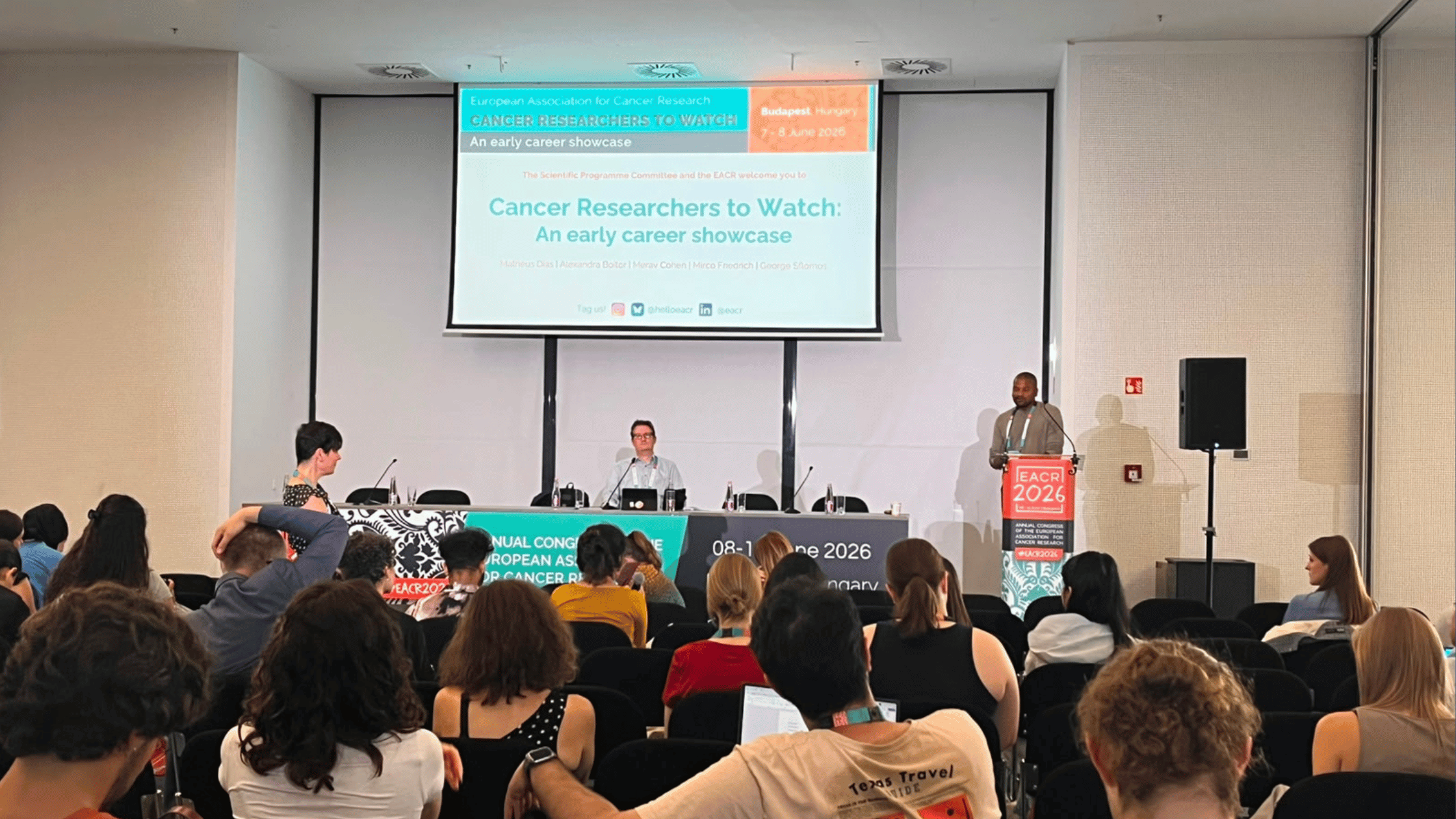
Cancer Researchers to Watch: An Early Career Showcase is a meeting organised by and for early-career researchers, held every year ahead of the EACR Congress in June. Organised by selected members of the EACR Early Career Researchers Council, this event is designed to provide a platform for the next wave of cancer researchers and in this spirit, gave an additional 8 PhD students and postdoctoral researchers who submitted abstracts to the EACR 2026 Congress the opportunity to present their work alongside invited junior group leaders.
This year, the event brought together 277 emerging researchers from 45 countries to share their work, discuss new ideas and methods, and build meaningful connections with peers. The programme brought together a broad spectrum of perspectives spanning the cancer research continuum, from fundamental discovery science to clinical practice. It covered a wide range of research topics across multiple cancer types, from diverse solid tumours to haematological malignancies, while integrating molecular and immunological aspects of cancer progression, plasticity, treatment resistance, and emerging therapeutic strategies.
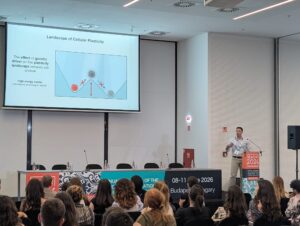
Matheus dos Santos Dias, junior group leader at the Princess Máxima Center opened the meeting with a fitting question, ‘What makes a cancer cell a cancer cell?’, then focused the conversation on the role of oncogenic signalling in underlying the hallmarks of cancer. Dr Dias focused on a critical aspect of oncogenic signalling: the need for optimal rather than maximal oncogenic signaling, bringing in conversation the concept of therapeutic overactivation of oncogenic signaling [1,2]. This concept is central to Dr Dias’ work. A couple of examples explored as part of this lecture include FGF 2 [3] and LB-100 [4,5].
Two of the proffered papers investigated other important determinants of cancer progression. In his presentation, Gabriel Diamante, PhD student in Rene Jackstadt’s group at DKFZ, focused on genetically instructed plasticity as a critical driver of metastasis [6, 18]. Raheleh Amirkhah, postdoctoral researcher in Philip Dunne’s group at Queens University Belfast, looked at the impact of regional epithelial zonation on shaping tumour initiation and evolution in colorectal cancer [18].
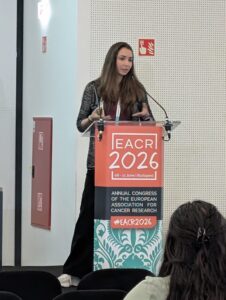
In addition to tumour progression, our attention was directed towards cancer treatment and therapy resistance. Natalie Scholes, junior group leader at the Netherlands Cancer Institute, spoke about targeted protein degradation, focusing on inhibitor-induced supercharging of native protein turnover [7]. Bristi Basu, clinical principal research associate at the University of Cambridge, directed her attention towards KRAS targeting in pancreatic cancer, considering both the effect on the tumour and its microenvironment. Yaara Oren, junior group leader at Tel Aviv University, focused her talk on mechanisms involved in therapy resistance and introduced the audience to the concept of persister cells. Kelsy Prest, PhD student in Elanor Wainwright’s group at Peter MacCallum Cancer Centre, looked for mechanisms of relapse in acute myeloid leukaemia through functional interrogation of rare persistent clones.
Adding another dimension to the conversation, several presentations focused on the tumour microenvironment, with particular emphasis on the immune microenvironment.
Merav Cohen, junior group leader at Tel Aviv University, explored the role of the crosstalk between immune cells and tissue niches in determining the function of tissue and resident cells [8,9]. In order to highlight novel mechanisms promoting tumour growth, Dr Cohen drew comparisons between molecular signaling networks that sustain tissue development and those that promote carcinogenesis. Her presentation had two focal points: the physical crosstalk between neutrophil and epithelial cells on one hand and cancer cells on the other hand in the mammary gland and the lysosomal acidification levels in alveolar macrophages in lung cancer [8]. To characterise the signalling niches promoting cancer aggressiveness, Dr Cohen’s experimental approach spanned scales from single-cell analyses to cellular niches across different time points.
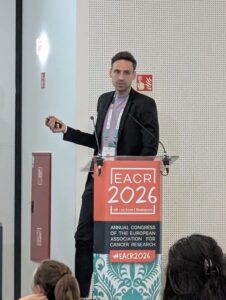
Several other aspects of tumour microenvironment were addressed during the meeting. Michael Kilian, postdoctoral research fellow at Brigham and Women’s Hospital and Harvard Medical School, discussed about the cellular interactions sculpting the immunity of the central nervous system. Samantha George, postdoctoral researcher in Victoria Sanz-Moreno’s group at The Institute of Cancer Research, explored the interaction between metastatic amoeboid cancer cells and tumour-associated macrophages, uncovering a potential therapeutic avenue [18]. Anaïs Eberhardt, scientific project manager in Julie Caramel & Stéphane Dalle’s group at the Cancer Research Center of Lyon, talked about the role of auto-antibodies directed against cytokines in the regulation of anti-tumor immune response in cancer patients [18]. Alex Jordan, PhD student in Kairbaan Hodivala-Dilke’s group at Barts Cancer Institute, presented a screen for a stromal gene signature that identifies increased recurrence [18]. Kamil Lisek, postdoc in Nikolaus Rajewsky’s group at Max Delbruck Center for Molecular Medicine, presented spatially resolved transcriptomic approaches to identify and characterise the early, coordinated events that initiate and structure tumour microenvironment remodeling in triple-negative breast cancer [10, 18].
The meeting also showcased a range of cutting-edge technologies that are driving advances in cancer research. Some presentations highlighted innovative experimental and computational approaches, such as Effero-seq, for instance [9], a technique developed by Dr Cohen’s group that couples single-cell transcriptomics with lysosomal acidification levels for single macrophages. Mirco Friedrich, junior group leader at DKFZ, presented synthetic immunology approaches to target blood cancers, focusing on a microfluidic-based platform to detect blood cancer-specific T cells [16] and novel in vivo delivery systems such as ‘Photobacterium virulence cassettes’[17].
Emerging techniques to model the disease were also showcased at the meeting, enabling increasingly detailed interrogation of tumour biology, the tumour microenvironment, and disease evolution. George Sflomos, junior group leader at the University of Geneva, addressed in his talk preclinical modeling of Lobular Breast Cancer. Dr Sflomos presented a comparison between various mouse breast cancer models and their uses [11], including an intraductal model [12,13]. This cancer model has tremendous translational potential due to its ability to express physiologically relevant hormone action, and Dr Sflomos presented a practical example of how this model was used to uncover an actionable signaling axis and test a translatable therapeutic strategy [14]. Another interesting cancer model was described by Paul Marcoux, postdoctoral researcher in Camille Laurent’s team at the Toulouse Cancer Research Center, who used a patient-derived 3D ex vivo model to understand heterogeneous treatment responses to Glofitamab for B-cell non-Hodgkin lymphoma [15, 18].
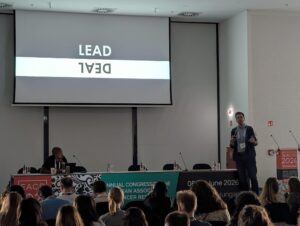
The Showcase concluded with a keynote lecture from Arkaitz Carracedo, professor and group leader at CIC bioGUNE. Prof Carracedo focused his lecture on leadership, sharing practical advice on how to run a lab rooted in literature and personal experience. His lecture emphasised the need to balance scientific knowledge with creativity and motivation, and the need for retrospection, introspection and continuous professional and personal development. Through his openness and authenticity, Prof Carracedo connected with the audience, and his inspirational lecture offered early-career researchers at the meeting not only valuable advice, but also a boost in motivation.
The meeting concluded having successfully fostered scientific exchange, collaboration, and new ideas across the early-career cancer research community. Participant feedback reflected the impact of the event, with 97% of respondents indicating that they would recommend the meeting to others. Moreover, 90% reported that the programme sparked new ideas or ways of thinking that they plan to explore further in their own research, while 72% established new professional connections during the event. These outcomes highlight the meeting’s success in bringing together researchers and clinicians from diverse disciplines to stimulate discussion, inspire future research, and strengthen collaborative networks.
References
- Dias M, Papagianni C, Bernards R, The case for therapeutic overactivation of oncogenic signaling as a potential cancer treatment strategy, Cancer Cell, 2024; 42, 919-922
- Dias MH, Bernards R. Playing cancer at its own game: activating mitogenic signaling as a paradoxical intervention. Molecular Oncology. 2021;15(8):1975-85.
- Dias MH, Fonseca CS, Zeidler JD, Albuquerque LL, da Silva MS, Cararo‐Lopes E, Reis MS, Noël V, Dos Santos EO, Prior IA, Armelin HA. Fibroblast Growth Factor 2 lethally sensitizes cancer cells to stress‐targeted therapeutic inhibitors. Molecular oncology. 2019;13(2):290-306.
- Dias MH, Friskes A, Wang S, Fernandes Neto JM, van Gemert F, Mourragui S, Papagianni C, Kuiken HJ, Mainardi S, Alvarez-Villanueva D, Lieftink C. Paradoxical activation of oncogenic signaling as a cancer treatment strategy. Cancer Discovery. 2024;14(7):1276-301.
- Dias MH, Papagianni C, Bernards R. PEBP1 is a candidate biomarker of response to the PP2A inhibitor LB-100. bioRxiv. 2025; 2025-02.
- Mastel M, Guiseris Martinez A, Diamante G, Meier J, Schuchmann L, Georgakopoulos N, Chiotakakos I, Steffens LK, Artmann C, Benitez D, Guenther M. Genotype-phenotype mapping identifies fetal-like CD55+ immunoregulatory cancer cells as mediators of immune escape in colorectal cancer. bioRxiv. 2026:2026-01.
- Scholes NS, Bertoni M, Comajuncosa-Creus A, Kladnik K, Guo X, Frommelt F, Hinterndorfer M, Razumkov H, Prokofeva P, Schwalm MP, Born F. Inhibitors supercharge kinase turnover through native proteolytic circuits. Nature. 2026 Jan;649(8098):1032-41.
- Camargo S, Moskowitz O, Giladi A, Levinson M, Balaban R, Gola S, Raizman A, Lipczyc K, Richter A, Keren-Khadmy N, Barboy O. Neutrophils physically interact with tumor cells to form a signaling niche promoting breast cancer aggressiveness. Nature Cancer. 2025 Mar;6(3):540-58.
- Balaban R, Moskowitz O, Levinson M, Ofer N, Raizman A, Kitron GL, Aviv E, Camargo S, Goldman L, Leemann A, Noachas E. Efferocytosis induces proangiogenic function and chromatin remodeling in tumor-associated macrophages. Science immunology. 2026 Jun 5;11(120):eaed1544.
- Lisek K, Theurillat I, Pentimalli TM, Beier S, León-Periñán D, Antonatou A, Dubnov S, Müller M, Hubl F, Xhuri A, Romanowicz H. Spatiotemporal dynamics of tumor microenvironment remodeling. bioRxiv. 2025 Jul 18:2025-07.
- Sflomos G, Schipper K, Koorman T, Fitzpatrick A, Oesterreich S, Lee AV, Jonkers J, Brunton VG, Christgen M, Isacke C, Derksen PW. Atlas of lobular breast cancer models: challenges and strategic directions. Cancers. 2021 Oct 27;13(21):5396.
- Sflomos G, Dormoy V, Metsalu T, Jeitziner R, Battista L, Scabia V, Raffoul W, Delaloye JF, Treboux A, Fiche M, Vilo J. A preclinical model for ERα-positive breast
- Sflomos G, Battista L, Aouad P, De Martino F, Scabia V, Stravodimou A, Ayyanan A, Ifticene‐Treboux A, Bucher P, Fiche M, Ambrosini G. Intraductal xenografts show lobular carcinoma cells rely on their own extracellular matrix and LOXL1. EMBO molecular medicine. 2021 Mar 5;13(3):EMMM202013180.cancer points to the epithelial microenvironment as determinant of luminal phenotype and hormone response. Cancer cell. 2016 Mar 14;29(3):407-22.
- Flaherty RL, Hughes F, Sflomos G, Ronchi C, Kemp H, Roumeliotis TI, Nicholas AA, Ambrosini G, Ziehme A, Becker S, Yang WW. LOX Inhibition Disrupts a Collagen–Integrin–MYC Axis to Suppress Progression of Invasive Lobular Carcinoma. Cancer Research. 2026 May 15;86(10):2487-507.
- Marcoux P, Gava F, Tosolini M, Gravelle P, Schniederjohann C, Quertinmont S, Serrat N, Bouquet F, Herter S, Tarte K, Roussel M. Patient-derived lymphoma spheroids reveal predictive markers of glofitamab resistance in relapsed/refractory B-NHL. Blood. 2026 Jun 4;147(23):2770-85.
- Wagner TR, Kehl N, Steiger S, Boschert T, Kilian M, Foster K, Hernandez GM, Ctortecka C, Michel J, Schach A, Zoller J. Conserved programs and specificities of T cells targeting hematological malignancies. bioRxiv. 2025 Aug 10:2025-08.
- Kreitz J, Friedrich MJ, Guru A, Lash B, Saito M, Macrae RK, Zhang F. Programmable protein delivery with a bacterial contractile injection system. Nature. 2023 Apr 13;616(7956):357-64.
- Abstracts submitted to the ‘EACR 2026 Congress: Innovative Cancer Science’, from 08–11 June 2026 and accepted by the Congress Organising Committee. Mol Oncol. 2026, August 23, 20: 1-692. https://doi.org/10.1002/1878-0261.70318