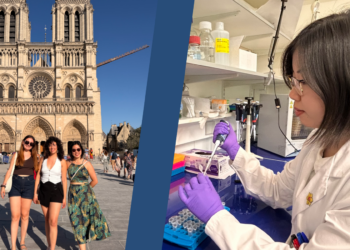

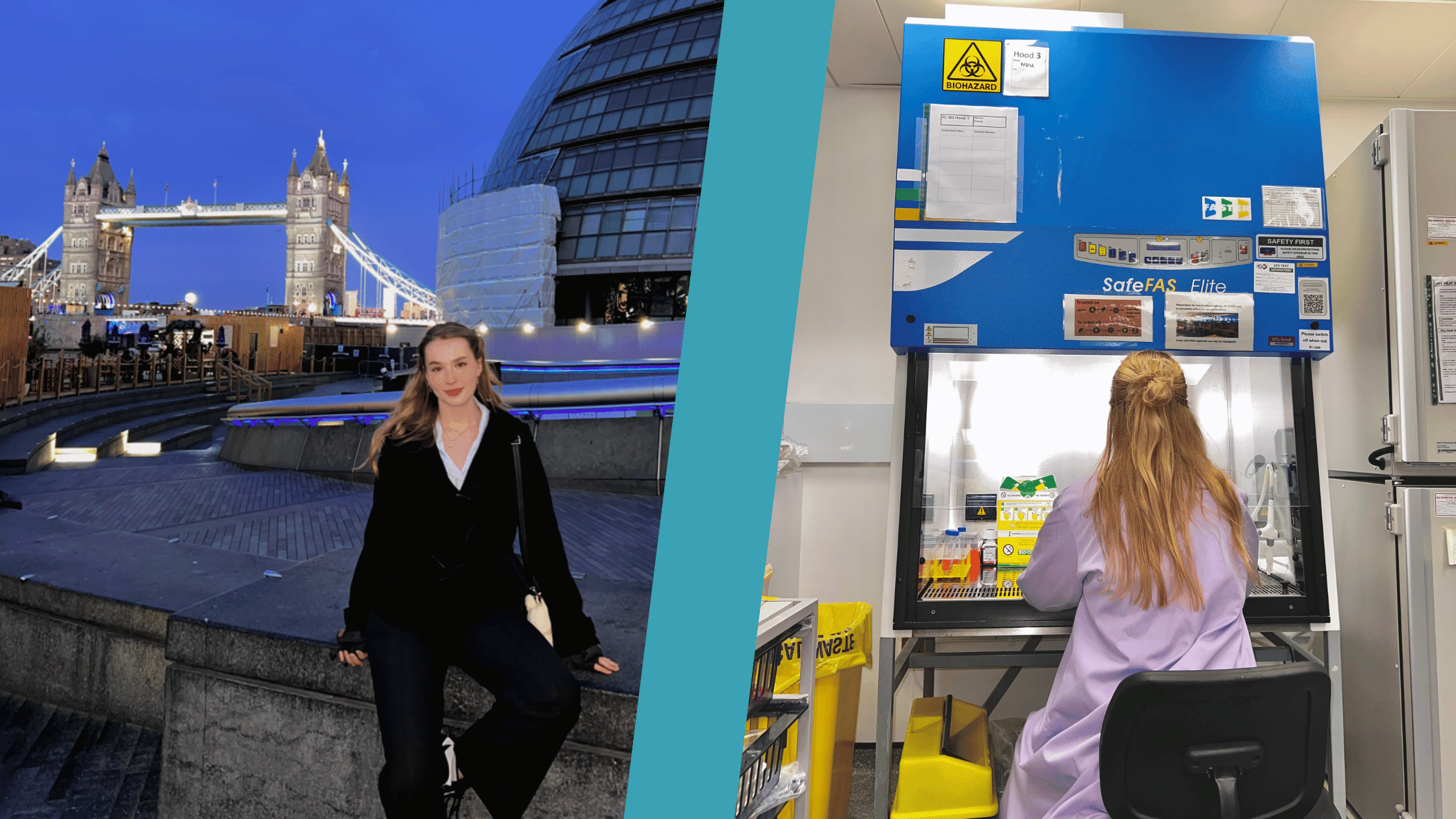
Ana S. De la Rosa-Herencia is a PhD student at the University of Córdoba, Spain who received an EACR Travel Fellowship to visit and work at the University College London, in the United Kingdom between 18 September 2025 and 22 December 2025.
The EACR, with support from Worldwide Cancer Research, provides Travel Fellowships of up to €3,500 to enable early-career cancer researchers to gain new skills through a short-term visit to a lab or research group in another country.
You can read about other Travel Fellows and their experiences here.
What is the topic of your current research?
I study paediatric brain tumours, a leading cause of cancer-related complications and mortality in children. Cancer can arise through multiple mechanisms, including disruptions in the processing of genetic information. My research focuses on alterations in gene expression regulation, particularly RNA splicing, a fundamental process that generates protein diversity and functional versatility. When this system is corrupted, tumour cells can acquire increased proliferative capacity and resistance to therapy. My goal is to identify key regulators of RNA splicing that may serve as novel diagnostic, prognostic, or therapeutic targets for these devastating diseases.
Why did you decide to apply for an EACR Travel Fellowship?
I decided to apply for an EACR Travel Fellowship because I have followed the EACR closely throughout my scientific training and strongly identify with its mission to support and promote early-career researchers. The EACR offers unique opportunities for young scientists to expand their scientific horizons, build international collaborations, and gain exposure to high-quality cancer research. For me, this fellowship represented not only financial support, but also a chance to become more actively involved in the EACR community. One of my main motivations was to broaden my professional network and connect with other scientists working in cancer research, particularly those engaged in neuro-oncology. I considered this fellowship an ideal opportunity to strengthen my scientific profile, learn from leading experts in the field, and contribute to meaningful collaborative research.
How did you choose the host lab?
The host lab led by Prof. Juan Pedro Martínez-Barbera at the UCL GOS Institute was chosen based on a successful previous collaboration established by my PhD supervisor for another project. This collaboration resulted in a recently published study on rare paediatric brain tumours, specifically craniopharyngioma, a field in which the host group, is a pioneer and one of the largest contributors worldwide. Given this strong foundation, my visit aimed to further strengthen this existing collaboration and expand our joint research efforts in paediatric brain tumours. The JP lab’s expertise in tumour heterogeneity, cellular senescence, and treatment response—particularly radiotherapy—was highly aligned with my research interests. Moreover, their extensive experience in paediatric neuro-oncology made his group an ideal environment to deepen my knowledge and develop new translational research directions.
Could you summarise the work you did on your fellowship visit?
During my visit, I primarily focused on learning the biological principles of cellular senescence and its diverse roles in cancer, particularly in paediatric brain tumours. I learned how to correctly identify senescent cells within the tumour microenvironment and distinguish them from other non-proliferative cell populations. A key concept I gained was that senescence is not always a terminal state; depending on external stimuli, such as therapy, senescent cells can re-enter the cell cycle, acquire stem-like properties, and behave more aggressively. I also learned how senescent cells can influence tumour composition and adaptation through the secretion of specific factors. In addition, thanks to the strong connections within UCL, I attended seminars and scientific discussions with other research groups. One particularly inspiring topic was the use of mathematical models to assess drug and radiotherapy combinations based on pharmacokinetic and pharmacodynamic parameters.
What were you able to do that you could not have achieved in your home lab?
This visit allowed me to overcome several limitations present in my home lab. Most importantly, I gained access to unique paediatric brain tumour samples, specialised expertise in senescence biology, and advanced animal model strategies that are not readily available at my institution. I was able to learn how to correctly characterise senescent cells within complex tumour microenvironments and understand their dynamic behaviour following treatment. Additionally, the interdisciplinary setting at the host institution exposed me to computational and mathematical modelling approaches that I had not previously encountered. These experiences significantly expanded my technical and conceptual skill set and opened new research avenues that would not have been possible without this visit.
The trip profoundly inspired my research by reshaping how I view treatment-induced senescence in cancer.
Did you take part in any interesting local or cultural activities?
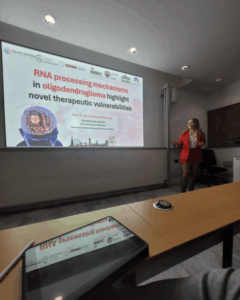
Yes, I actively participated in several local and academic activities during my stay. In particular, I became involved with the Society of Spanish Researchers in the UK (SRUK) and took part in its Cancer Seminar series, where I had the opportunity to present and discuss one of my research projects with other early-career researchers as well as established group leaders. This experience allowed me to receive valuable feedback and engage in stimulating scientific discussions. Being part of SRUK also enabled me to integrate into the local research community and contribute to organising and participating in different scientific events. Importantly, this involvement allowed me to connect with researchers at different career stages, who provided advice and guidance that helped me better define my next career steps, as I am currently in the final year of my PhD. Additionally, I attended an event organised by the British Spanish Society, where the work of young researchers conducting research in the UK was recognised. Hearing about their experiences and enthusiasm was highly motivating and inspired me to aim to participate with my own work in future editions.
What was a personal highlight of your trip?
A personal highlight was the opportunity to engage in in-depth scientific discussions with experts in paediatric brain tumours, senescence, and therapy response. Also, I was able to discuss my own data with my host group who have extensive experience in this field and were extremely valuable in helping me see my project from new perspectives. Notably, I appreciated the openness of the group to share ideas, question assumptions, and think critically about experimental design and interpretation. Another highlight was attending internal seminars, the Glioma-Club and joint meetings with other UCL groups, which exposed me to complementary approaches such as mathematical modelling applied to cancer therapy. These experiences not only strengthened my scientific confidence but also reinforced my motivation to pursue an academic career focussed on translational brain cancer research.
Was there anything in particular you enjoyed about your host institution?
The host institution differed from my own mainly in its strong emphasis on interdisciplinary collaboration. I particularly appreciated how experimental biology, clinical research, and computational modelling were closely integrated. Regular interactions between different research groups encouraged open discussion and innovative problem-solving. The international and collaborative atmosphere, combined with a rich seminar program, created a highly stimulating scientific environment.
Did you have a personal mentor or anyone who particularly helped you?
My host supervisor, JP Martinez-Barbera, played a key mentoring role during my visit. His extensive expertise in paediatric brain tumours, senescence, and radiotherapy response was invaluable. He dedicated significant time to discussing experimental strategies, interpreting results, and placing my work in a broader translational context. Additionally, the members of his lab, special mention to Hiba, were extremely supportive and always willing to help with technical and conceptual questions.
How has this visit been beneficial to your research and your career?
The trip profoundly inspired my research by reshaping how I view treatment-induced senescence in cancer. Understanding senescence as a dynamic and potentially reversible state has influenced how I interpret therapy resistance and tumour recurrence. In my home lab, we plan to continue and expand our collaboration with the host lab. Building on our previous joint publication on craniopharyngioma, we are currently discussing new projects that integrate senescence biology, transcriptomic analyses, in brain tumours. These projects are expected to result in future joint publications and funding applications, further strengthening this long-term collaboration.
Is there anything else you’d like to mention?
This experience would not have been possible without the support of the EACR Travel Fellowship. Beyond the scientific outcomes, it allowed me to connect with inspiring researchers, explore new ideas, and gain clarity about my future career path. I am deeply grateful to the EACR for enabling this opportunity.
Want to find out more?

If you are interested in applying for the Travel Fellowship scheme, please click here for more information: EACR Travel Fellowships