
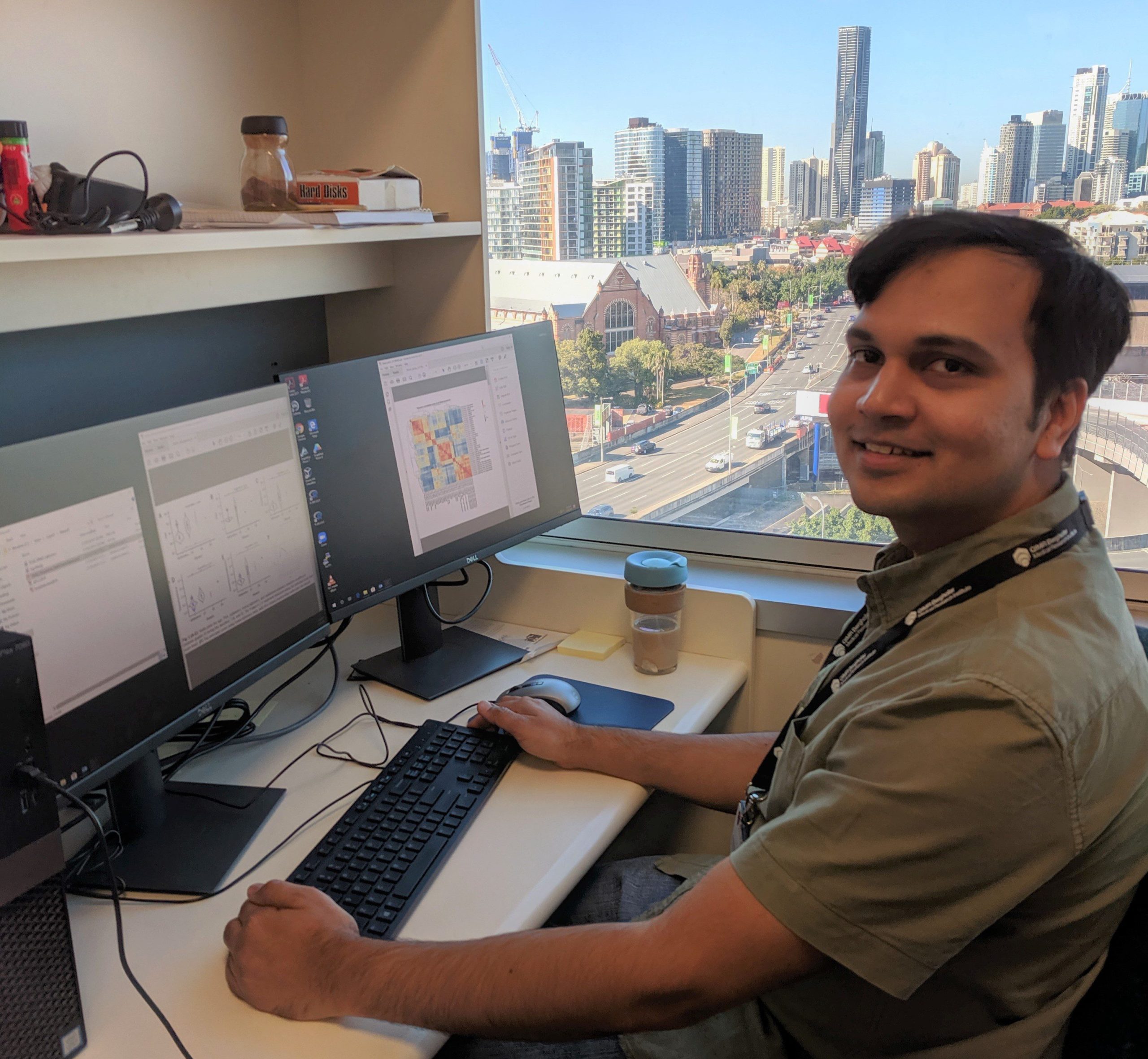
Sriganesh Srihari provides an insight into the world of AI and bioinformatics in cancer research, and how he learned that “if you feel it in your gut just be brave and take the leap of faith”.

24 September is World Cancer Research Day, which raises awareness of the important and lifesaving work done by researchers. As part of this the EACR asked a variety of members to share a day in their life as a cancer researcher.
Name: Sriganesh Srihari
Nationality: Australian
Place of work: (i) QIMR-Berghofer Medical Research Institute, Brisbane, Australia; (ii) Maxwell Plus (AI startup), Brisbane, Australia
Job title: (i) Scientific Officer; (ii) AI Engineer
How long you have worked there: Since 2012
Tell us about a typical day in your life in cancer research.

My typical week, if collapsed into a single day, is a combination of developing clinical AI tools and providing bioinformatics support to cancer immunologists. Therefore, I’m often on my own: coding away, running ‘experiments’ on massive amounts of data, browsing through stack-overflow for code snippets/solutions to technical bugs, researching new AI tools and new datasets to test them. However, sometimes, I am interacting with lots of enthusiastic immunologists and running statistical analysis and generating colourful figures. Once a week, I get more ‘startup’ and participate in all things startup. This includes morning team stand-ups, coffee, sprints, JIRA tasking, coding, talking math or tech stuff, more coffee, one-on-ones, sales figures, Slack banter, and end-of-the-day stand-downs. Occasionally, I am involved with manuscript and grant (co-)writing and reviewing, speaking and organizing presentations/events, and interacting with clinicians.
How does your work fit in with your home life?
Work-life balance in research/academia is hard, but I try to wind down whenever (and wherever) Often, I find some time by listening to music. You’ll usually find me with my headphones on while walking or on the bus. I enjoy and I am reading onto my fourth murder-thriller of the year. Also, I love gyming, and cooking but mostly only assisting my partner with the cooking.

What do you enjoy most about your work?
The thing that I enjoy the most about my work is the surprise element that it offers (be it in cancer biology or AI) every single day. Sometimes it is better even than the murder-thrillers. You analyse a dataset or code-up a tool/script and something new or a new angle to an existing turns up, often blowing you away with ‘Woah! I would have never anticipated that!’
Why did you choose to work in your field?
As is the case with many of interdisciplinary researchers, I accidentally stumbled my way into the field(s) I am in today and continue to find new directions and fields to explore. I started with theoretical computer science and algorithmics, where I tried to solve (hard) graph and network problems. However, in no time found myself working on protein interaction networks. This involved me finding protein complexes and modules from these networks. I wrote a book on the topic, published by ACM Books. This led me to cancer networks and systems biology, subsequently diversifying into other clinical and omics data types and approaches including machine and deep learning (AI) to deal with these diverse data. However, I am all into big multimodal, multiomics clinical data using AI to improve treatment, management, and care for cancer patients.

Have you learned anything about yourself working in your field?
An important lesson that I’ve learned, especially from my AI ventures in the last couple of years is: if you feel it in your gut just be brave and take the leap of faith. Don’t be too conservative, take calculated risks, and sometimes beginning even before you feel you’re fully ready makes all the difference. Moreover, it is important to channel all your failures, embarrassments, and frustrations to altering your life in a better way. Learn from cancer cells: adapt, adapt, adapt!
How can you get involved with World Cancer Research Day?
1. Sign the World Declaration for Cancer Research
2. On 24 September share a snapshot on social media from a day in your life as a cancer researcher: use #WorldCancerResearchDay
Click here to see more posts about a ‘Day in the Life’ of other cancer researchers.
About the author
I develop AI software to crunch massive amounts of patient data. This includes clinical risk factors, radiology images, pathology reports, as well as genetics and sequencing-based data to forecast patients’ chances of responding to particular treatments and cancer recurrence. These predictions are used to identify patients early who are not likely to do well under current treatments but instead can be directed to alternative more-effective treatments or clinical trials. I describe my job as enabling cancer discoveries using artificial intelligence and clinical application of AI tools to bring these discoveries closer to cancer patients.