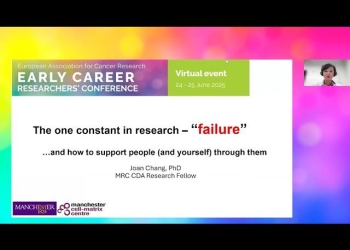



Many people find it difficult to speak in front of groups, whether that be their peers or a group of strangers. But every fantastic speaker that you’ve seen at a scientific conference was, at some point, a young scientist giving their first presentation, and probably feeling pretty nervous.
In a recent issue of Science magazine, EACR member Mathilde His gives her advice on how to stand out as a speaker. Her advice is very relevant to students and early-career members who will feel anxious and nervous about giving their first few talks. She writes about her progress from being “unable to control [her] shaking voice” to “[enjoying] each minute of [her] talks.”
“I never would have thought I would someday be so eager to give presentations.”
She discusses her initial struggles and what she did to combat them. Then, she explains her realisation that she was still not happy with how she was speaking. Finally, she discusses her growth in public speaking and how her “confidence grew” to the point where she now enjoys speaking.
Caring about the take-aways
My audiences started to appear energized and invested in what I was saying, and their questions showed that they had learned something.
While presenting to a nonscientific audience, Mathilde realised she wasn’t engaging with the audience. She wanted to do better. She decided to focus on the things people would learn from her presentations. Previously, she simply spoke as much as she could in a block of time. Mathilde explains how she changed her preparations from mainly performing relaxation exercises to new methods. For example, varying her presentation slides, writing scripts as more of a blueprint and concentrating on the message she wants to convey. By keeping the audience engaged, she knew she wouldn’t be the speaker who gave a disappointing presentation and couldn’t keep the audience interested.
Putting the hard work in
Most people like hearing stories, seeing interesting findings in the forms of graphs or meaningful pictures, and being guided through a slide with thoughtful animations. We don’t get much from walls of text.
As Mathilde points out, it isn’t merely about a speaker’s talent. Instead, good speakers prepare well and work hard in order to ensure that their “talks stand out”. Importantly, Mathilde highlights the value of feedback and rehearsals with colleagues, supervisors and friends. It provides a barometer for what is going right and what isn’t going right. For Mathilde, putting this hard work in during the preparation stage saw her “efforts rapidly [pay] off” and she felt like giving talks were no longer something of a chore but instead motivated her.
She gives four key tips that helped her become a speaker with invested audiences:
-
CURATE
-
SHOW, DON’T WRITE
-
PREPARE
-
LEARN FROM OTHERS, BUT FIND YOUR OWN STYLE
The idea of finding a style that suits each individual is a key message, something that is often overlooked by others when they give tips on how to be a good speaker. Mathilde discusses what works for her. However, she acknowledges that it isn’t universal and that it’s vital to find what works for each individual.
Read Mathilde’s article for Science Magazine here.