
Mikhail Ermakov is a PhD student at the Medical Univerity of Graz, Austria who received an EACR Travel Fellowship to visit and work at Harvard Medical School in the US between September 2024 and March 2025.
The EACR, with support from Worldwide Cancer Research, provides Travel Fellowships of up to €3,500 to enable early-career cancer researchers to gain new skills through a short-term visit to a lab or research group in another country.
You can read about other Travel Fellows and their experiences here.
Name: Mikhail Ermakov
Job title: PhD student
Home institute: Medical Univerity of Graz, Austria
Host institute: Harvard Medical School, US
Dates of visit: 01 December 2024 – 01 March 2025
Research: My research focuses on how genital cancers develop and progress at the molecular level. These cancers arise through two main cancer-causing pathways: one associated with human papillomavirus (HPV) infection and another independent of HPV, often occurring in the context of chronic inflammation. In my doctoral project, I study how DNA changes, such as mutations, differ between these tumour types and what their biological effects might be. My goal is to better understand cancer development and identify potential treatment options, ultimately improving how we fight these diseases.
Why did you choose the host lab?
My primary motivation was to gain a completely new research experience that would contribute to my ongoing studies and support my development as a cancer researcher. The Laboratory of Systems Pharmacology (LSP) is well-known for its expertise in spatial biology – an approach deeply embedded in classical pathology methods like H&E staining, but now significantly enhanced by multiplexed immunofluorescence and spatial transcriptomics. Given LSP’s expertise, including their development of cyclic immunofluorescence for multiplexed imaging and the MCMICRO bioinformatics pipeline for image analysis, it was an ideal choice for exploring this field, aligning perfectly with my research goals.
“I’m glad that I remain curious, continue to explore new ideas, and stay open-minded in my own research”
Can you summarise the research you did during your visit?
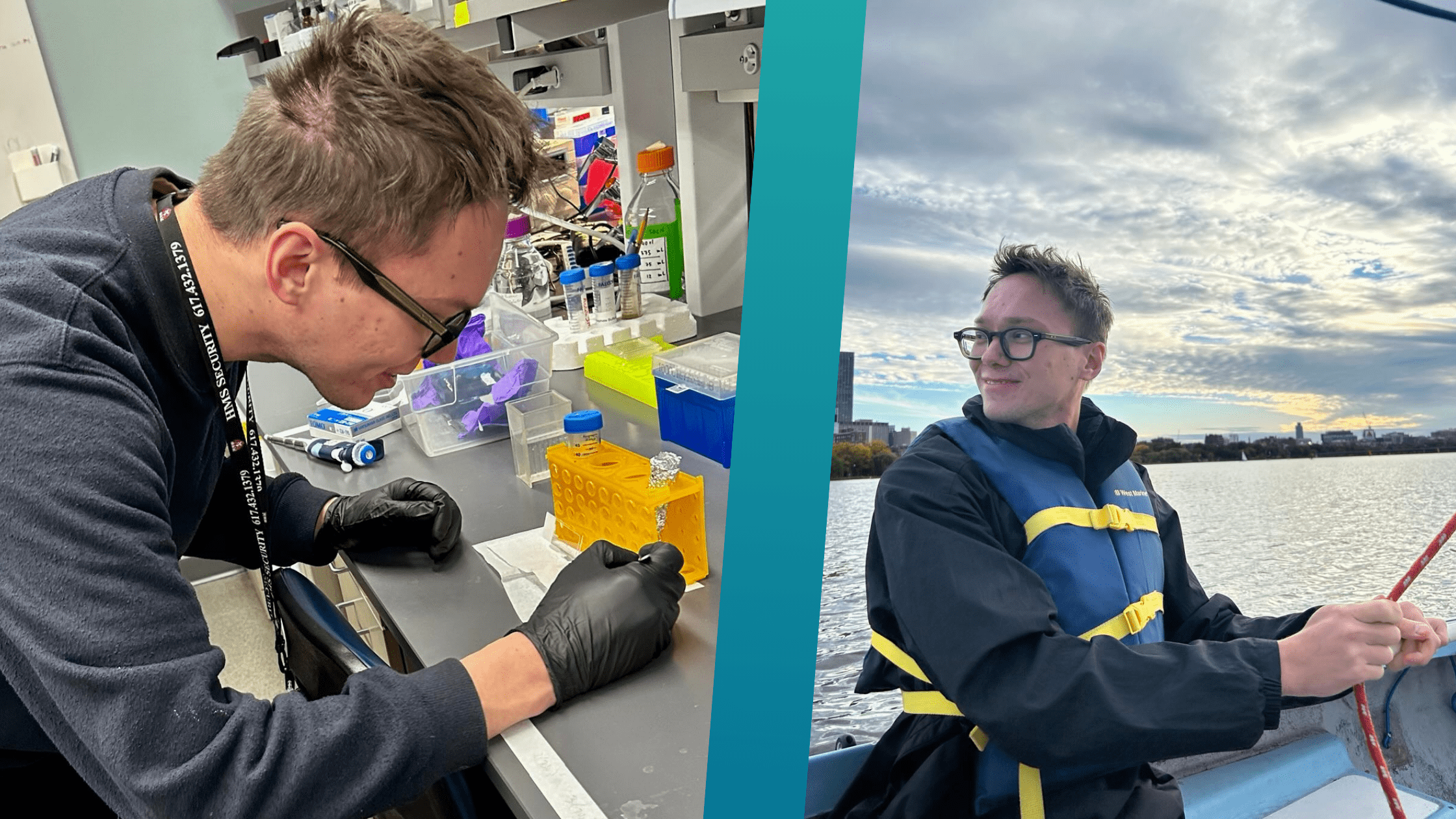
During my internship, I contributed to the development of a pathology-style reporting tool specifically designed for multiplexed imaging data generated by MCMICRO. I gained hands-on experience analyzing multidimensional single-cell data using Python, along with practical skills in cyclic immunofluorescence imaging and laboratory protocols. It was my first experience working with single-cell data analysis, and I believe it went really well!
 Did you take part in any interesting local activities?
 Did you take part in any interesting local activities?
I absolutely did! Massachusetts offers so much beyond research and career – I explored Boston’s museums, including the Museum of Fine Arts and the Harvard Natural History Museum, enjoyed local cultural activities and food, went hiking in the beautiful nearby nature, visited Salem during Halloween and even learned sailing on the Charles River. It was a perfect balance between research and experiencing local life.
Was the host institution very different from your own?
The experience at LSP was quite different from my home institution, mainly due to its larger scale and infrastructure. I particularly appreciated how LSP maintains a friendly, collaborative atmosphere usually found in smaller labs, despite its size. I also had great experience working closely with specialised teams dedicated to specific research problem (for example work with H&E images), software development and data organisation.
How has the trip inspired you in your research?
During my research stay, I felt inspired by the people I met at LSP and Harvard Medical School. I was impressed by their openness to exploring broad concepts in cancer research, while still focusing on details and designing practical, cancer-specific projects. I also attended several seminar series at our department and was happy to interact with scientists from leading US institutes who presented their perspectives on topics in cancer biology and immunology. I’m glad that I remain curious, continue to explore new ideas, and stay open-minded in my own research.
Have you brought back any specific knowledge or technique that has benefited your home lab?
Yes, and that was actually one of my main goals! In fact, I’m already applying what I learned – I am currently staining slides with antibodies to perform our lab’s first in-house cyclic immunofluorescence experiment. Additionally, I brought back a lot of knowledge about image analysis which is going to help us to work on the data.
Is there anything else you’d like to mention?
I want to mention that I’m deeply grateful to my home institute supervisors for their support. Professor Karl Kashofer consistently provides me with scientific freedom, greatly supporting my development in bioinformatics and actually inspired my research stay at LSP. Professor Sigrid Regauer, whose guidance sharpens my scientific ideas and encourages me to explore new paths, has been extremely important in helping me grow in my career as a cancer researcher.
At LSP, I appreciated mentorship, inspiring discussions and a lot of innovative ideas from Professor Peter Sorger. I’m also genuinely grateful to my colleagues – Jeremy Muhlich, Edward Novikov, Clarence Yapp, Ajit Nirmal, Zoltan Maliga, Tyler Jost, Gregory Baker, Ziyuan Zhao, Kristin Qian, Maxim Markovic, and all other lab members – for being welcoming, helpful, and open to thoughtful discussions. They made my experience both scientifically rewarding and personally enjoyable.
I’m also thankful to my PhD program at Medical university of Graz, the Austrian Marshall Plan Foundation and EACR Travel Fellowship for their generous support and making this research stay possible.
Want to find out more?

If you are interested in applying for the Travel Fellowship scheme, please click here for more information: EACR Travel Fellowships.