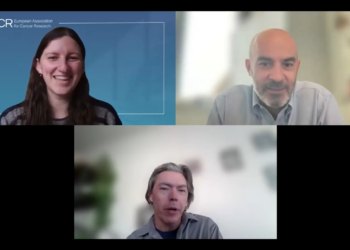


 Prof. Nicola Aceto of ETH Zurich, Switzerland is the deserving 2023 recipient of the Pezcoller-EACR Translational Cancer Researcher Award, recognising excellence in the field. We were delighted to speak with him recently about his experience of being a part of the cancer research community thus far in his career. He shares some invaluable advice for early career researchers, and what important qualities he looks for in new recruits to his lab.
 Prof. Nicola Aceto of ETH Zurich, Switzerland is the deserving 2023 recipient of the Pezcoller-EACR Translational Cancer Researcher Award, recognising excellence in the field. We were delighted to speak with him recently about his experience of being a part of the cancer research community thus far in his career. He shares some invaluable advice for early career researchers, and what important qualities he looks for in new recruits to
 What is your current research about?
Most of our work is focused on understanding key biological principles driving metastasis formation. We do this by interrogating cancer cells at key moments during their metastatic journey, particularly upon their detachment from a cancerous lesion, while they circulate in the bloodstream. Circulating tumor cells (CTCs) are hard to catch, yet they carry plenty of very useful information. What excites me most about this topic is that it is relatively “young” and with a lot remaining to discover. New findings in this context can be very impactful and generate knowledge that may enable the development of new drugs that interfere with cancer progression.
What’s your favourite part of each working day?
What I enjoy most about each working day is the moments invested in planning what comes next. Essentially, the creative part. This comes in many different forms and shapes, but clearly the most enjoyable is meetings with my team members. I meet everyone in my team very regularly and together, we discuss the newest data and plan the next set of experiments. There are plenty of exciting moments in there, where we feel we are really deciding which directions we should take in our explorations and imagining where this may lead us in a near future.
“I like to surround myself with very excited and energetic colleagues”
When did you know you wanted to be a scientist and was your career path planned out in any way?
Absolutely not. I am definitely not one of those people that always wanted to be a scientist. In fact, I decided this was my path relatively late, after obtaining my PhD. On the other hand, I have always been very interested in sports, and my real dream was (…and somehow still is…) to be a football player!!
What’s the best piece of career advice you were ever given?
Be nice, but firm. I am not sure this is a typical “career advice”, it is probably more like a general recommendation when it comes to interactions with colleagues and team members. It has however helped me taking decisions and shaping interactions in a few different work-related situations. I tend to be quite analytical when taking all kinds of decisions, calculating possible outcomes and likelihoods, while applying the “nice, but firm” advice.
What advice would you offer an early career scientist who wants to progress to your level?
Be scientifically very ambitious. Practically, this means aiming for discoveries that are not incremental on fields that are already relatively well studied, but really ask yourself the most exciting and unexplored questions and give all you have to answer them, even if very challenging. I find that often, too many young researchers underestimate the “discovery” part of their job, which is arguably the most exciting and rewarding, and shift the focus on aspects that while important, may have a narrower focus and lack a truly transformative nature.
What qualities do you look for when you’re hiring new scientists to your lab?
The answer depends a little on the specific position I am looking for. When it comes to younger team members, such as PhD students, I typically look for excitement for research and overall “energy levels”. I like to surround myself with very excited and energetic colleagues, who are clearly self-driven and cannot wait to do the next set of experiments (or better, discoveries). When it comes to more experienced team members, I still look for excitement but also at past achievements, experience in a particular subject and knowledge of the field. This helps creating the right “mix” in the lab, both in terms of creativity, experience and knowledge.
We thank Prof. Nicola Aceto for this interview, and invite you to learn more about the Pezcoller-EACR awards here. Nominations for the 2024 awards are open until 14 September 2023.