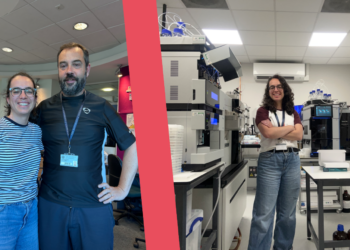

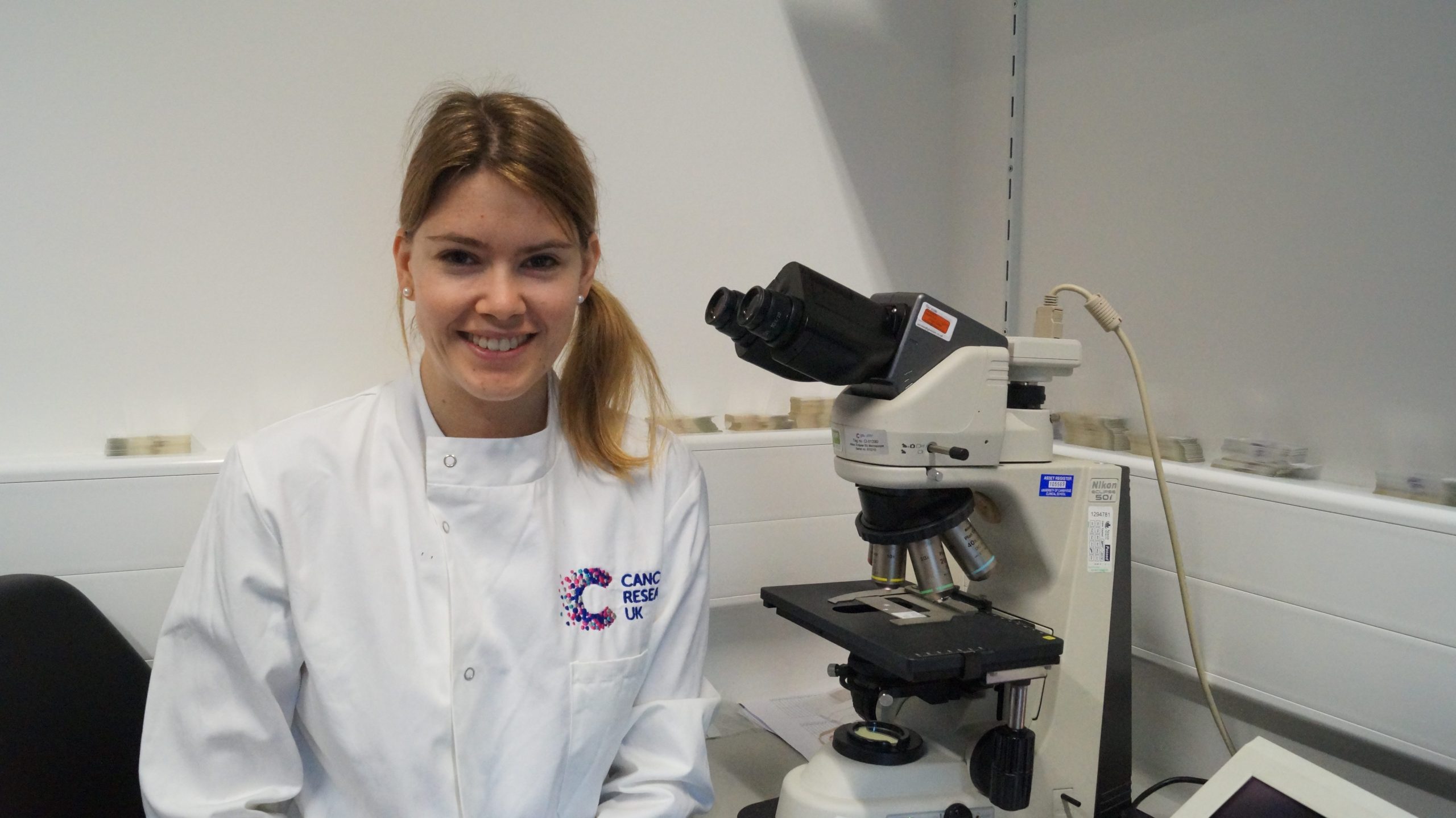
After spending what is described as “a rather painful night inside [… a] moderately aromatic boot”, Cora Olpe’s access badge takes us through a typical day in her life at the CRUK Cambridge Institute.

24 September is World Cancer Research Day, which raises awareness of the important and lifesaving work done by researchers. As part of this the EACR asked a variety of members to share a day in their life as a cancer researcher.
Name: Cora Olpe
Nationality: Swiss/Polish
Place of work: CRUK Cambridge Institute, University of Cambridge, UK
Job title: PhD student
How long have you worked there: Including undergraduate, since 2011 (PhD since 2016)

Usually, I am awoken at 7 am after spending a rather painful night inside of one of Cora’s moderately aromatic boots. She places the lanyard I am attached to on her neck and swings herself onto her road bike. There are only two possible destinations to our ride. The pool or the lab, turning right or left after leaving the house, respectively. The pool is boring for me, as I spend 90 minutes inside a damp, dark locker but at least it does not smell… During that time Cora swims about 3K to get herself pumped for the day. However, I much prefer it when we head directly to the institute.

Upon entry, Cora swipes me to get through an automatic barrier, very much alike to those you find at an airport or the London underground. The future is now. She then often heads straight to the histology department to check if any slides are ready for pick up. I am swiped again. Cora has VIP out-of hours access – thrilling.
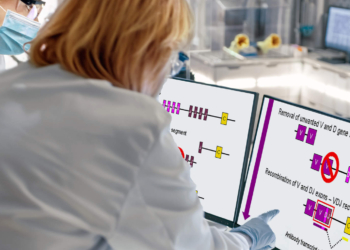
Cora spends a lot of her days looking down the microscope. She analyses pieces of human bowel on which she can visualise mutations in DNA by a technique called immunohistochemistry. This allows her to understand the very beginning of tumour growth. When I say a lot of days I mean a lot of days.
During her 3-year PhD she estimates to have looked at around 60,000,000 intestinal glands. Throughout those hours I have been there with her, enduring the painful monotony that comes with her quite peculiar style of listening to music: picking a song of the day and listening to it on repeat. The. Entire. Day. Some favourites include “Nobody to love” by Sigma, “Senza una Donna” by Zucchero and “Paradise” by Coldplay. Don’t judge her. I do enough of that already.

Unfortunately, Cora often spends her lunch break working at her desk, sorting out emails, fighting against Microsoft Excel or marking students’ work. Me on the other hand, I just chill and observe. I wonder how she can ever find anything on that messy desk of hers. There are three stacks of research papers, sleeves with more microscope slides, STAR WARS paraphernalia and often seasonal decorations such as a Christmas tree and lights.
As of this year, the lights have turned into an all-year installation as they are pink, Cora’s favourite colour. In fact, most of her lab ware is pink, including her microscope slides, her tube holders, her lab tape, scissors etc. It keeps her happy during those long lab days, which can sometimes be quite lonely, especially out of hours. Thank god she has me there, keeping her company, helping her gain access to all the important areas such as the microscopy facility or the store room.

However, there are days when she just sits at her computer all day, analysing data, reading papers or writing her thesis. It gets very boring as I just hang there, on my own. Sometimes she even takes me off and leaves me on the side. Sad times. For a while I had a partner, the freezer card, with which Cora could purchase chemicals. We were great friends, despite her slightly arrogant attitude. Cora once blew £500 on chemicals in a week while my café purchases usually amount to a tenner a month. It made her very cocky. However, now that Cora’s PhD is coming to an end, she has run out of grant money, so the card had to go and I’m alone again. I hope she is in a better place now.
Nevertheless, I feel privileged to be part of Cora’s exciting job. Every day, when she swipes me to get across the barrier to leave the building and cycles me home, I can hear her whistle those awful Coldplay songs. I know she’s done some cool science and is happy with it. I hope it will advance our understanding of cancer. It’s that thought that makes it bearable to spend yet another night inside those frankly quite smelly boots. Someone buy the woman a (pink) hook.
How can you get involved with World Cancer Research Day?
1. Sign the World Declaration for Cancer Research
2. On 24 September share a snapshot on social media from a day in your life as a cancer researcher: use #WorldCancerResearchDay
Click here to see more posts about a ‘Day in the Life’ of other cancer researchers.
About Cora’s work:
In the human bowel, several genetic mutations need to happen in the same cell for it to turn into a cancer cell. We have a number of methods to visualise or infer the presence of mutations in normal bowel tissue. By looking at samples from individuals of a wide range of ages we can understand how mutations accumulate in this tissue as we age and how this may promote colorectal cancer. We are also hoping to gain insights into the impact of lifestyle factors such as obesity and smoking on bowel cancer incidence. Together, these studies may inform prevention strategies.