
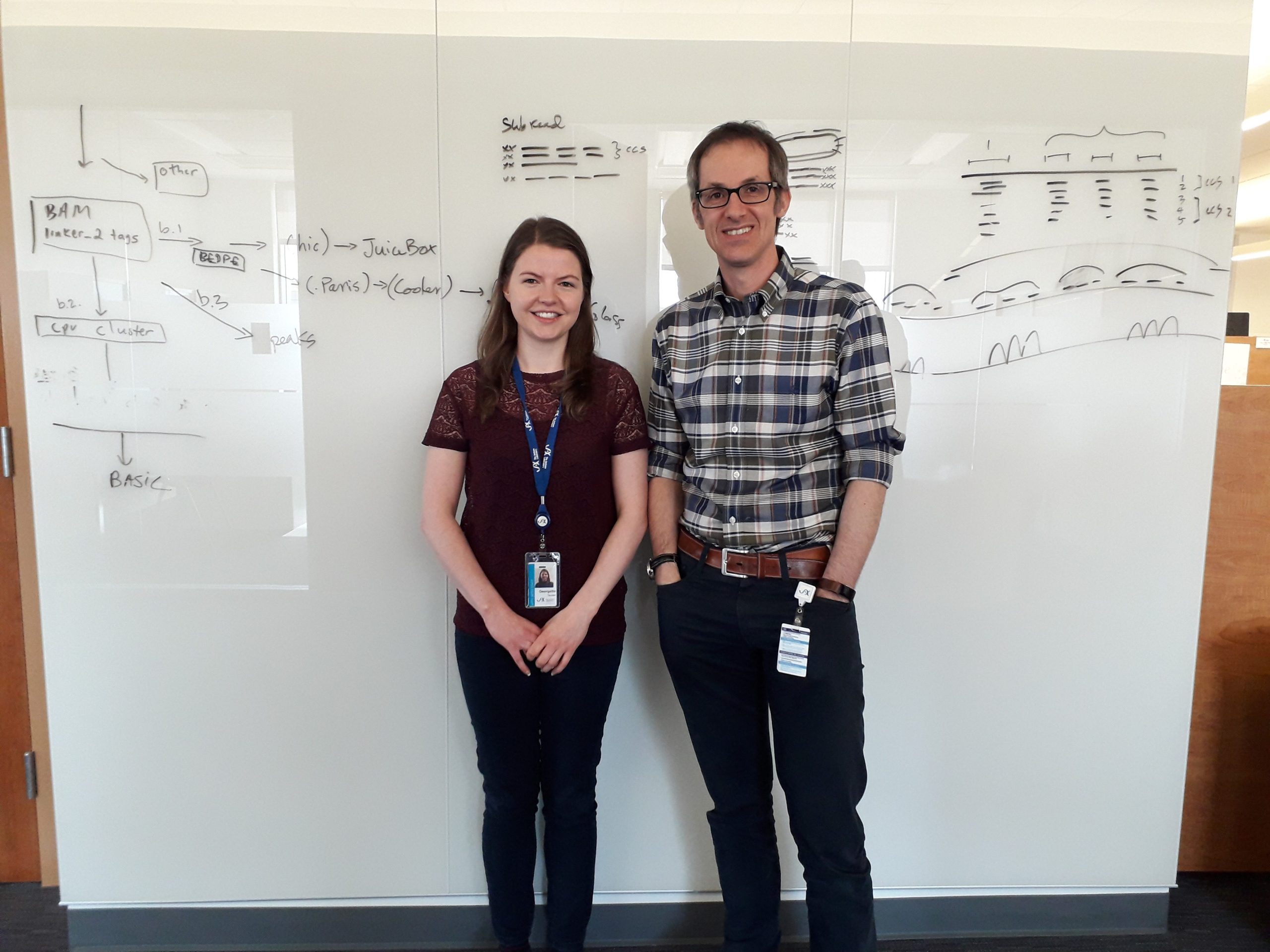
EACR Travel Fellowships are co-sponsored by Worldwide Cancer Research and provide funds up to €3,000 to early-career cancer researchers. For more information on how to apply for Travel Fellowships, you can visit the EACR website.

Name: Georgette Tanner
Title: PhD student
Home institute: University of Leeds, UK
Host institute: The Jackson Laboratory, US
Dates of visit: 21 April – 6 May 2019
Other funding organisations who supported your trip: The BACR provided funding for me to attend a conference in Cold Spring Harbour from 7 – 11 May.
Research: My research is focussed on understanding how glioblastoma tumours evolve through therapy. Glioblastoma is a currently incurable disease that always recurs. This is despite surgical resection, chemo and radiotherapy, and results in a median survival of just 15 months. I’m therefore aiming to identify what processes in these tumours allow them to resist treatment, by studying how the sets of mutations in the tumour cells change through therapy. This may then enable us to design much needed improved therapies for glioblastoma patients.
I enjoyed being surrounded by like-minded researchers
Why did you decide to apply for an EACR Travel Fellowship?
I wanted to broaden my experience of working in academic research and build on collaborations between my group with others. This would allow me to gain ideas and advice from another research group to assist me in my current PhD project, and also help me to determine what areas of research and types of institute I wish to apply to for carrying out post doctoral work in the future.
Why did you choose the host lab?
I chose Professor Roel Verhaak’s group for several reasons:
- Roel Verhaak is possibly the most eminent researcher in my field. Therefore, his team are the best possible people to learn from and gain experience in how they carry out research. Having spent time in his group will also be very beneficial to my career and gaining future post doc positions.
- I had previously collaborated with Professor Verhaak’s group on a paper and, therefore, Roel was very willing to host me at his lab.
- Roel’s group have set up the Glioma Longitudinal Analysis Consortium (GLASS). This novel dataset is hugely important in Glioma research and one that I am currently using. Not only this, I will continue to use it in the future. Seeing how it was created was very helpful. I wanted to familiarise myself with the dataset as much as possible.

Can you summarise the research you did or what you learned on your visit?
During my time at the Jackson Laboratory, there were two separate parts to the work I undertook. The first involved continuing with a collaboration project based on identifying the evolutionary progression of Glioma tumours using the GLASS dataset. This enabled me to become more familiar with the GLASS dataset. It also helped me to improve my skills in using R and databases. Second, I used the GLASS dataset to identify what pathways in particular are affected during Glioma progression. Roel’s team were able to provide guidance and suggestions on how best to perform this analysis.
What was a personal highlight of your trip?
The highlight was having lunch with Roel’s group and Professor Charles Swanton. Professor Swanton was visiting the Jackson Laboratory during my visit. This was a fantastic opportunity to be able to join in on conversations between members of Roel’s prestigious group with one of the top cancer researchers in the world. It was also interesting to hear about the latest results from Professor Swanton’s TRACERx projects.
It was a fantastic and really useful experience.
Was the host institution very different from your own?
The Jackson Laboratory heavily focusses on computational biology. This is in contrast to my home institute which has fewer computational biologists than those that work on experimental projects. I enjoyed being surrounded by like-minded researchers and discussing projects with and gaining ideas from them.
How has this visit been beneficial to your research and/or your career?
The visit helped my career and impacted on how I carry out research in two key ways. Firstly, it allowed me to experience what it was like to work in an established bioinformatics group. This included seeing how codes and documents are shared and collaborated on. This will help me to transition into working in such groups in the future. Secondly, spending time in such a prestigious group will help make me stand out when I apply for post docs in the future, allowing me to continue working in the areas of research I enjoy most.
Is there anything else you’d like to mention?
Finally, I would like to say thank you to the EACR for awarding me the funding to visit the Jackson Laboratory. It was a fantastic and really useful experience.