

EACR Travel Fellowships are co-sponsored by Worldwide Cancer Research and provide funds up to €3,000 to early-career cancer researchers. For more information on how to apply for Travel Fellowships, you can visit the EACR website.
Home institute: Institute of Pathophysiology and Allergy Research, Medical University of Vienna, Vienna, Austria
Host institute: Department of Cancer Biology, Instituto de Investigaciones Biomedicas Alberto Sols, Madrid, Spain
Dates of visit: 30 October 2017 – 01 December 2017
My PhD research project is focused on the therapeutic potential in colorectal cancer of the Calcium-Sensing Receptor (CaSR). The CaSR is a G-protein coupled receptor protein that mainly controls Ca++ homeostasis, however it also regulates cell proliferation, differentiation and apoptosis.
The CaSR has been hypothesised to act as tumour suppressor in certain types of cancer, such as colorectal cancer and neuroblastoma. Unfortunately, in those tumours, the CaSR expression is lost and the mechanisms that leads to its down-regulation remain elusive.
To test compounds that are able to restore CaSR expression in tumours, I used the tumour organoids (tumoroids) technology; it consists of a 3D cell model were primary cancer cells, extracted from tumour biopsies of the patients, are cultured in matrigel supports. This tool allows the growth and the expansion of cells in three dimensions, mimicking in vitro conditions that better resemble normal physiology. For this reason, tumoroids offers a valuable platform for drug screening. It is possible to create a biobank of patient derived tumoroids, creating so an array of different cancer platforms suitable for testing drug efficacy.
Using the self-organising properties of stem cells of assembling in 3D complex and differentiated structures (organoids), resembling so organ physiology in a smaller-scale, it is possible to culture primary colon cells and generate so crypt-like structures. In the past, colorectal cancer cell lines were mostly used to study the epithelial cells of the intestine but organoids technology now offers a more reliable strategy.
This technology is not yet established in our laboratory; therefore, we started a collaboration with Professor Dr. Alberto Muñoz Terol and his research group in Madrid that extensively use organoids and tumoroids as experimental models. One of the aims of our collaboration was to gain expertise in these techniques and employ them in my “home” laboratory.
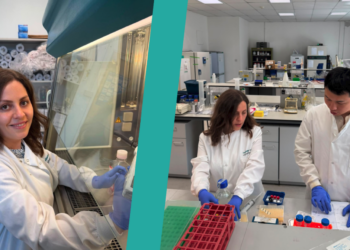
During my secondment in Prof. Muñoz’s lab, I learned how to isolate human and mouse colon crypts and, from them, how to generate and expand colon organoids. Moreover, I have been trained in extracting tumour cells from patient biopsies and how culture them as tumor organoids. During this period, I had the chance to meet and collaborate with talented and experienced researchers who helped me to learn these difficult, time-consuming techniques. They also helped me to quickly integrate into the new environment and to set up and schedule my own experiments and they gave suggestions on experimental procedures such as qPCR and immunostaining.
During this exchange period, I also had the possibility to conduct some interesting analyses, testing the effect of vitamin D on the organoids. The preliminary data obtained there needs to be further validated and the experiments need to be repeated in my “home” laboratory. Due to the promising results and the collaborative environment in Madrid, we are going to further cooperate with Professor Muñoz’s group. We will collaborate on the research project started in Spain and keep in touch for sharing ideas and working together again in the future.