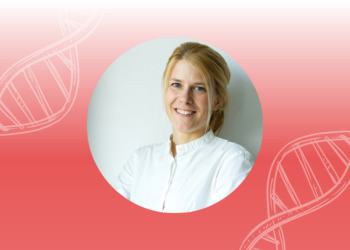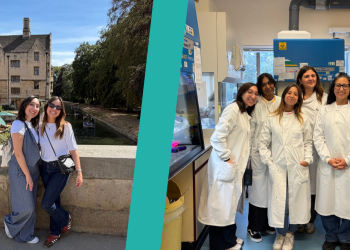
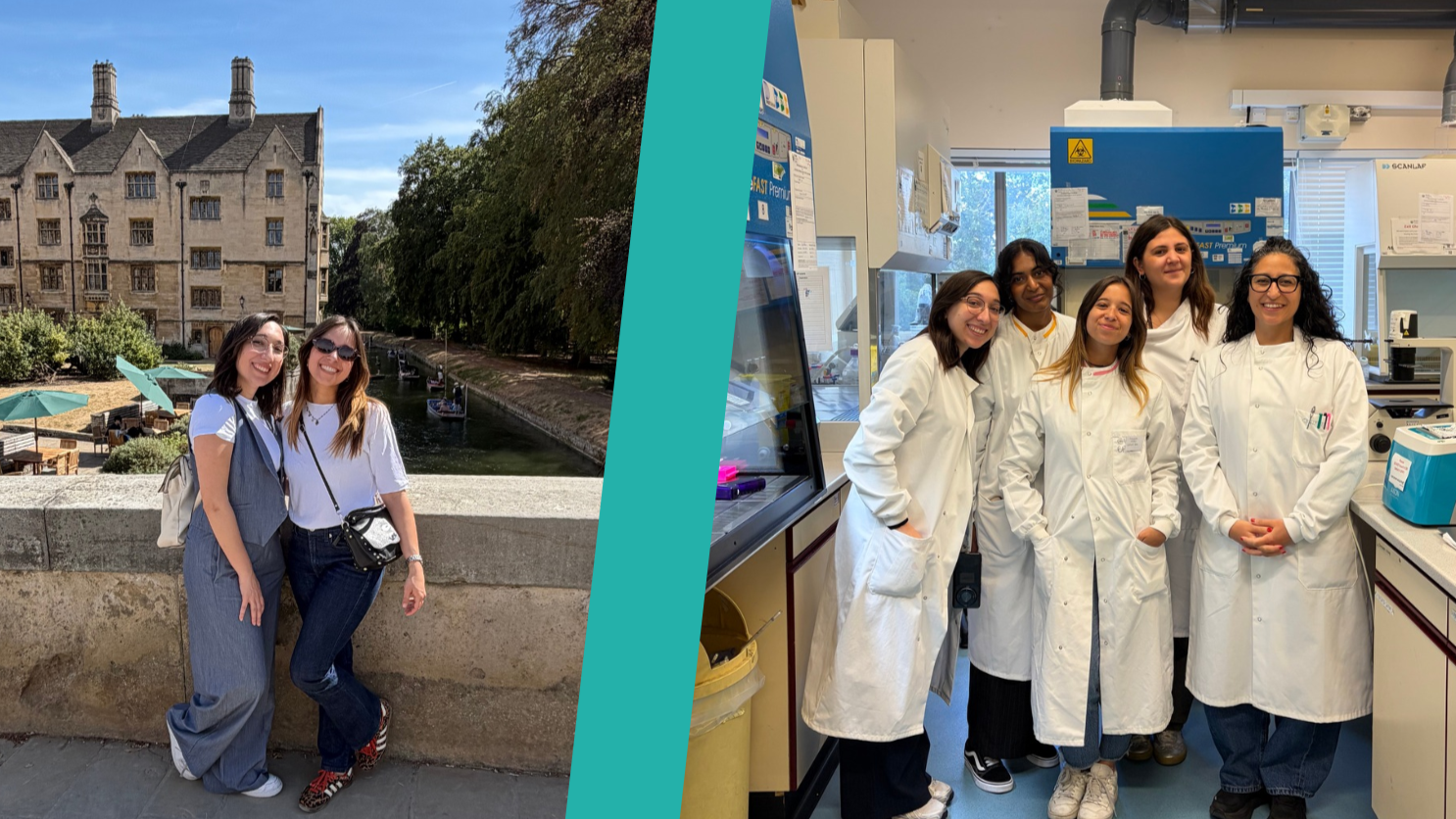
Virginia Maini is a PhD student at the European Institute of Oncology (IEO), Italy, who received an EACR Travel Fellowship to visit and work at the Brunel University of London, UK, from June to September 2026.
The EACR, with support from Worldwide Cancer Research, provides Travel Fellowships of up to €3,500 to enable early-career cancer researchers to gain new skills through a short-term visit to a lab or research group in another country. This trip was also sponsored by an Associazione Italiana per la Ricerca sul Cancro grant.
You can read about other Travel Fellows and their experiences here.
Tell us a little bit about your research.
In the context of ovarian cancer, I am investigating the role of a soluble isoform of a transmembrane protein (L1-∆TM), released by tumour vessels, and acting on surrounding cancer stem cells in the microenvironment. To mimic the tumour microenvironment, the most physiological in vitro set-up would be the one of the “organ-on-chip” technology, which comprises the possibility to co-culture different cell types for prolonged period of times, in order to assess their mutual influence.
Why did you choose the host lab?
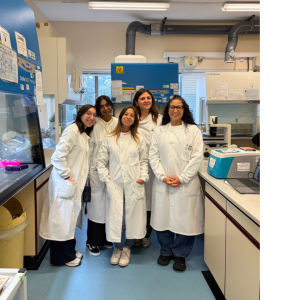
During the first few months of my PhD research, I was really adamant that I wanted to setup a functionally relevant organ-on-chip system that would allow me to perform my experiments using a cutting-edge platform. I chose the host lab based on the relevant expertise of the Group Leader, Dr. Camilla Cerutti, who both was a leader in the field of organ-on-chip technology and also had extensive knowledge on the use and development of microfluidic-based assays.
Both of these aspects are particularly of interest to me, and are important to the research that I am currently carrying out in my home institution in Milan. The idea was to learn the techniques and bring them back to my home lab, not only for my personal research, but also as a resource that the whole lab could benefit from.
Describe a ‘typical day’ on your visit?
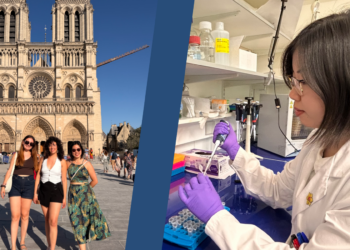
During a typical day of my visit, I arrived to the lab and grabbed a coffee with the other visiting PhD student who was hosted by the same PI. This morning routine helped us to brainstorm the activities of the day, and eventually coordinate if one of us needed the other’s help with experiments during the day. The morning was usually dedicated to routine cell culture work, whereas the afternoon was used to perform assays with Camilla Cerutti, who helped me learn, and subsequently perform, the new techniques that she is an expert in.
Did you take part in any interesting local or cultural activities?
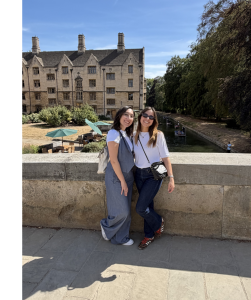
During my stay in the UK, I decided to visit not only London and all its beautiful boroughs and attractions, but also participate in guided tours of university towns such as Oxford, Cambridge, and Bath. These visits helped me learn a lot about the culture and the history of Great Britain.
 What was a personal highlight of your trip?
 What was a personal highlight of your trip?
A personal highlight of my trip was making a new friend. During my stay, I had the pleasure of working with Anna, another PhD student working on cancer research that was visiting in the same group I was in. By chance, we also found out we had rented an apartment in the same building. This allowed us to spend a lot of time outside the lab together and develop a true friendship; I really value making sincere friendships in the scientific field, and this connection gave us the possibility to interact not only from a personal point of view, but also from a scientific one, merging different backgrounds and knowledge for the improvement of our respective projects.
How has this visit been beneficial to your research and your career?
The travel fellowship exchange was a valuable opportunity for both my scientific development and career progression, as well as my personal growth. Being in a new lab environment allowed me to broaden my research expertise, but also to target my research to answer new biological questions that developed after seeing the results of assays performed with the new techniques. Living and working in an environment away from home also challenged me to step outside my comfort zone and adapt to unfamiliar circumstances, ultimately helping me to develop resilience, flexibility, and problem-solving skills (which are always valuable in a research career). Working in an international environment also encouraged me to critically evaluate my own work, approach scientific challenges from different perspectives, and become more independent in planning and conducting experiments.
Is there anything else you’d like to mention?
Overall, this experience was a great start for my first year of doctoral research. It really gave me the opportunity to carry out significant experiments for my project, always reminding me that a PhD is a long road in continuous evolution, and all of the experiences represent learning opportunities which can ultimately add up to producing a complete and independent scientist. I would like to thank the EACR for funding this first leg of my journey, as it really gave me the ability to learn and experience things that I am certain will positively impact the rest of my career.
Want to find out more?

If you are interested in applying for the Travel Fellowship scheme, please click here for more information: EACR Travel Fellowships