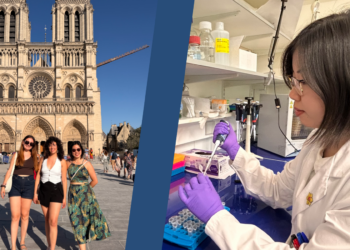

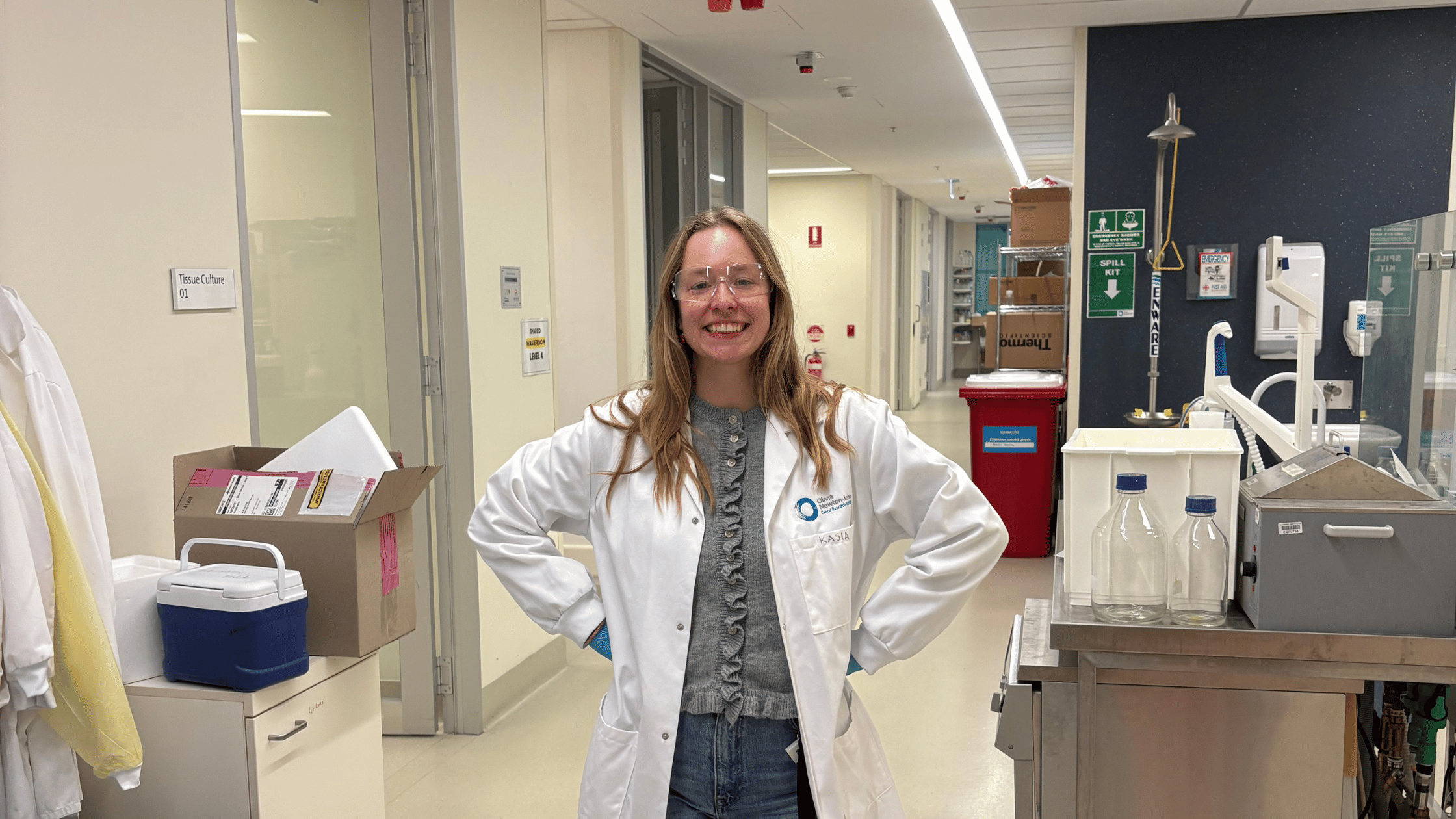
Katarzyna Wierzbicka is a PhD student at IRB Barcelona, Spain who received an EACR Travel Fellowship to visit and work at the Olivia Newton-John Cancer Research Institute, Australia from April to June 2026.
The EACR, with support from Worldwide Cancer Research, provides Travel Fellowships of up to €3,500 to enable early-career cancer researchers to gain new skills through a short-term visit to a lab or research group in another country. This trip was also partially funded by an FPI grant of Generalitat de Catalunya.
You can read about other Travel Fellows and their experiences here.
How would you describe your research to a non-scientist?
We can compare metastasising cancer to a heist. As in Ocean’s Eleven, each person performs a certain role to steal the money from the casino – the same can be viewed for this cancer research. There is a group of cells collaborating together for a common goal – metastasis. Each cell has a different specialty which allows them to achieve metastasis, and only by working together and communicating can they complement each other and succeed in their goal. My PhD project is akin to being a detective who investigates the roles of each cell, to interrupt their conversations and stop the heist while it is happening.
Why did you choose the host lab?
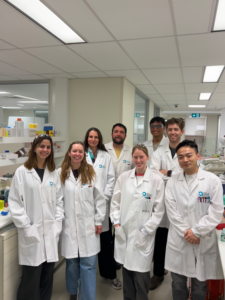
I chose the lab of Prof. Merino, as the members of this cohort are collaborators with my host lab. I met Dr. Jean Berthelet during a conference in Belgium, and after discussing my research, he suggested that I could further establish this collaboration by obtaining LeGOTeknik plasmids not yet available to the public. After further discussion regarding the different aspects of this technique, we concluded that it would be beneficial for me to come to the lab in Australia and learn all there is to know about this approach in order to complete my research project.
What was a personal highlight of your trip?
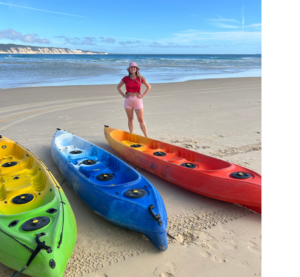
Personally, the highlight of my trip was the day one of my long-term dreams came true. I have always wanted to be in the ocean surrounded by whales, and as it turned out, I went for my exchange in Australia during the whale migration season. One day, together with some friends from the lab, we went kayaking in the ocean close to migrating whales, and it was one of the best experiences in my life!
Have you brought back any specific knowledge that has benefited your home lab?
This stay focused on mastering the LeGOTeknik lineage tracing technique that I am currently implementing in my laboratory. This experience allowed me to be confident in performing it alone in my home lab and creating the protocols for everyone who would like to use it later for their own research projects. Additionally, together with a bioinformatician in the host lab, we have created a pipeline and trained an algorithm to analyse the images obtained from the microscope in a more efficient and automated way.
Did you have a personal mentor or anyone who particularly helped you?
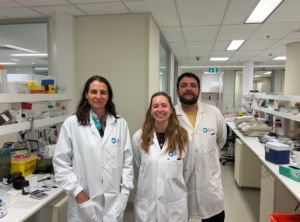
My personal mentor was Dr Jean Berthelet, a senior postdoc in Delphine’s lab. He was the one who, from the beginning, was involved in my project and helped me all the way through, together with Delphine. I could not be more grateful for both of them. Jean was patient in teaching me everything I needed to learn in order to master the LeGOTeknik and also addressed anything else I was simply interested in. When my curiosity was above his expertise, he helped me find someone who would be able to answer all my questions. Being away from home can be difficult, and he helped me integrate into the lab and feel like a part of the group, and by doing that became a friend.
Was there anything you particularly liked about the host institution?
My host institution was part of the biggest hospital in the southern hemisphere. Because of that, we had access to patients’ samples, as well as direct expertise from clinicians and scientists working on clinical trials. All of this access gave me a new perspective on how research can be done with a primary focus on helping the patients and discovering new druggable targets.
Another thing that I particularly liked was that ONJCRI does not have a separate genomics facility that would do sequencing experiments for researchers. This allowed me to perform scRNAseq from scratch together with my supervisor, which I cannot do in my home lab, and I consider very valuable knowledge.
Want to find out more?

If you are interested in applying for the Travel Fellowship scheme, please click here for more information: EACR Travel Fellowships