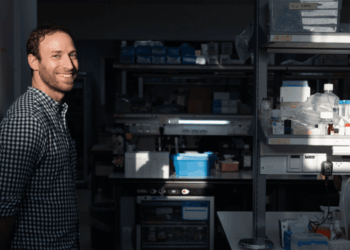


Marta Kovatcheva was the 2025 recipient of the EACR-Mark Foundation-Pezcoller Foundation Rising Star Award, which granted her funding to commence the project she proposed as part of the previous year’s ERC Starting Grant call. The award is intended to bridge the period before re-submission of unfunded Score ‘A’ cancer-related projects to the ERC.
Marta is a Group Leader at the AIRC Institute of Molecular Oncology in Italy. As part of this award, she presented an Award Lecture at the EACR Congress that took place between 16-19 June 2025 in Lisbon, Portugal. We recently caught up with her to hear about the progress she has made in her research since winning the award.
Can you tell us about the topic of the research you are currently undertaking?
When injured, many epithelial tissues including the intestine undergo dedifferentiation into developmentally primitive states that are critical for tissue repair. Similar dedifferentiated states are observed in the transformed version of these tissues, such as colorectal cancer. Nevertheless, whether the dedifferentiated cells are a direct precursor to tumorigenesis is unknown. In this project, we are using in vivo lineage tracing models and multi-omic approaches to ask whether epithelial cells that have undergone injury-induced dedifferentiation directly contribute to tumorigenesis, how dedifferentiation alters their epigenetic state, and whether we can manipulate these fates using epigenetic interventions through 1-carbon metabolism manipulation.
What were the highlights of your first year of the Rising Star Award?
The first and perhaps most obvious was the chance to dive into the science we were so excited to do. This award really offered us the chance to explore a high-risk, high-reward project. So far, it seems to have paid off. We have generated really exciting preliminary data and thanks to the support of the Award, we are in an excellent position to push our science forward and make new discoveries relating to cancer initiation.
The other highlight that really sticks out for me is the opportunities this award afforded me to interact with new scientists. The experience of giving a special Award Lecture at the EACR Congress and being able to attend all of the exciting EACR talks was fantastic. My trip to Trento and the Pezcoller Foundation was a joy to experience, where I met so many outstanding group leaders and young scientists and had really vibrant scientific exchange. These experiences have led to lasting relationships, including several new collaborations, and I am grateful for the visibility that the Rising Star Award fomented, in order to allow these new relationships to blossom. I truly believe collaboration and idea exchange is the very foundation upon which science rests, and it is how we will make meaningful advances in cancer research.
At this stage, how do you think the Rising Star Award has contributed to your career goals in cancer research?
My career goal is to become a tenured group leader focusing on mechanistic cancer biology that has translational potential, maintaining a strong record of mentorship and scientific communication. The Rising Star Award has fomented all of these by: allowing me to attract top scientific talent in my lab, and pursue high-risk, high-reward mechanistic biology; travel to conferences to present our research and introduce my nascent lab; participate in career development sessions at the EACR Annual Congress and online events; gain visibility through the prestige of the award, which has led to higher recognition of and interest in the research emerging from my lab.
I am very grateful for the support of the EACR, The Mark Foundation, and the Pezcoller Foundation for their support of young researchers. I feel incredibly fortunate to have been welcomed into this community, and look forward to all the interactions and exciting science to come!
More about the EACR-Mark Foundation-Pezcoller Foundation Rising Star Award
This award recognises exceptional researchers in the field of cancer research and aims to support groundbreaking projects that have the potential to make significant contributions to the field. It is open to EACR members with an unfunded Score ‘A’ cancer-related project from the previous year’s ERC Starting Grant calls, and aims to bridge the period before re-submission to the ERC. The awardee receives funding of up to €100,000 to begin their project. Learn more here.