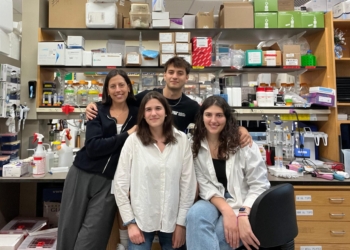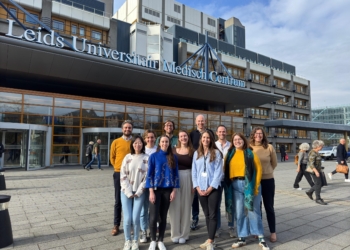


Eleanor Woodward is a PhD student at Newcastle University, UK who received an EACR Travel Fellowship to visit and work at Northeastern University, Boston, US between 03 August and 01 September 2025.
The EACR, with support from Worldwide Cancer Research, provides Travel Fellowships of up to €3,500 to enable early-career cancer researchers to gain new skills through a short-term visit to a lab or research group in another country.
You can read about other Travel Fellows and their experiences here.
 Name: Eleanor Woodward
Job title: PhD student
Home institute: Newcastle University, UK
Host institute: Northeastern University, Boston, US
Dates of visit: 03 August – 01 September 2025
Research: I study the genetics of childhood cancer, which are very different to adult cancers. Using advanced sequencing techniques, I look at regions of the genome that are often missed. By examining changes and patterns in these regions, I aim to better understand how they contribute to the development and progression of childhood cancer.
Can you summarise the research you did or what you learned on your visit?
During my PhD studentship, I have performed long-read whole-genome sequencing on childhood cancer patient samples to characterise recurrent structural variants. As these structural variants often occur within highly complex and repetitive regions of the genome, ultra-long reads (>50kb) have been necessary to resolve the rearrangements. Ultra-long reads typically require larger amounts of DNA input, which is not always possible for childhood cancer patient samples, where small amounts of material are available.
The aim of the travel fellowship was to learn optimised protocols from the host laboratory that would increase my read lengths, while maintaining throughput with low DNA input. From this, using the same patient DNA samples, I was able to double my read lengths from what I achieved in Newcastle, while decreasing the amount of input by 80%.
Data generated will be used to develop assemblies and allow for us to underpin the mechanism of formation for common variants. At Northeastern University, I was able to hold discussions and receive advice about how to conduct these assemblies from Miten Jain, who is an expert in human genome assembly. Sequencing protocols and the analysis advice will allow me to increase my cohort size and improve the quality of my data analysis.
Describe a typical day on your visit.
A typical day would start by me walking from my apartment, across the park and to Northeastern University. Mornings were generally spent doing library preparations, with afternoons loading and sequencing them, assisted by Dr Jain and one of his PhD students, Talia Tzadikario. On Friday afternoons, I attended the lab’s group meetings where I heard updates from individuals’ projects and had the opportunity to present my own work.
What were you able to do that you could not have achieved in your home lab?
During my visit, I learnt minor alterations to library preparation protocols to maximise read length and yield by being delicate enough to preserve read length but still ensuring that the reaction is mixed. These adjustments allowed me to double the length of my sequencing reads from those achieved in Newcastle from the exact same DNA samples.
I also had access to a PromethION 48 sequencer with ample computing power, enabling me to rapidly scale up my sequencing experiments once I had mastered the protocol. These resources are not as easily available at my home lab.
“This trip has massively influenced how I view my research in the field”
Did you take part in any interesting local activities?
Boston, Massachusetts is an amazing city, filled with history and culture. I walked the Freedom Trail where I learned about the American Revolution, making sure I stopped by one of the famous Italian bakeries in the North End for cannoli.
My apartment was right beside Fenway Park. I enjoyed attending a baseball game where I saw Red Sox beat Miami Marlins, and the overall buzz of the area when there was a baseball game on.
I also enjoyed exploring the Massachusetts coast by ferry and commuter rail on the weekends, with the highlight being the fishing town of Rockport. Here, I enjoyed the beach, wandering around the independent shops and artist galleries, and of course, a lobster roll!
Did you have a personal mentor or anyone who particularly helped you?
During the travel fellowship, I was supported by Dr. Miten Jain, who played a central role in my experience. Dr. Jain’s work has been fundamental in the development of nanopore sequencing, and I even got the opportunity to see the original nanopore sequencing instrument with a single nanopore.
His expertise in generating ultra-long reads and conducting human genome assemblies with them, including the first telomere-to-telomere human genome reference, has helped shape how I see my own project. I was encouraged to ask questions and explore new ideas.
Towards the end of my time at Northeastern University, we carried out an experiment to further optimise nanopore RNA sequencing. This gave me a valuable insight into how the chemistry of the sequencing method can affect biological sequencing outcomes, and how Dr Jain works to understand and interpret these results.
How has the trip inspired you in your research?
This trip has massively influenced how I view my research in the field. It provided me with a clearer appreciation of the novelty of my research and how it can contribute towards a publication. This has been really motivating and has encouraged me to begin drafting a manuscript which I have shared with Dr Jain, and my PhD supervisors for their feedback.
The laboratory I visited is strongly focused on method development, which was a fascinating contrast to my own group, who work on employing these new techniques to human disease. Presenting my work to them was particularly valuable as I received thoughtful questions and feedback that challenged me to see my work from a different perspective.
Does your lab plan to do any future collaboration with the host lab?
Yes, our groups will continue to collaborate on several publications, including the manuscript I have drafted using the data generated at Northeastern University. Looking ahead, we also discussed the possibility of me returning as a postdoctoral fellow. This would give me the opportunity to gain valuable hands-on experience in RNA extraction and long-read sequencing of brain tumour tissue samples, which is directly relevant to our future research and an exciting opportunity to continue the collaboration.
Want to find out more?

If you are interested in applying for the Travel Fellowship scheme, please click here for more information: EACR Travel Fellowships