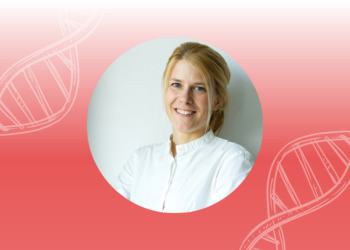

 Professor Andrea Ablasser of the Swiss Federal Institute of Technology in Lausanne (EFPL), Switzerland, is the first winner of the Pezcoller Foundation-EACR Translational Cancer Researcher Award. The award celebrates academic excellence and achievements in the field of translational cancer research. Prof. Ablasser was presented with her award at the EACR Congress (9 -12 June 2021). Find out more about the award.
We took this opportunity to find out more about Prof. Ablasser, her career and the research she is involved in.
What is your current research about?
We are interested in understanding how the innate immune system senses DNA as a signal of “thread”, for example during infection or during tumorigenesis. We are also interested in exploring the biological consequences of maladapted immune responses to one own’s DNA. To achieve this goal, we are taking advantage of several distinct tools of modern biology to elucidate fundamental molecular mechanisms and to propose new therapeutic principles.
What excites you most about your current research?
The broader topic of my research – innate immunology – is fascinating for the following reason: Some of the work we are pursuing is fundamental and allows us to make new connections or discoveries that were unknown before. At the same time, the mechanisms and pathways that we are studying are related to human health and disease. Hence, there is always the thought that our findings may become translationally relevant on the horizon.
What’s your favourite part of each working day?
The discussion of scientific data and science in general with the students or scientists in my group or other colleagues is what makes my day. This is because, in the end, I have always learned something new.
What’s the best thing about your work?
Change and progress. In general, I very appreciate the future-oriented aspect of my work as a scientist. To contribute building knowledge is very gratifying.
You’ve had an incredible career in cancer research. When did you know you wanted to be a scientist and was your career path planned out in any way?
I studied Medicine, and, despite my passion for natural sciences, a career in basic research was not very obvious at the beginning. But when I started working in an experimental research group, I was captivated by biomedical science, particularly immunology. Therefore, after earning my approbation, I decided to fully devote my time to fundamental immunological research. At that time, the medical implications of the work were not yet evident. Today, after several years in academia, my research is still strongly shaped by my medical perspective and the desire to contribute to novel therapeutic approaches for human diseases.
About Professor Ablasser
Prof. Andrea Ablasser obtained her MD at the University of Munich. After her post-doc at the University of Bonn, she joined the Swiss Federal Institute of Technology in Lausanne (EPFL) as an Assistant Professor in 2014. In 2019, she was promoted to Associate Professor at EPFL.
Amongst several distinctions, Andrea Ablasser is recipient of the Coley Award, the Sanofi-Institut Pasteur Award, the National Latsis Prize, the ACTERIA Prize, and the Eppendorf Award, and she is an elected member of EMBO. She is the founding scientist of IFM Due, a biopharmaceutical company developing cGAS-STING antagonists for the treatment of inflammatory disorders.