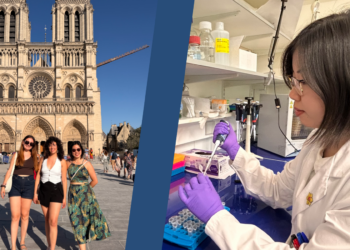

Australian-based German researcher Anna Jaeschke writes about the world of 3D models in cancer research, and her contribution to the jigsaw puzzle that is cancer and the search for cures.

24 September is World Cancer Research Day, which raises awareness of the important and lifesaving work done by researchers. As part of this the EACR asked a variety of members to share a day in their life as a cancer researcher.
Name: Anna Jaeschke
Nationality: German
Place of work: Institute of Health and Biomedical Innovation (IHBI), Queensland University of Technology (QUT), Australia
Job title: PhD Candidate
How long have you worked there: Since April 2017

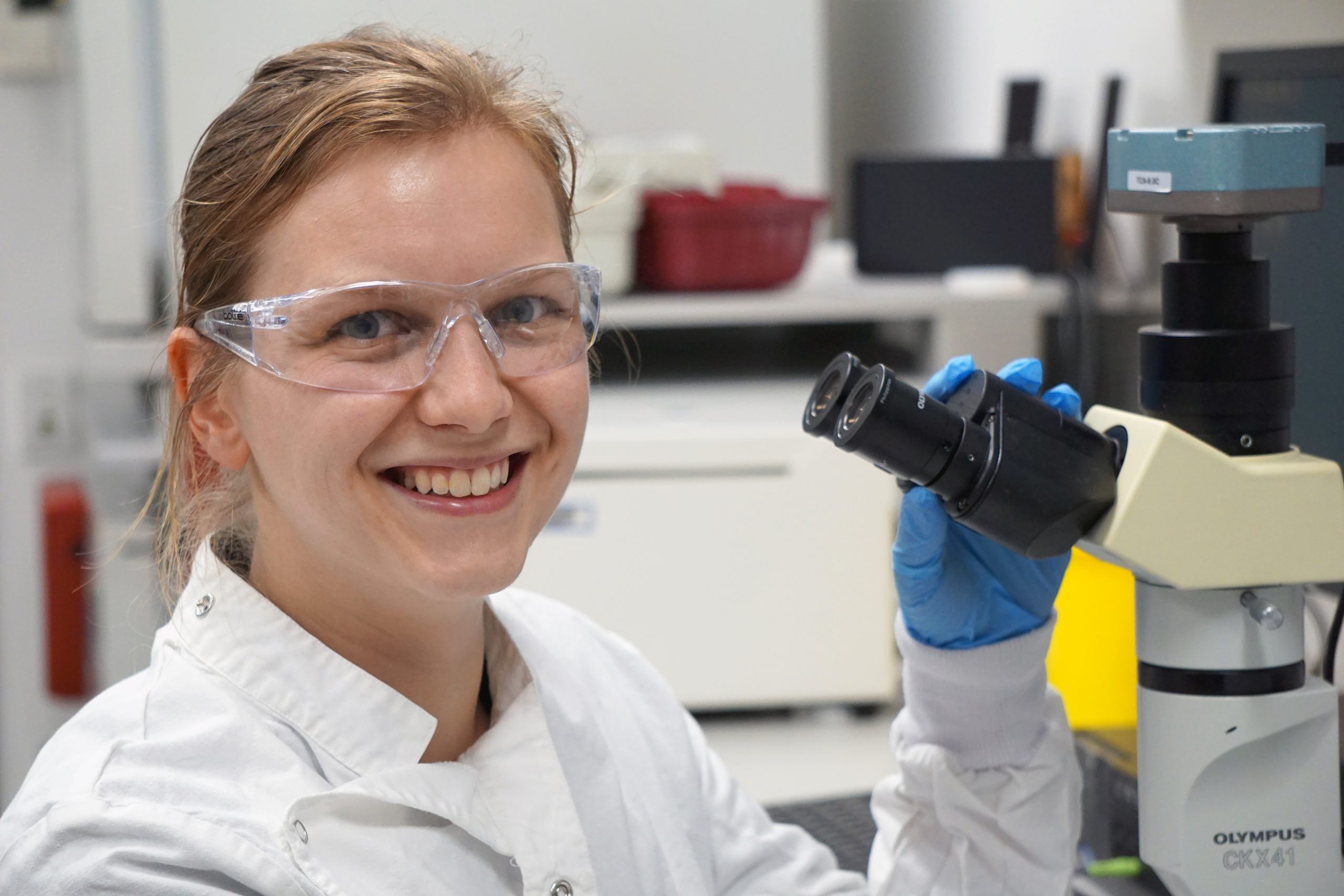
For me, every day is different. I am a PhD candidate in Dr Laura Bray’s team. Our research is focused on three-dimensional (3D) experimental models for cancer research.
Some days, I spend almost entirely working with cells in the lab. For my research, a hydrogel – similar to a contact lens – serves as a 3D scaffold providing a more physiologically relevant structure for cells. In particular, I look at interactions of microvascular cells with other cell types such as cancer and stroma cells. All of the cells used for the 3D tri-culture cancer model are isolated from patient tissue.
For hydrogel preparation, I collect the cells, mix them with liquid chemical components and voilà; after 20 seconds, there is a hydrogel with human cells. Over time, I observe the cells under a microscope. The microvascular cells stretch out, eventually interconnect to form 3D networks, and interact with the other cell types.
We take small steps every day in cancer research.
Later in the process, another technique comes into play: confocal microscopy. Each cell gets labelled with a distinct marker which allows me to know what particular cell type it is. As the cells are fluorescently marked, and the gel is transparent, I can therefore follow the “glow in the dark” cellular structures in 3D. To analyse the cells later, I acquire image stacks by taking photos every couple of micrometres throughout the gel. Because confocal microscopy is based on fluorescent light, this work happens almost entirely in the dark.
After acquiring the images, I spend many hours at my computer. With the help of specific software packages, we reconstruct the image stacks into a 3D image. Based on this 3D reconstruction, we can analyse cell behaviour, e.g., investigating network morphology or cell-cell contacts.
While microscopy is a significant part of my research, I also isolate RNA and proteins from the cells grown in 3D. The molecular markers help me to analyse mechanisms behind the cellular behaviour I see and understand how the cells cross-talk.
Sometimes, I have to complete other tasks during my experimental days. For example, I take part in meetings, or write scholarship and travel grant applications. Furthermore, I often submit papers for conferences or work on publications.
I enjoy that no day is ever the same, however it is never boring. Every day comes with new challenges to tackle.
When I talk about my project to people not involved in research, I am often asked: “So, when do you find a cure for cancer?” or “Does this and this cause cancer?”. These are challenging questions. I have to explain that cancer is not that one disease which can be cured with this one drug. It is incredibly heterogeneous, with a variety of factors determining cancer onset, progression, and curability. Also, there will be no one person or even one research group which will find the one cure for cancer one day.
Everyone involved in cancer research contributes a piece to a jigsaw puzzle. I heard of this metaphor recently at a conference in a keynote lecture from Prof Fiona Wood AM, a burns surgeon. She talked about challenging the golden standards and asking ourselves if the golden standards are good enough, which I found extremely inspiring. We take small steps every day in cancer research. We cancer researchers bring our puzzle pieces together to make progress towards better drugs, prevention program, and ultimately a better outcome for the patients.
How can you get involved with World Cancer Research Day?
1. Sign the World Declaration for Cancer Research
2. On 24 September share a snapshot on social media from a day in your life as a cancer researcher: use #WorldCancerResearchDay
Click here to see more posts about a ‘Day in the Life’ of other cancer researchers.
About Anna Jaeschke’s research
My research utilizes a hydrogel – similar to a contact lens – as a 3D scaffold providing a more physiologically relevant structure for cells. I analyse the interactions between different the cell types involved in Prostate Cancer. Multicellular 3D models are becoming increasingly important for cancer research. This is because each component of native tissue architecture is essential, not only in healthy tissue but for cancer progression. Specifically, I study the mechanisms by which the tumour, and the surrounding tissue, encourages blood vessels to colonize. This process increases tumour survival and the chance of the tumour moving to other tissues (metastasis).